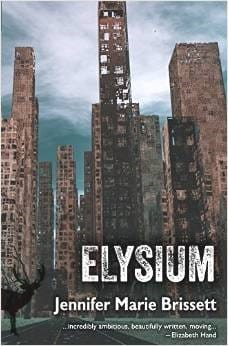
 Elysium
by Jennifer Marie Brissett
(Aqueduct Press, Dec. 2014)
2015 Philip K. Dick Award nominee, 2nd place special citation
Reviewed by Dave Truesdale
Elysium, the debut novel by Jennifer Marie Brissett, is in one respect an ambitious work. Like many such projects, it succeeds on some levels and others not so much, though not for wont of trying. The long reach itself is noteworthy, though in this case the fruit of total success lies just beyond the author’s grasp.
The novel can be thought of as two distinct entities: the rather convoluted structure, and the storyline itself—a standard alien invasion scenario—as meted out and unraveled through the structure.
As I write, the novel has been out a mere six months and many potential purchasers may not have yet become aware of it save by its notoriety as a PKD nominee. That said, a broad summary should suffice to give the interested reader enough information when deciding if this book falls into line with their personal tastes, though let it be noted that to explain how and why the story works or falls short will necessitate some spoilers.
The novel begins with a brief message from a computer as it establishes a “bridge connection.” The story proper then begins, the following being a highly condensed overview of the primary elements.
The brief opening scene introduces us to Adrianne, walking through a city, taking a phone call from her friend Helen, who is canceling their lunch appointment. Abruptly the scene ends with an interruption from what is obviously the computer, this time with a message of ***SYSTEM FAILURE*** — CREATING FILE: core.dmp – ERROR: CANNOT OPEN FILE – FILE DELETED – SYSTEM ERROR BYPASSED – BRIDGE PROCESS: **RESTARTED**. At which point a new scenario begins, this time showing Adrianne at home with Antoine. This continual computer interruption after many brief, starting and halting scenes continues throughout the book, with fewer interruptions as the various scenes become a bit longer. The disjointed scenes the reader is asked to follow and hopefully begin to make sense of always change; sometimes Adrianne and Antoine become Adrian and Antoine, a gay couple, at others the gender switching introduces us to Antoinette and Antoine. Several unconnected scenes introduce us to the transgendered Hector/Helen, who even one of the characters we have been following through various gendered iterations and is a friend of Hector/Helen has trouble identifying.
Roughly halfway through the book and the reader, still trying to see how all of the computer interruptions and dead-end scenes will come together, begins to get antsy, tiring of the story not moving ahead in any discernible manner, mentally juggling the disjointed bits and pieces of the characters’ lives and still perplexed at how the computer interruptions fit in. Is this all a computer program and is nothing real? Are some of the jumps from chapter to chapter filled with real people? The reader begins to theorize that maybe we’re in Matrix territory here. But again, to what end? Nothing even begins to make ultimate sense until late in the second half of the story.
The second half reveals that aliens have come to Earth and dispersed an engineered “dust” designed to destroy the environment and most of the people. A few scientist types have retreated to an underground scientific facility and have uploaded the history of mankind into a very fancy computer system which has then sent mankind’s legacy into the upper atmosphere, where it circles the planet, hopefully forever. This is a neat idea. Putting mankind’s history into computer code and having it circle above the planet hidden in normal atmospheric streams—rather like a Ringworld Cloud of information storage, if you will.
The conclusion, the reveal, is disappointing. Adrianne comes to the conclusion that her reality is but a computer construction, so in despair she simply ends the program. The story ends with a sympathetic alien historian/researcher who was born on Earth long ago, watching Adrianne dissolve to nothingness. The computer legacy of mankind—its history as held in the bytes of a computer—has been corrupted to the point where it is terminated by one of its virtual reality inhabitants. Mankind is now gone, along with its history, and the aliens who have taken over the planet centuries ago continue on their merry way. This is all so very dystopian, isn’t it? Mankind has been wiped out and its only legacy is now lost forever. No struggle to survive, just a final note to the universe that we were here is all we could manage. And now that too is gone.
Dystopian futures are part of science-fiction history. Some have been brilliantly wrought, while others down the dark decades have passed quietly in the night and are forgotten. The fact that Elysium is a doubled-down dystopia is not a mark against it (unless one is just plain tired of the never-ending spate of them). What detracts from it is that the focus is not clear. What exactly is the message? Is it to show the reader the various gender identifications in order to make some point? If so, what is this point? The characters are shown to the reader at an observational remove. We do not get inside their heads to any degree. We are shown slices, vignettes (some quite short) before the frustrating computer interruptions switch scenes and characters and we must start over. So aside from the mere introduction of characters who switch genders with no apparent connection to the overall arc of the alien invasion story, their brief mundane segments add nothing to the story; they are continually halted interludes. The less forgiving reader might easily conclude that the element of gender in the story is nothing but a gratuitous nod to those who actively promote such vaguely (and over-broadly) interpreted notions as “diversity,” and are naught but tokens. As far as an integral part of the story, however, the gender switching is irrelevant, it adds nothing at all to the story. Then why the emphasis on it? Gay characters are nothing new in science-fiction. It’s old hat. Exploring gay themes is not new either, with Sturgeon and Delany and Russ and LeGuin and Tiptree and many others having done it very well, in some instances over half a century ago. If an author chooses to have their story peopled with gay (or transgendered) characters, or with People of Color, this is fine. No one I know of cares, as long as the tale being told is a good one. Story comes first.
In this case, since the gender of the characters isn’t germane to the story (a computer program corrupted and breaking down after an alien invasion), then the attraction for some must lie in the ambitious structure, or the story itself. The alien invasion motif is hardly new, it’s been worked to death for nearly a century, and as with dystopias and other forms of science-fiction, sometimes brilliantly and others forgettably. There is nothing unique with Elysium‘s take on the alien invasion theme. They invaded, we lost, and the aliens have made Earth their home for many years now. This is made known to the reader only near the very end of the story, as hardly more than an afterthought. When the big reveal is made on the final page, we are left with That’s it? At which point we go back through the book trying to assess what we may have missed, scratching our head and blinking our eyes.
This leaves us with the structure. Fred Pohl told me once that “style is the problem solved.” By this he meant that sometimes (as in his novel Gateway) the only way he could figure out how to tell his story effectively came from his strewing about his cruise ship cabin bits of newspaper clippings, magazine articles and the like and having a tough time deciding how to incorporate all this useful information into the novel without infodumping or otherwise slowing down the story. So he chose to employ an expanded dos Passos technique. Using this “different” style of incorporating information into the story his problem was solved. Unfortunately, I don’t see the structure used in Elysium as supporting the story, but more in service to whatever slim point the author wished to make regarding differences in gender identification or sexual preference, for with a corrupt computer program she found a way to introduce gender variations between sets of characters as the point, for the characters are hardly more than limned, sketched. No insight, therefore, into the nature of sexual orientation or preference was attempted, so we are left only with the ciphers on stage with nothing much to do or show us. And since these gender iterations are products of a corrupted computer program and we learn the characters are not “real” after all, then we are left with the structure supporting the minor, sketchy, mundane events in the novel (forever being interrupted by the broken program) rather than the larger story—the larger story not revealed with any absolute truth until the very end, and which is almost dismissed as irrelevant to what has gone before. But if the alien invasion wasn’t the primary focus here, then what was? The corrupt computer program? The inclusion of various characters assuming different gender orientations? Any of these questions leads us in a circle, back to the original point of lack of focus as to the theme, or message, or point the author was trying to make. A clever structure doesn’t always make for a satisfying read. Story always comes first.
Is Jennifer Marie Brissett an author to watch? Most certainly. That said, and while I admire an author who takes chances, the end result of Elysium fell far short of its intent (whatever it was) for this reader.
♣ ♣ ♣
Next: Edge of Dark: The Glittering Edge (Book One) by Brenda Cooper (Pyr, March 2015).
Dave Truesdale has edited Tangent and now Tangent Online since 1993. It has been nominated for the Hugo Award five times, and the World Fantasy Award once. A former editor of the Bulletin of the Science Fiction & Fantasy Writers of America, he also served as a World Fantasy Award judge in 1998, and for several years wrote an original online column for The Magazine of Fantasy & Science Fiction. Now retired, he keeps close company with his SF/F library, the coffeepot, and old movie channels on TV. He lives in Kansas City, MO.