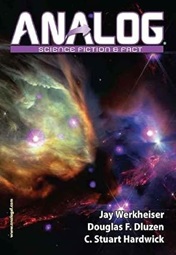
 Analog
“Carpenter” by Jay Werkheiser
“Some Plates Get Eaten” by Thoraiya Dyer
“Schismogenesis” by E.G. Condé
“Camino Mundo” by Brian Hugenbruch
“Telling the Bees” by Eóin Dooley
“The Enshittification of Dogs” by Tom R. Pike
“Amel and the Bride” by Julie Duffy
“Awkward Incident Transpiring While Exploring the Neighbourhood” by Timons Esaias
“A Lesson In Orbital Mechanics” by Michael Johnston
“In The Overlap” by Eric del Carlo
“Imprint” by Zach Poulter
“Children of a Sunnier Star” by Gregory Feeley
“The Two Thousandth and Seventieth Time Sara Deletes Her Family” by J. R. Dewitt
“Hetero Sapiens” by Sarina Dorie
“Whispers of Twilight” by Ken Miura
“An Arm For Every Tooth” by Colin Alexander
“Nirvana and Mr. Sparks” by Kevin J.E. Walsh
“The Cold Embrace” by C. Stuart Hardwick
Reviewed by Mina
This is an excellent issue as we travel through talking cars via bees, spaceships, androids and microbiology.
In “Carpenter” by Jay Werkheiser, Hal moves to the country after the death of his wife. He begins a battle with the carpenter bees in his fence. His obsession leads to the carpenter bees evolving to survive. As they become sentient, they hatch a plan. Ultimately, this is a horror story.
It reminded me of the B movies I saw in the 80s with killer bees, ants and (the funniest) mutant rabbits. Not original but well done.
“Some Plates Get Eaten” by Thoraiya Dyer is truly depressing. Although, on the surface, it’s about a bomber trying to disrupt scientific projects combating the build up of carbon in the atmosphere; underneath, it’s more about relationships. In particular, inter-generational relationships. The “plates” in the title are a metaphor for tectonic plates, and the tragedy is in the plate that gets “eaten.”
It’s well-written but I would need a stiff whisky to read it again.
“Schismogenesis” by E.G. Condé is somewhere between myth, SF and horror. A female geneticist of mixed birth uses her skills and unique ancestry to power her work: “Symbiogenesis. Even God, it seemed, did not have the patience for purity.” She ushers in a new age of genetic anarchy.
The illustrations by K.A. Teryna for this story were beautiful.
In “Camino Mundo” by Brian Hugenbruch, we are on an artificial world, but the knowledge of who constructed it and why has been lost. An old man on a journey to gain answers across thousands of years and miles decides it is time to pass his quest onto someone new. Beautifully written, almost like a parable, with some Portuguese thrown in.
My favourite line: “The wisdom will come later, after mistakes are made.”
“Telling the Bees” by Eóin Dooley is neat. It could have ended in one of three ways at least and I didn’t know, till we got there, which one it would be (reviewers are hard to surprise). A woman goes to visit the honey production site of a new strain of bees. It’s a very human story in the end.
(This issue seems to have an obsession with bees—there’s even a honeycomb puzzle on one page.)
I can tell you straight off that I hated this title in “The Enshittification of Dogs” by Tom R. Pike, and that this story was going to have to be good for me to forgive it. The story looks at the development of “plug-in” dogs, with a rechargeable battery instead of a digestive system. But all the innovations are against the interests of the owners. And the corporation behind the bioengineered dogs is as ruthless as you would expect. The fragmented structure suits the story. I forgive it.
“Amel and the Bride” by Julie Duffy is fun. Amel makes a living from mining asteroids. But she is in debt and trying to buy her ship back from a corporation. This means working with a corporation-appointed partner, Harrald. Then Harrald orders a mail bride and Amel starts to get her life back.
“Awkward Incident Transpiring While Exploring the Neighbourhood” by Timons Esaias is a satirical story about first contact on a planet that sounds like Earth. It’s told from the point of view of a machine, SYS5+. The machines assume that the intelligent life forms on the planet are machines and they try (and fail) to communicate with them.
It could have done with being shorter and I didn’t find it funny (probably because I am missing that organ that finds Terry Pratchett funny).
“A Lesson In Orbital Mechanics” by Michael Johnston is very well constructed, weaving the past and present together. Arthur and Nari are hurtling through space after a meteor strike. As Nari tries to save Arthur, she remembers how they met, then their grief at the death of their son that tore them apart. A sad yet hopeful tale, as the moon eclipses the sun.
I thoroughly enjoyed “In The Overlap” by Eric del Carlo. It was good old-fashioned SF with spaceships and a somewhat worn but real hero. The baddies were two-dimensional baddies, but there was real psychological complexity in the main character.
Straus lives in the Overlap, where humans and the krat live together on the edges of two empires. He is shanghaied by the military to train human and krat pairs to repeat a manoeuvre that made him famous decades before. It’s fun but also has enough depth to put it a notch higher.
“Imprint” by Zach Poulter is intriguing. We have a guilt-ridden protagonist and a talking car that is much less cuddly than KITT in Knight Rider. In fact, it has a malicious sense of humour, of which the protagonist bears the brunt. The protagonist is trying to get to Alaska, with a body in the boot. We slowly discover why. A great ride.
“Children of a Sunnier Star” by Gregory Feeley weaves poetry and Greek mythology into this tale about a modern Medea. Lupida works for a scientific facility (BioMorph) in a ruined world. We don’t know how the world became what it is, just that parts of the facility are being moved to Canada by the unseen Thiessen. Lupida is constantly monitored, her only privacy is to read paper books: “The pleasure of reading may offer balm to weariness, but it does not reverse its course.” Then she discovers Thiessen’s betrayal and breaks free.
“The Two Thousandth and Seventieth Time Sara Deletes Her Family” by J. R. Dewitt is achingly sad. It’s a look at how addiction can take over your life. Sara keeps escaping into a fake reality with no stress created by her sim-chip but one day she becomes trapped in it. Will she ever be able to get back to her family?
“Hetero Sapiens” by Sarina Dorie is a flash story. The protagonist has to deal with an angry customer but it turns out he is not homophobic after all, just other. A welcome light relief after the previous story.
“Whispers of Twilight” by Ken Miura is well written. From the point of view of the reader though, nothing happens: two scientists set out to “hear” the speed of light. It’s full of science-speak and the (non-scientist) reader has no idea if it’s possible, extrapolated from the possible or pure fantasy. At the end, the author tries to communicate a feeling of wonder, which is hard to do. I would like to read more by this author but he needs not to forget his readers.
In “An Arm For Every Tooth” by Colin Alexander, the protagonist goes to a mechanical dentist. It looks like a giant metal spider and has a complex about its appearance. Again, not a lot happens. Probably cathartic if you have a dentist phobia?
“My Next Duchess” by Anna Kahn is an odd tale, but it does keep you reading till the end. Suffice it to say that Drone-Safiyah and Nearly-Safiyah are planning to get revenge on Nadia’s murderer; one is sent by Nadia’s father, another by her sister. They join forces in a novel way.
“Nirvana and Mr. Sparks” by Kevin J.E. Walsh left me close to tears at the end. The story is set on Mars and the main protagonist is an android, nicknamed Mr. Sparks. The tale starts off quietly with Mr. Sparks working for Ares Expeditions. He remembers his time in search and rescue with Mr. Tran, who became a firm friend. As the story progresses, we see that Mr. Sparks is able to mediate in a way the human “pilgrims” are not. We watch his path to nirvana. And it is splendid.
“The Cold Embrace” by C. Stuart Hardwick is a detective story. A man sets out to find out how his Russian grandfather died in space. When he finally tracks down a former American astronaut, the truth turns out to be more complicated than the rewritten history. Not bad but nowhere near the dizzy heights of Capricorn One.