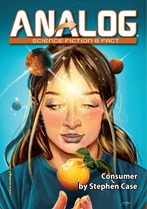
 Analog, March/April 2026
“Consumer” by Stephen Case
“And Wear a Golden Sorrow” by Eric Del Carlo
“Songbirds” by H.A.B. Wilt
“Shade” by David Whitmarsh
“Slingshot” by David Gerrold
“Carbon” by Jay Werkheiser
“The Pearl Divers of Connell-B” by Scott Steensma
“Rovers” by Paul Carlson
“The Three Billion Base Pairs of the Prophet” by Gregor Hartmann
“Godspeed” by C.R. Hodges
“Seeking Singularity” by Joel Richards
“The Shiny New Folk” by Steve Rasnic Tem
“Conscience” by Tom R. Pike
“False Light” by MB Valente
Reviewed by Mike Bickerdike
“Consumer” by Stephen Case is an inventive space opera novella. In the far future, humanity has not only dispersed far throughout the galaxy, but has been all but wiped out by malevolent subspace entities that attack as soon as humans engage a faster-than-light drive. In this setting, a disparate ‘family’ of lost souls slowly travel through space in search of Dyson spheres—which are fabled to be the current cradles of surviving humanity. However, when they finally track down a sphere, they find it is not all they hoped for. The story is quite immersive, especially in the first half, though it actually drops slightly in its engagement once the crew visits the Dyson sphere. One problem of the Dyson sphere concept—i.e. a spherical shell around a star, with the inner surface providing land for habitation—is that the scale is so immense, that it cannot easily be conveyed. The problem isn’t helped here by scale in this tale, seeming to be inconsistent. Impressions are given of curvature of the surface (no curvature would of course be appreciable) and the speed of contact and activity from one side to the other (suggested to be seconds, when it should be hours), likewise spoil the rendering of the concept. What starts offering that all-important ‘sense of wonder’ is lost when the details are presented. Rather a lost opportunity, perhaps.
“And Wear a Golden Sorrow” by Eric Del Carlo is an interesting SF novelette. A very few humans are capable of using an ancient alien technology, found on a distant planetoid, that teleports them to other alien worlds in the form of the original (and now extinct) species of those worlds. ‘Wearers’ of the alien bodies may only last a few trips before the transmogrifying process kills them, while the most celebrated ‘wearer’ has now been on nearly fifty trips. It’s not a bad idea, and is well written, though some readers may wish that it explored the technology or alien worlds more; in the main this is a story of the relationship between two ‘wearer’ travellers, though it delivers that reasonably well.
“Songbirds” by H.A.B. Wilt is a short story in which birds in the future are being protected from extinction in a city aviary. The twist here is that an AI entity can interpret and translate what the birds are ‘saying’ in their songs and calls. Unfortunately, the translated communications presented are entirely unrealistic and anthropomorphic, and the story fails as a result. Birds don’t, of course, think anything in a human language sense, and the idea they can sense or express regret or anger just seems silly.
“Shade” by David Whitmarsh is an SF short story that didn’t linger very well in the memory. A huge shade sail is being launched into space to help reduce the sun’s glare on Earth. With this concept as a backdrop, the action centres on the rescue of a worker whose truck has broken down close to the launch site. There’s a twist at the end, but overall it doesn’t offer enough to rise above the average as an SF tale.
“Slingshot” by David Gerrold is a reasonably neat SF idea in answer to the well-worn story of a spaceship mishap on the way to the moon. It’s a little too short to draw the reader in much, however, as there’s only time to develop the technical idea, and it doesn’t expand on character or develop tension.
“Carbon” by Jay Werkheiser presents an intriguing idea. In the story, it is discovered that all alien civilisations discovered on exoplanets appear to be locked into a pre-industrial era. However, while the idea that solves this riddle ultimately makes some sense, the background search for alien life, and the data itself seems nonsensical. Any search across the galaxy would not be possible without faster than light travel (leading to massive variation in the timeline between planets) or take many hundreds of years (making the conclusions worthless) and the chances of finding any alien life extant at the exact time we’re looking—given the billions of years range any civilization could potentially evolve on an exoplanet—makes the whole question of universal technological staging at this precise moment highly unrealistic. This might not be a problem, except that the underlying idea depends on hard-SF principles, so we cannot ignore the many times hard SF principles are ignored. It’s a shame the story couldn’t be made to work better, as Werkhieser is a significant and skilled author in the field.
“The Pearl Divers of Connell-B” by Scott Steensma is quite good, though at first the scenario looks unlikely and invites incredulity. Free divers, living on a spaceship attached to a distant asteroid, dive down to the surface to mine metals and ores. This is of course risky, and we wonder why they need to free-dive and mine the ore by hand, but in time, the full picture is revealed, and it makes more sense. The imagery is ultimately quite good, and there is some character development here. The story might have been improved if some of the scenario and their predicament could have been signposted a little sooner, so it didn’t seem quite so unlikely in the first half, but that’s a minor complaint.
“Rovers” by Paul Carlson is an SF novelette. A truck driver delivers parts to a space research and development company in California. Set in the future, the start of the story is quite promising, showing us the nature of trucking in the future and it’s quite engaging. However, once the driver reaches his destination, the background to trucking is no longer used, making it nothing more than colour for the story, rather than an essential element. The story then revolves around the testing of a planetary rover designed for a mission to the surface of Mercury. For reasons essential to the plot—but sounding highly unlikely—the truck driver helps with a test drive of the rover. Not only does it seem unlikely the local truck driver would be allowed anywhere near a multimillion dollar planetary rover prototype, but he and his friend take it round the neighbourhood where it has a mishap with a dog and sustains damage. Almost everything about the story therefore beggars belief, and with no real SF ideas of note to support it, this novelette is skippable.
“The Three Billion Base Pairs of the Prophet” by Gregor Hartmann is quite a nicely written tale, though which character we should root for is a little unclear as it suffers slightly from the issue of everyone being unlikeable. A young heiress to a commercial empire is hidden away in a monastery for a year, ostensibly to gain electoral favour through apparent piety. The religion followed at the monastery is a bizarre construction—the genetic code of a prophet has been ‘decoded’ into trite theistic phrases, which form the prophetic text of believers. These are spouted by devotees in conversation the same way followers of religion quote scripture. The young woman hates this and doesn’t believe there’s anything in it. Likewise, nor does the reader, and our sympathies therefore lie with the girl, though she is also petulant and quite unpleasant, so there’s a quandary who to support. There is a nice twist to it though, and while for some time the story seems to be about religious tolerance, there’s more to it, making it ultimately more satisfying than expected midway through.
“Godspeed” by C.R. Hodges takes an unusual structural approach, by starting at the end, and then in subsequent passages, retreating back in time in each section to flesh out the story with more background. The story itself deals with a program set up to address the threat of a significant asteroid impact on Earth. The nature of the threat and the mitigation plan is almost secondary to the backstory of the main characters. Overall, the tale is okay, but the structure is not entirely successful, and the plan itself does seem unlikely. As a side-note, it’s curious to see how often the reader is required to suspend disbelief in this particular issue of the magazine!
“Seeking Singularity” by Joel Richards is a short story set in deep space. An old ship is found drifting out of a solar system by a more modern ship, which is captained by the ship’s mind. The older antique has suffered damage from slavers, and its own mind now seems to have a personality disorder. The tale is well-told and its engagingly written. The story perhaps lacks punch, overall, but it’s a nice enough idea.
“The Shiny New Folk” by Steve Rasnic Tem is a contemplative piece, addressing old age and mortality. Two old men meet at a coffee shop, mourning the loss of their spouses and friends, who have passed away before them, and they struggle to accept the latest technology that seeks to avoid the finality of death. This is a superior piece of fiction, raising interesting themes in a subtle way, without pretending it has all the answers, and is recommended reading.
“Conscience” by Tom R. Pike starts off very promisingly, but by the end perhaps takes its scenario farther than credibility allows. In the most dystopian future imaginable—AI has destroyed the Earth and everyone on it—people live out their lives as self-aware computational constructs, recreated by the controlling AI out of guilt for its genocide. The idea is rather good, bringing the theme of ‘machines taking over’ up to date by viewing it through a modern AI lens. However, the scenario gains more and more complexity, and the larger scale themes that are developed lessen the focus and interest in the main character. This tale initially reads like Simak but unfortunately loses some of that charm partway through.
“False Light” by MB Valente is an engrossing novelette, set on a massive space station, “Stella,” connected to a barren, radioactive Earth by a space elevator. With thousands of floors, the city of Stella is well-drawn, almost providing a character in its own right. A young artist produces “windows” for a living, that depict Earthly scenes for clients’ enjoyment and positive mental health. Against this backdrop, she struggles with her own drug use, difficult relationship and her curiosity to visit the Earth. The length of this story—its quite a long novelette—provides the story the space to breath and develop its themes with a depth that is harder to achieve in shorter forms, ultimately providing quite a satisfying read. It’s more of a reflective piece than a story based on high-action or tension, but its exploration of the psychological challenges of living in limited spaces and with restricted freedom is well done and this is recommended.
More of Mike Bickerdike’s reviews and thoughts on science-fiction can be found at https://starfarersf.nicepage.io/