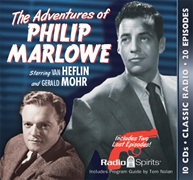
 The Adventures of Philip Marlowe (1948-51) aired “The Tale of the Mermaid” on Saturday, October 1, 1949 as the 52nd of its 114 episodes with Gerald Mohr as Marlowe. This is but the 6th episode of the show we have showcased here since the first in 2020, and only the third since 2022. For those coming to the show for the first time I reprise the introductory background material from that initial episode.
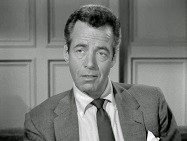
The original brief run starring Van Heflin debuted as a summer replacement for The Bob Hope Show from June 17, 1947 – September 19, 1947. For various reasons it didn’t wow audiences, or the creator of the character himself, Raymond Chandler, and so was cancelled, only to be retooled with a new actor as Marlowe (the incomparable Gerald Mohr, 1914-1968, photo top right) and new scripts.
Mohr was a ubiquitous figure in radio and later in television. Just a few of his more than 500 radio appearances as star or supporting character include: Jungle Jim, Archie Goodwin on The New Adventures of Nero Wolfe, The Whistler, The Shadow of Fu Manchu, Box 13, Escape, and many others. Beginning in the 1950s, Mohr appeared in more than 100 TV series during his life, among them: Maverick, The Lawman, Cheyenne, Sugarfoot, Bonanza, The Rifleman, and other Westerns. Non-western TV appearances included but were not limited to: Perry Mason, 77 Sunset Strip, Hawaiian Eye, and of SF interest episodes of Lost in Space and Voyage to the Bottom of the Sea. Of interest to comic books fans, Mohr did the voice of Reed Richards in The Fantastic Four animated cartoon series in 1967, and that of Green Lantern in the animated Aquaman series in 1968.
Conversant in Swedish, Mohr had flown to Stockholm in the Fall of 1968 to star in the pilot of a proposed television series. Shortly after filming he dropped dead of a heart attack on November 9th, 1968 at the age of 54. He was buried on the island of Lidingo, Sweden.
 Raymond Chandler (1888-1959, photo at right) wasn’t the first to create what would come to be known as the hard-boiled detective. Dashiell Hammett was first on the scene with his Sam Spade character introduced in his 1930 novel The Maltese Falcon (first serialized beginning in the September 1929 issue of Black Mask magazine). But with Chandler’s first novel, The Big Sleep, published in 1939, he took the gritty, noir detective novel to a new level with his tough as nails private eye, Philip Marlowe. (It should be noted here that the screenplay for the classic 1946 version of the film was co-scripted by William Faulkner, Jules Furthman, and none other than SF’s own Leigh Brackett. It starred Humphrey Bogart as Marlowe and his new real life wife Lauren Bacall as Vivian Rutledge.) Marlowe’s character was not only able to handle himself on the street, he was an intellectual cut above the average gumshoe in that he had attended college, played chess, and had an ear for classical music. This side of his character only masked his off the cuff ability to fling witty descriptions and ready-made similes to pepper his
 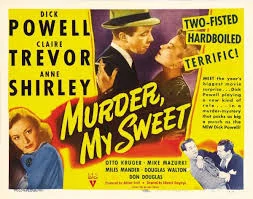 already colorful narratives, and was to become one of his trademarks, emulated by many another writer who wished to show how clever their own detective creations were. It became a widely recognized form of dialogue that later transferred itself well to the silver screen, custom made for audiences eager for the noir crime/detective experience, and was given full voice in the movie adaptation of Chandler’s 1940 novel Farewell, My Lovely. Released in 1944 under the novel’s original title in the UK, for American audiences the title was changed to Murder, My Sweet and starred Dick Powell and Claire Trevor. It was a well-received, seminal film that helped define the noir genre, and was a breakthrough role for Powell as well, who had spent a good decade or more playing the young, handsome, crooning playboy roles but never the serious leading man.
This episode plays into the perception of Marlowe as the quintessential hard-boiled detective. The clipped, no nonsense street lingo, slapping bad guys around when not using his rock-em, sock-em fists, and never slow about having his gun at the ready, “The Tale of the Mermaid” was made for Marlowe. As usual, a lot of money is at stake when an expensive piece of jewelry known as the Mermaid is the McGuffin, and the bad guys are willing and able to kill anyone who gets in their way. This is a meat-and-potatoes Marlowe feast for those who like action over talk, and it makes the half hour fly by all too quickly.
(The CD linked above contains this episode and 19 more on a 10 CD set, all restored and remastered.)
Play Time: 29:47
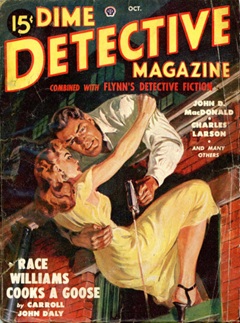
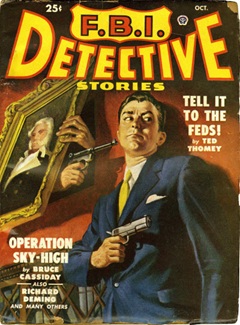
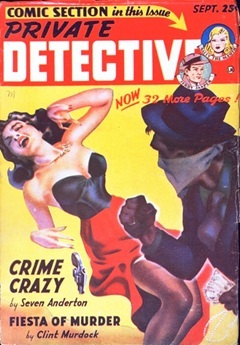
{After listening to this Philip Marlowe episode, the neighborhood gang was ready to hit the nearby newsstand the next day after church. The little rascals could never get enough of the Good Guys vs. the Bad Guys and there was an unending supply of both in the various detective pulps they were fond of spending their allowances (and money earned through their paper routes or lawn mowing jobs) on. Dime Detective (1931-53) was the most well regarded of Popular Publications line of detective pulps. It published 274 issues, all but the last three years of its run as a monthly magazine. F.B.I. Detective Stories (1949-1951) somehow lasted for 14 bi-monthly issues, a remarkable achievement when you consider the heyday of the federal agent story in several pulps (think G-Men Detective for one other such pulp) had all but run its course years prior. Private Detective (1937-1950) appeared on newsstands roughly three years after the advent of the “spicy” pulps, Spicy Detective being one of them. Published by the same publisher—Trojan Publishing—Private Detective came to be viewed more or less as a slightly less socially offensive magazine than Spicy Detective, in that its covers were less sexually suggestive and the criminal aspect was perceived as being not quite as much in the deep end of the psychopathological pool as before. Though a bi-monthly in 1949 it managed only 5 issues.}
[Left: Dime Detective, 10/49 – Center: F.B.I. Detective, 10/49 – Right: Private Detective, 9/49]
To view the entire list of weekly Old Time Radio episodes at Tangent Online, click here.