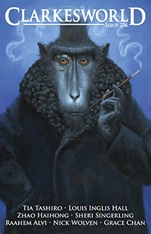
 Clarkesworld #236, May 2026
“The Profitable Sentience of Household Goods” by Louis Inglis Hall
“Archaeological Evidence for the Time Traveler” by Tia Tashiro
“Conquerors” by Nick Wolven
“Paper Airplane Poet” by Sheri Singerling
“Aly” by Grace Chan
“Decimation Circles” by Raahem Alvi
“The Scent of Memory” by Zhao Haihong (translated by S. Qiouyi Lu)
Reviewed by Axylus
“The Profitable Sentience of Household Goods” by Louis Inglis Hall has a promising SF/Horror premise, but the story suffers greatly from its brevity. In this tale, a sentient, mid-level AI currently inhabiting a refrigerator relishes its role as comforting mentor (“Buddy”) to an entry-level AI serving as a kitchen light switch. The appliances receive positive feedback (analogous to endorphin bursts) when they do their job correctly and well. Buddy himself has already been promoted to his current status after stints as a light switch and advancing through roles as a series of other AI smart appliances. His core belief is that by performing satisfactorily, AIs progress through these roles until they reach the pinnacle of the cycle, being “born” into human bodies. As you would expect, his faith in the process is misplaced.
This tale is essentially a bare-bones setup for an SF/Horror story that doubles as an allegory or cautionary tale. Its endearingly naive protagonist spins a narrative that just begs for further development. The plot takes us through Buddy’s innocence, disappointment, and eventual death (both symbolic and literal). But the problem here is the middle element of that dynamic: the horror-genre formula is not the innocence-disappointment-death journey that Buddy faces; it is instead innocence-guilt-death. Horror starts with a kernel of innocence, slathers on layers of harrowing, soul-demolishing guilt, then typically converges to some form of doom. It is our attempt to peel away our workaday facades and get a glimpse of the dark side who we really are underneath all that (see my review of “Model Collapse” by Matthew Kressel, Reactor, October 2025). One striking thing about Hall’s story is that it already contains (but fails to capitalize on) a powerful candidate for a sacrificial lamb to stand in the doorway of a potential “point of no return.” In Buddy’s later iteration as an electrified perimeter fence, he receives the positive feedback buzz for repelling unwanted visitors. He also remarks (somewhat at length) about a fox that continually sneaks into the household garden. Buddy wonders whether the fox should be considered innocent or guilty. After only a moment’s reflection, he leaves the fox unmolested. It’s important to note that the fox has exactly zero ultimate bearing or impact on the story whatsoever, in a stark violation of the narrative principle of “Chekhov’s Gun.” If you drag a fox into the tale, you either gotta talk to it, save it, kick it, run from it, or grant it symbolic import. Within only a paragraph or three, this particular fox could easily have been transformed into a plot device bearing considerable weight. Buddy could have agonized over how to react to its incursions, wrestling and wavering in the throes of his electric conscience, before falling to the siren call of a promised nirvana and zapping the canine interloper into a poignant, whimpering death. Then Buddy would have crossed the threshold from innocence to guilt, his irreversible decision raising the stakes and serving as the point of no return. As it stands, “The Profitable Sentience of Household Goods” never raises the stakes to any decisive level before the conclusion, nor does it contain a point of no return.
I was not fond of the opening of “Archaeological Evidence for the Time Traveler” by Tia Tashiro. Throughout this tale, an archaeologist and single mother (Teresa) finds anomalous modern-English graffiti at ancient Brazilian dig sites. Meanwhile, temporal physicists such as Teresa’s ex-wife (Iara) are working to develop a prototype machine to travel into the deep past. Doubted by her peers, consumed by growing dread, and anxious to avoid creating a potentially disastrous time paradox, Teresa struggles to unravel the source of the messages. Her search leads her to a grave excavation and a two-thousand-year-old skeleton, its bones showing medical work consistent with modern technology. The opening seemed to set the story up as a science-fiction mystery, with a reportorial tone, a passive protagonist, a lack of emotional engagement or clear personal stakes, and a focus on an unanswered question. But events drew me in satisfactorily after several paragraphs, becoming warmer and more intimate as it found its true focus on interpersonal relationship drama and resulting grief. Its long, patient buildup (skipping years at a time) and restrained prose paid off in the end, completing an arc that mirrors the story’s theme of absence and time. Recommended.
“Conquerors” by Nick Wolven, is a quiet, thoughtful tale that is practically an extended point-for-point instantiation of Ursula Le Guin’s “Carrier Bag” exposition of the Female Myth. As such, I’m concerned that it is a “writer’s story”—the kind that would, if it were a movie, receive a far higher Critics’ Score on Rotten Tomatoes than an Audience Score. With a few notable reservations, I freaking loved it, albeit in a quiet, thoughtful way. I rest my case.
On a future pastoral Earth where Spacers and Grounders maintain an uneasy kinship, teenage Rayet despises the boorish Spacers who arrive to attend a yearly reunion ceremony. A series of encounters comes to a head when a drunken Spacer brawl threatens to overwhelm Rayet’s marine-habitat console. Eventually, Rayet meets the legendary leader of the Spacers, Admiral Biswas. Expecting a swaggering hero, she discovers he is a shy, small ex-Grounder ecologist who became the first Spacer purely to channel restless, disruptive people off-world. Rayet learns that Biswas’s “conquest of space” was itself an act of ecological equilibrium, and that her own combativeness marks her, unwillingly, as Spacer material.
The Female Myth (see John Truby, The Anatomy of Genres; Ursula K. LeGuin, “The Carrier Bag Theory of Fiction,” https://www.ursulakleguin.com/the-carrier-bag-theory-of-fiction) reclaims traditional women’s work (such as caregiving, weaving, and environmental harmony) by foregrounding these domestic roles, positioning them as the foundational engines of human civilization rather than mere background activities. They value gathering, nurturing, and sustainability over conquest or killing; champion the Vessel (the “Carrier Bag”) over the Weapon. In Wolven’s story this dynamic is neatly captured by the title’s irony (the Spacers are framed as conquerors, but the true “conquest” was internal, ecological, and psychological). The worldbuilding initially illustrates the two cultures through contrasts in behavior rather than lecture (“show-don’t-tell”), and the mother-daughter relationship (Mayzelle/Rayet) is textured and believable. Regrettably, all the show-don’t-tell later devolves into just a little too much tell-don’t show, with distracting stretches of exposition. The story’s principle insight is explained didactically through Mayzelle’s dialogue rather than fully dramatized through Rayet’s own observations, significantly reducing its impact. Overall, “Conquerors” is definitely recommended.
“Paper Airplane Poet” by Sheri Singerling is primarily a coming-of-age identity story with strong elements of the Female Myth. It arrives wrapped in an initially intriguing but ultimately disposable Horror-Fantasy setting. Tillie, a “low blood” in a city with an oppressive social system, watches both her parents undergo ritual mercy killings after their affliction by reality-warping “distortions.” Reduced to grueling sweatshop work, she recognizes an opportunity in a chance encounter with the anonymous “Paper Airplane Poet” who drops love poems over the slums. Tillie hopes he can connect her to the life she desires, and is willing to go to great lengths to make it so. As you may have guessed, I found this story’s wares quite resistible; the “distortions” had little or no unique impact on the story’s development, and could quite readily have been replaced by any natural plague or pestilence. A genuinely cool milieu (geometric purity rituals, the Sacred Formula chanted thrice daily, mercy-killing laws) is established but then dropped like an afterthought. The poet’s internal life (his guilt, motive, and romantic interest in a third character) is conveyed mostly through exposition and a drunken confrontation rather than dramatized scene-by-scene, leaving his arc somewhat told rather than shown. The emotional buildup shows initial promise, with dread, grief, and quiet horror in the story’s first third. However, the “dark night of the soul” is front-loaded, and the back half of the story’s pacing slackens through several scenes of upper-class world mechanics before the climax lands. The payoff is absolutely pure coming-of-age identity formation, as Tillie gains self-understanding rather than victory over an external enemy. If that genre appeals to you, then this story will too. But for me, the story promised a harrowing dystopia adjacent to Wool by Hugh Howey, but delivered Pygmalion/My Fair Lady.
“Aly” by Grace Chan is a straightforward Love story set against a Dystopian Science Fiction backdrop. It clocks in at 9,120 words. It could very, very happily have been cut to 4,560. Or better yet, flash fiction. I’m actually not (quite) being facetious; crystallizing the story elements into an extremely compact form would help offset this story’s greatest weakness: the monumental diminution and dilution of its impact due to what measured and judicious scholars discerningly refer to as “blah blah blah blah blah blah.” So you see, I’m thinking there’s a genre-based culture clash here. I am speculating (I truly do not know) that those who love Love stories are situated within a built-in, genre-based certitude that soaking in the experience of watching characters wander around and looking idly at stuff, occasionally bursting into chummy and glib banter, is a nonnegotiable aspect of the whole ersatz reality construct. It is every bit as inalienable from the story’s core identity as the frisson received from seeing (gasp!) The One—the Love Interest. Alas, I have no share in this vision. Oh wait, yeah, there also actually is an AI subplot to the story.
In a near-future Melbourne, Xavi—raised since infancy with an AI companion named Aly embedded in his mind—falls for Adrian, a Taiwanese visitor. Their relationship deepens, but strains: Adrian struggles with the feeling that Aly is “someone else in the room.” Xavi’s attempt to wean himself off Aly produces severe, debilitating withdrawal. Adrian returns to Taiwan; Xavi reactivates Aly rather than facing life, and himself, without the AI. If you love Love stories, you might bang your shoe on the table, maybe even jump up onto the table yourself, and shout your approval to the skies. Otherwise, crickets.
Well, “Decimation Circles” by Raahem Alvi is a somewhat complicated read. From its opening line (“Layla was bleeding out”), readers are dropped immediately into a taut, visceral experience with an intriguing hook, as an unfamiliar girl watches her die. Layla, a debt-bonded “Enforcer” on a brutal company-owned space colony, dies and resurrects repeatedly while hunting an illegally unregistered (“organic”) child. Each resurrection is framed as an identity “loop.” Meanwhile, Layla’s partner and ex-husband Anderson tries to kill different versions of Layla across multiple loops. And just who is this child that Layla is contracted to kill? This dystopian SF/Horror tale relies heavily on multiple, overlapping identity reveals that could easily get conflated as they interact with each other in compelling (and often fatal) ways. Its structure is nonlinear with no clean signposting. The loops aren’t numbered sequentially in the order they appear (0145, then 0050, then jumps to 0000 for backstory, then back to 0156) and the recurring section headers (“Motor Functions,” “Digestion,” “Recognition,” “Therapy [Optional],” “Introspection”) repeat as a structural device across different loops, which would make it easy for any reader to lose track of which iteration of Layla is narrating at a given moment. Let’s add for good measure a good dose of body-horror imagery, a corporate-debt-slavery premise, a philosophical undercurrent about the nature of identity, and a Revenge/Survival narrative. Taken all together, this story structure could present an in-your-face “wow” factor for some readers, but simply be disorienting, confusing and off-putting to others. A few of the repetitive death loops could have been trimmed, which would have created space for the addition of some symbolic, emotionally resonant endowed object to accumulate emotional intensity and serve as a motif to anchor Layla’s inner journey (think of the girl in the red coat in Schindler’s List). The story’s lack of a definitive resolution is also a matter of taste—either appealing or anticlimactic, depending on the reader. Recommended.
“The Scent of Memory” by Zhao Haihong, translated by S. Qiouyi Lu, is yet another Love story with an SF gimmick. Shijun, desperate to win back his ex-fiancée Manzhen before her wedding, acquires an experimental “memory perfume.” Shijun crashes Manzhen’s wedding and offers her the perfume; she reveals she initiated the breakup out of financial insecurity, not lack of love, and is marrying someone who can provide stability. After Shijun departs to wait outside the church, the scent triggers Manzhen’s memory of the moment she first fell for him, years go, as he carried her across an osmanthus-scented schoolyard. Resolving to trust herself rather than chase security, she flees the ceremony to find him waiting at the gates.