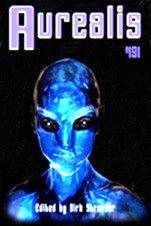
 Aurealis #191, June 2026
“The New Thirty” by Anne Aulsebrook
“Crow” by Kit Holmes
“A Good Age to Go” by Adam Porkolab
Reviewed by Axylus
“The New Thirty” by Anne Aulsebrook is a very interesting story that could be approached from distinct critical frameworks that don’t tend to agree with one another. Summary: In a future where an age-arresting treatment is commercially available and nearly universally adopted, elderly Eleanor is interviewed by journalist Gail for an article titled “Seventy Is The New Thirty.” Eleanor’s husband Jonathan took the treatment decades ago and still looks thirty-four at nearly eighty; Eleanor, meanwhile, looks her true seventy-six. Gail gently and patiently probes until discovering that Eleanor’s long-maintained official narrative (the treatment “just couldn’t take” due to some combination of a rare genetic incompatibility with the treatment and an adverse stress reaction at the clinic) has always been a lie. Eleanor admits the true events aloud for the first time. Gail’s published article ends on a two-line exchange that (Aulsebrook asserts) quietly exposes the protagonist’s lie.
“The New Thirty” is built for readers who want a quiet, interiority-driven character study rather than plot or hard speculative logic. It’s strong on mood, voice, and the central thematic move (silence as the real deception). People who enjoy stories about long marriages, unspoken accommodations, and the slow accumulation of small lies that calcify into permanent distance will find it satisfying. The SF conceit (age-arrest treatment) isn’t really doing speculative-fiction work here. Instead, it’s a literary device that delivers a metaphor for aging, intimacy, and the gap between two people’s diverging realities. So approaching “The New Thirty” from the plot-centered critical framework and SF/F/H genre aspects that my reviews tend to emphasize may leave a reader walking away unsatisfied. And maybe that’s OK.
Having said that, this story actually fails even on its own terms, though many readers may not see it that way. It contains numerous, overlapping, subtle contradictions and inconsistencies that at least place a serious strain on credulity and at most add up to an unearned central premise and one or more fatal flaws. But its confident narratorial assertion (“finally exposed for the lie that it is”) and emotional momentum may well tend to carry a reader past logical gaps that would be visible on a slower, more skeptical re-read. Rather than unwinding the full, tangled list of logical inconsistencies, we can consider what may be the largest one: did Gail’s article expose any info to any characters within the story (as opposed to you and I as real-world readers of Aulsebrook’s tale—a crucial distinction) that would enable them to uncover Eleanor’s secret? Various clues offered within the story (emotional reactions including a suppressed “bitter” thought, a chest-hurt moment, etc.) can support the conclusion “Eleanor’s answer was false,” but they cannot support the stronger conclusion the text actually asserts, which is that the answer is exposed to other characters as false. If no character inside the story’s world ever actually receives the information needed to recognize Eleanor’s final answer as false, is the ending’s claim of being “exposed” an unearned assertion? That gap between what the conclusion claims and what the evidence supports is a variety of non sequitur. The only conceivable scenario that I can come up with which would rescue the in-world conclusion of “exposed truth” is that readers of Gail’s article would conclude that it meaningfully flouts the Gricean Communicative Maxim of Quantity: “Make your contribution as informative as required for the current conversation, and do not provide more information than is necessary.” That is, Gail surprises her readers by saying absolutely nothing other than “Eleanor is not angry”, which would lead them to wonder (and probably conclude) that the strange omission is a hint that Eleanor in fact is angry. But that reading is never signaled within the text, leaving it fatally tenuous.
There are several other logical gaps. For example, I sense feelings of sorrow/loss/mourning, embarrassment, and estrangement in the protagonist, but never anger. As for the rest, I leave them for the reader to find, as an exercise. Rather than invoking my “Hemingway’s 47 endings” rule of “you really need to spend more time rewriting your ending,” I would suggest that Aulsebrook really needed to spend more time making sure the story is logically coherent and licenses its ending.
“Crow” by Kit Holmes sits firmly within the Horror genre (specifically, Animal Horror). Late at night, Abraham investigates a violent noise in his father’s locked shed and finds an enormous, injured crow-like creature with a long insectile proboscis dangling out of its beak. When he picks it up, it attacks him. The story then cuts to Abraham’s younger brother Isaac waking in Abraham’s car; Abraham is pale, bloodied, and behaving strangely, insisting they must visit their dying mother before Isaac leaves to catch a train back to school. Weirdness ensues.
A dangling participle in the second paragraph offended my grammatical sensibilities (“Approaching the tin shed, the gritty hatchet his father had given him burned thick splinters into his fingers.”) But the story locked in: mildly surreal and disturbing, vampire-adjacent, thoroughly enjoyable. The story escalates effectively through mystery, dread, and gradual revelation. Is it real, or is it just a dream? Ask the mozzies buzzing around a light bulb in the shivery cold weather. This story had at least as many gaps and leaps of logic as “The New Thirty,” if not more. But that’s OK. In this case, gaps are a feature, not a bug. Recommended.
“A Good Age to Go” by Adam Porkolab is narrated by Death, who describes a dystopian society that financializes mortality through the “Fatline Market” (not “Flatline Market,” as you might expect). In this parallel to a stock market, every newborn receives a tradable “Life Ticker” and twenty-seven is the socially expected age to “depart”. As Death explains it, the society has “…made a stock exchange out of me.” Cutter, a thirty-one-year-old surgeon-trader, opens a short position against Ing Reed Imbue, a sixty-three-year-old “Long” with failing kidneys, betting that she will die within thirty-one days. He does so to fund his ten-year-old daughter Mira’s tuition. Over a thirty-one-day countdown, Death observes her baking and giving food away and her recurring, unprompted question, “Are you eating properly?” He also sees her folding paper cranes and setting them on the windowsill of her room. For the first time ever, Death begins to ponder the inviolable, clockwork order of his actions.
One fear I have while pondering stories at length to review them is the danger of giving preference to “writer’s stories”—stories that, if they were movies, would receive a notably higher Critics’ Score than Audience Score on their Rotten Tomatoes online reviews. I loved the layered metaphors of this one—so Ing Reed Imbue is imbuing greed with what, latent echoes of the warm core of humanity? Palimpsests of joie de vivre, vestigial traces of personal concern? The value of well-intended, irrational gestures? I found the story’s ending particularly strong. On the flip side, its opening made me wonder whether I’d hate this tale, as Death more or less demanded my attention and told me how to feel while delivering a thesis, rather than persuading me into the first two and showing me the third. But I forgave all that as the story progressed. Definitely recommended.