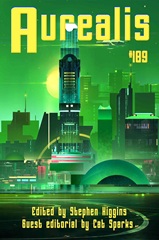
 Aurealis #189, April 2026
“Out of Time” by Carolyn Galbraith
“Little Drid Makes a Call” by Andrew Renganathan Roberts
“Epimetheus” by Luke Weavell
Reviewed by Dave Truesdale
If the definition of surrealism is defined as an exploration of the workings of the mind, championing the irrational and the poetic, and is something that aims to blend dreams, the unconscious, and reality into something beyond what we believe is real—the surreal, then Carolyn Galbraith has produced a fine example of surrealism, one carefully draped with a soft whisper of melancholy with her “Out of Time.”
In this strange realm we are given the voice of what we learn is a comforter through whom the story is told. We do not learn from whence comforters come, where they live, or much of anything about these enigmatic…people, save that our comforter narrator is clothed in a flowing robe of midnight blue, a shade that matches her eyes. More than that is not necessary to the literary conceit which is the focus of the tale. Our comforter is assigned certain rooms she must visit, the purpose of which is to comfort the already dead, bedridden as they breathe their last, to reassure them that their lives have been worthwhile and their legacies intact, their accomplishments remembered and cherished. Sometimes she is assigned a writer, then a scientist or an artist or poet. Some, like Oscar Wilde or Albert Einstein we recognize from clues we are given, others are harder to know. It is a sad series of death rooms she must continually enter and then depart, until the endless routine is broken when she is startled by one who is not dead and speaks to her. She reports this…mistake to her supervisor and continues her never-ending assignments, only to inevitably return to this living dead person several times, whereupon she learns who he is and what he will be remembered for. And Carolyn Galbraith sticks, as it were, the landing perfectly, with the revelation of who the person is and the tone with which the story eases us out of this otherworldy meditation. In fact, the tone of the entire story, its perfectly chosen, consistent voice and use of imagery, bespeaks a talent to watch, for it complements the metaphysical questions she brings up along the way, those concerning, among others, why some people, more than others, want to hang onto life and why. Overall, from a refreshingly different concept (comforters to a strange iteration of the living dead) to a satisfying and successful treatment of the theme, this is a recommended work.
Humanity has lost an interplanetary war and has been totally enslaved by their now overlord aliens. Andrew Renganathan Roberts’ “Little Drid Makes a Call” shows us one such enslaved factory planet that has the look and feel of an Earthly 19th century industrial scenario much akin to a Dickens’ novel where dirty factories belch smoke into the atmosphere while underpaid, overworked city dwellers eke out a one-step from the grave existence. Come the mid-morning shift’s end on this unnamed planet and a dirty young boy of 16 waits for the tired workers he has come to know and befriend to trudge out of the factory before some of them head his way. Little Drid then offers a number of them, for a price, the drug that will make it possible for them to continue, so they can make it through another shift and collect their few payment chips for food and another day’s drudgery, one after the other with no respite in sight. It is a mind-numbing existence under the thrall of the aliens, with no hope of relief in sight for the remainder of their sorry lives. The aliens overseeing the factory look the other way as Little Drid is the middleman selling his drugs to the workers, for the alien overseers know without his drug their work force would soon dwindle.
Then one day Little Drid is approached by an unknown human, in private, with an offer that would change his life forever should he accept it. This man explains to Little Drid that he is part of the Resistance, which is something Little Drid knows nothing of until it is explained to him that when his mother left on an outbound ship when he was but a child of nine, promising to return for him someday, she was in reality a newly recruited member of the human Resistance, gone off to fight for humanity on some other planet enslaved by the aliens. The Resistance Man tells Little Drid that if he will plant and set a timed bomb at a certain location important to the aliens, it will destroy equipment valuable to them, making it possible for mankind to turn the tables on the aliens and give humanity a good chance of regaining its independence. The only downside would be that the factory where thousands of humans work, and who supply Little Drid’s livelihood by buying his drugs, would die in the explosion. Little Drid would be taken care of by the Resistance. And to sweeten the pot and convince him to do this one job for the Resistance and humanity at large, he is told that his mother, who he thought had abandoned him, has made quite a name for herself as a Resistance fighter on other worlds.
Little Drid is given much to think about with this offer. On one hand if he plants the bomb at the special place requested by his new friend, sets the timer, and escapes to be saved by the Resistance and be rid of his dull life of peddling drugs with no good forseeable future in sight, he will also possibly be saving millions of his fellow humans on other planets in the bargain; or on the other hand if he refuses he will most certainly doom millions of his fellow enslaved humans on other planets to be sentenced to their own mindless existence, but will save the thousands who work in the dirty factory who have become his friends. Could he live with himself if he let them die while potentially saving humanity’s millions? Such is the moral choice Little Drid finds himself anguishing over, and is what makes “Little Drid Makes a Call” such a philosophically thought-provoking story and definitely worth a read. What would you choose to do if you found yourself in Little Drid’s back-to-the-wall with nowhere to run or hide position?
Luke Weavell has aptly titled his short novelette “Epimetheus,” it being the name of his generational starship on its way to the planet Eden. Epimetheus in Greek mythology was the brother of Prometheus, who against the wishes of the gods gave man fire. As punishment for accepting Prometheus’ gift to mankind the gods sent us Pandora. Where Prometheus was the god of forethought and foresight, Epimetheus was the god of impulsiveness and afterthought and married Pandora, who as we know let loose all manner of suffering on mankind; thus the name of the starship becomes metaphorical when certain issues are discussed by several passengers during their long voyage between the stars, and the real reason behind the inclusion of certain creatures on this Noah’s Ark of space are revealed.
Since the entire story takes place inside the ship and becomes more or less a travelogue as parts of the ship are explored, there is no real plot but more of a simple storyline instead, as things happen, but without a conventional plot structure as we have come to know the term. We learn through dialogue between a curious passenger and a friendly security officer (who is privy to certain secrets about why the ship has brought along certain species from Earth, and why others must be destroyed if they should escape) that because of the lessons we had learned the hard way on Earth, there are some of the ship’s designers and those who held power who have built the ship with a fail safe option, that should specific situations occur on Eden, then a decision must be made either to take appropriate action to destroy Eden, or destroy the ship and all of its Earthly creatures (including frozen embryos of various kinds), humans included. So here we have another thoughtful story where a life or death situation is presented involving either the fate of a new world for mankind or the destruction of a generational starship full of what might be the only creatures left from a dying (or already dead) Earth, including what may be the last of the human race. So read carefully and see if the author has presented his case fairly or not to your way of thinking, and render your own verdict as to which of the choices or options presented (or another that is not given) might be your own.