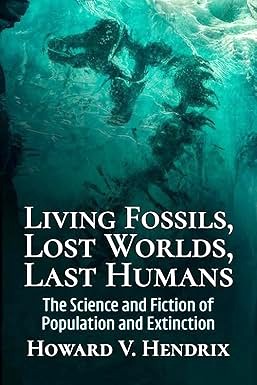
 Living Fossils,
The Science and Fiction
of Population and Extinction
by
Howard V. Hendrix
(McFarland & Co. May 2026, pb, 228 pp.)
∞ ∞ ∞
Review by Manjula Menon
The author, Howard V. Hendrix, brings an impressive breadth of research in Living Fossils, Lost Worlds, Last Humans: The Science and Fiction of Population and Extinction. One glance at the 8-page bibliography and 13-page index confirms this. The author has drawn from a wide range of material, all assiduously referenced.
The author aims to answer the question posed in the first sentence of the preface: “Why, over the last two centuries, have the scientific descriptions and fictional depictions of living fossils, lost worlds, and last humans come to occupy a prominent place in the popular imagination?”
He provides the answer in the very next sentence: “Georges Cuvier’s discovery of mass extinction (1800), Mary Shelley’s novel The Last Man (1826), Charles Darwin’s On the Origin of Species (1859); nineteenth and twentieth-century colonization and decolonization; twentieth and twenty-first-century existential threats of nuclear weapons, anthropogenic climate crises and danger posed by artificial intelligence—all of these landmarks of the past few centuries have undoubtedly influenced popular thought concerning living fossils, lost worlds and last humans.”
The opening sentences typify the author’s style, which consistently favors comprehensiveness over selectivity. In spite of the ambitious scope, this is a fairly slim volume, coming in at about 228 pages (including 37 pages of afterword, chapter notes, bibliography and index). To accomplish such a comprehensive approach in such a modestly sized work, the author incorporates a high density of wide-ranging references and ideas into almost every paragraph.
The book begins with an introduction followed by six sections: (1) Fossils and Fossil Collectors, (2) Poets, Philosophers, and Disasters, (3) Liminal Species, Liminal Spaces (4) Creatures of an Island Oasis in the Desert Ocean of Space, (5) Blank Spaces and Blind Spots, Dark Places and Lost Races (6) A Course in Crashes. This is followed by an afterword, 14 pages of chapter notes and several pages of bibliography and index.
The author makes frequent allusions to political topics. I’ve included a few examples. Whatever one makes of the individual claims, they arrive with some regularity:
On humans and the environment:
-
Page 60: “Greenhouse gas emissions and other pollutants created by humans, deforestation and other habitat destructions by humans, overfishing by humans, overhunting by humans, overpopulation of humans, overconsumption by humans, and the potential for nuclear warfare waged among humans may well result in perhaps 50 percent of all living species dying off by the end of this century.”
-
Page 107: “The more human population and its corresponding resource consumption accelerate in an upward direction, the more overall biodiversity accelerates in a downward direction, with more and more species being sped on their way ever faster towards the dead end of extinction.”
On capitalists and the “billionaire class”:
-
Page 92: “The Utopian viewpoint that nobody should be “placed so far above the rest,” is inherently also a relevant critique of our global billionaire class and its members’ inhumanly vast concentrations of wealth.”
On a reference in Jules Verne’s Journey to the Center of the Earth to “our own white race”:
-
Page 119: “Whether this comment, read in context, is racist (expressive of belief in a hierarchy of races, some inherently superior, some inherently inferior) is an ambiguous point here—especially since, although “race” today continues to persist as a social construct, race has no inherent biological meaning or uniform genetic basis in humans.”
The main thesis of the book, encapsulated best in the afterword, is that Homo sapiens, like any other species, has a finite span. The author is critical of both utopian science fiction for ushering in what he calls “technosolutionism,” adherents of which he cites the likes of Elon Musk, Jeff Bezos and Peter Thiel. Likewise, he is also critical of what he calls “extinctionism,” a dystopian worldview which looks to hasten the demise of the species and for which he places partial blame on dystopian science fiction writers.
To summarize, this is an ambitious, densely packed, heavily referenced work that frequently draws connections to contemporary political concerns. The result is a network of ideas more than a conventional sustained argument, rewarding readers interested in breadth of reference, while demanding considerable patience from those seeking a more focused narrative. It will find an audience among readers who appreciate interdisciplinary cultural analysis and connections between historical, scientific, literary, and contemporary concerns.

Manjula Menon is a writer whose work explores the intersections of science, philosophy, and speculative imagination. Her recent essays include “The Science Fiction and Philosophy Society: An Introduction” in Sci Phi Journal and “Sea and Space Laws” in Amazing Stories. Her fiction has appeared in Nimrod International Journal, North American Review, Santa Monica Review, Pleiades, Southern Humanities Review, and Tampa Review, among others. Her honors include a Yaddo Fellowship, a Bread Loaf Writers’ Conference waitership, and a Writing Downtown Fellowship in Las Vegas.
Trained in astrophysics and electrical engineering, she has been part of the founding teams of two technology startups, worked at a major New York consulting firm, and designed cellular networks internationally. Her current work examines questions of consciousness, intelligence, and the ways science fiction shapes our understanding of reality.
Menon was born in India, and spent part of her childhood in Zambia. She lives in San Francisco.
All text copyright © 2026 Manjula Menon
All Rights Reserved.