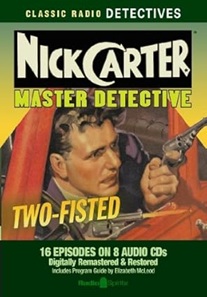
 Nick Carter, Master Detective (1943-1955) aired “The Substitute Bride” on November 17, 1943. We have showcased 19 previous Nick Carter episodes since 2009, this being the 3rd in almost 3 years, our last coming in June of 2025. Carter’s history is long, covers numerous media, and is one of the more fascinating we’ve come upon. To crib from one of our earlier entries for new listeners, and slightly tweaked with new material, Nick Carter on radio ran a respectable twelve years, from 1943-1955, but the famous detective’s history begins much earlier. During the post-Civil War era known as Reconstruction, a short story featuring Carter appeared in an obscure fiction paper (The New York Weekly) in 1886 (predating the first Sherlock Holmes story by two years). The publisher was none other than Street & Smith, a fledgling, struggling publishing firm which would later become the most dominant pulp magazine publisher in the world. Among its later titles would be Astounding Science Fiction (now Analog), the only magazine from Street & Smith to survive the pulp magazine crash of the 1950s.
Award-winning radio historian Elizabeth McLeod notes that, “Within a decade, an ongoing series of Nick Carter novels vaulted [Street & Smith] to the front ranks of dime-novel publishers, and made Nick himself a national institution. Nick’s own magazine, The New Nick Carter Weekly, would carry the detective into the twentieth-century.” By 1915, however, the then titled Nick Carter Weekly became Street and Smith’s Detective Story Magazine, a true pulp magazine and S&S’s initial entry into this new format. Again, from Elizabeth McLeod: “Detective Story Weekly soon became Street and Smith’s flagship publication. With the rise of radio in the 1920s, it became the firm’s entree into the broadcast medium. The Street and Smith Detective Story Hour became a favorite of listeners at decade’s end, with elaborate tales of murder and crime hosted by a mysterious narrator introduced only as “The Shadow.” While Nick Carter himself did not appear on the program, his spirit was very much in evidence in the various detective characters that populated the stories.” Of course, we all know what happened next. The mysterious voice only introducing the S&S Detective Story Hour became so popular that S&S launched The Shadow magazine in 1931, and shortly thereafter S&S added Doc Savage to its pulp adventure line. Amidst all of this activity Nick Carter was even given his own magazine (again) in 1933, proving the character’s resiliency and staying power—he was now 47 years old.
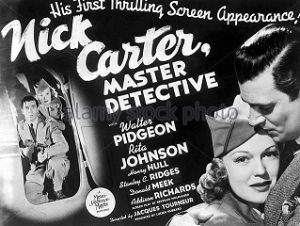
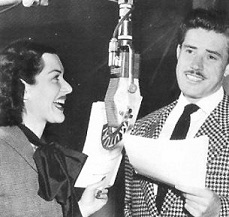 Nick Carter Magazine ran for 40 issues, from March 1933 to June 1936, the final six issues slightly retitled as Nick Carter Detective Magazine. While the magazine had folded, its long-running character still lived, for in 1939 Hollywood picked up the movie rights and produced three “B” Carter films starring noted actor Walter Pidgeon* (who later would star in the classic 1956 SF film Forbidden Planet). A mere three years later, Nick Carter would rise from the dead yet again in his own radio series, Nick Carter, Master Detective. The show’s producer and often the writer, Sherman “Jock” MacGregor, would enlist some of the best writers in the business to script Carter’s episodes, including Robert Arthur and David Kogan of Mysterious Traveler fame, the creator of The Shadow, Walter Gibson, and none other than legendary SF author and SFWA Grand Master Alfred Bester (one of which Bester-written episodes, “Chemical Chickens,” we ran in March of 2014 here). Lon Clark played Nick Carter throughout its 12-year run, ably supported by first Helen Choate until mid-1945 (photo above right with Lon Clark) and then Charlotte Manson as Nick’s intelligent, perky secretary Patsy Bowen. Other mainstay characters included Police Sergeant Matty Mathieson, young newspaper reporter Scubby Wilson, and scruffy old veteran of the crime game Waldo McGlynn.
*(The first of the three Nick Carter films was 1939’s Nick Carter, Master Detective. Of interest to SF/F/H genre buffs is that it was directed by Jacques Tourneur, now famous for directing the following trio of Val Lewton horror films: Cat People (1943), I Walked with a Zombie (1943), and The Leopard Man (1943).)
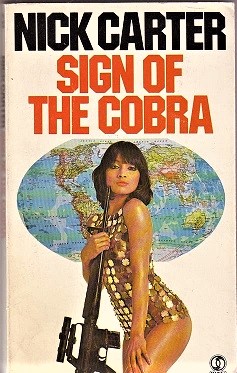
From Nick Carter’s beginnings in 1886 through his final radio show in 1955, Carter would change with the times; from clean-living detective (actually, at the beginning of his career, Nick was a private investigator and consulting detective to the police department, much like Sherlock Holmes, and did not work as a police detective), master of disguise, to anti-espionage agent, to the bane of mad scientists or the defender of scientists beset by crooks, Nick Carter has enjoyed one of the longest surviving, most popular runs in various media for over 100 years, for when his radio show ended in 1955 he would resurface (yet again!) in a series of James Bond-type paperback novels in the 1960s (sample cover top right) which ran into the 1990s, quite a few of them written by women.
“The Substitute Bride” is an engaging episode in that there is not only a single kidnapping to set the stage, but two. A young man is to meet his fiancee arriving on a boat from South America. She has been living with friends for the past three years. However, after the boat has docked and her future husband cannot locate her as prearranged, Nick Carter is hired to find her. The plot wheels begin to turn, but in a most curious manner. Not only has the bride-to-be been kidnapped and her aging (rich) father (who has also come to meet her) being extorted for a large sum of money for the return of his daughter, he has been kidnapped too! So now Nick not only must locate the missing woman and deal with her captors, but learn their motive (the extortion being unknown to him initially) and whether they are acting alone, or are lackeys of some power or powers higher up, but then unravel the puzzle of why her father has been taken, also by whom and for what reason. Has he been taken by a rival group of bad guys working at unknown cross purposes from those who snatched his daughter, or just another group working for the same criminal boss who took his daughter but perhaps got their signals crossed and have kidnapped the wrong person? But again, why? Keystone cops or overly clever puppet master with some ulterior motive? This illogical double kidnapping makes for an interesting episode to say the least, with the final reveal worth hanging around for as only then do we find the reason for “The Substitute Bride.”
(The linked CD at top includes this episode and 15 others on a digitally remastered and restored 8 CD set.)
Play Time: 29:27
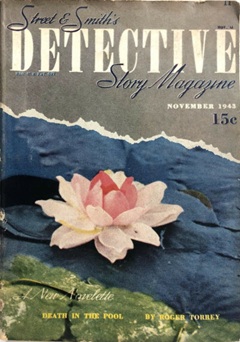
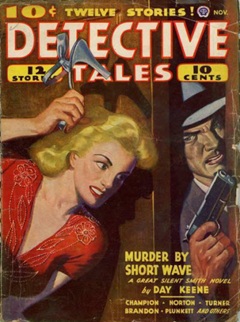
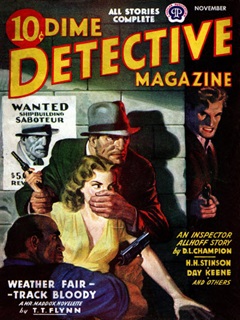
{This episode of Nick Carter aired at 8:30 on a Wednesday evening in mid-November of 1943. Its schedule was hard to keep track of, it changing many times over its 34-year run. As proof, this 8:30-9:00 PM Wednesday schedule would last for but the month of November, at which time it would unceremoniously switch to an earlier Saturday evening time slot. Be that as it may, the neighborhood gang cared not at the moment, knowing only that they would meet at the nearby newsstand after school the next day to pore over some of their favorite detective pulps, a few of which they would happily bring home. Street & Smith’s Detective Story (1915-1953) was the first pulp devoted to detective fiction. Its first issue was a continuation of a dime novel serial featuring Nick Carter of all characters. Detective Story would publish 1,057 issues, roughly half of which were on an unbelievable weekly basis. It was a monthly in 1943. Detective Tales (1935-1953) was a very successful detective pulp from Popular Publications. Publishing for 18 years, it managed a respectable 202 issues. It was a monthly in 1943. Dime Detective (1931-1953) was also published by Popular Publications and was the most successful of its detective pulps. It ran for an even more respectable number of years and issues, racking up 274 before it too called it a day in 1953. It closed as a monthly in 1943. Interesting to note is that all three of these detective pulps shut down their presses in 1953, a bad year for pulps of several genres.}
[Left: Detective Story, 11/43 – Center: Detective Tales, 11/43 – Right: Dime Detective, 11/43]
To view the entire list of weekly Old Time Radio episodes at Tangent Online, click here.