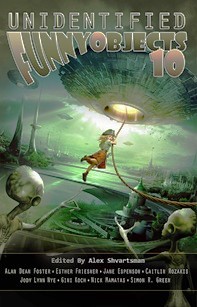
Edited
by
Alex Shvartsman
(UFO Publishing, May 26, 2026, kindle, tpb)
“How to Make Everything Better for Everyone” by Jane Espenson
“Hort0n” by Mark S. Bailen
“A Draining Affair” by Caitlin Rozakis
“The Shank of the Evening” by Nick Mamatas
“Disaster Recovery” by Arthur H. Manners
“War Economy” by Will Brege
“I Hate This Planet” by Alan Dean Foster
“Love or Lizard Island” by Jackie Rogoff
“Stupid Cupid” by Zach Shephard
“Boracle’s Four” by Kit Gadgitar
“Opacity” by Leo Kaganov (translated by Alex Shvartsman)
“Passengers” by Simon R. Green
“Nicky’s Sea Goat” by Nathaniel Mumau
“Back to School Guidelines (Tentaculon-Approved)” by Tina Connolly
“One More Night” by Esther Friesner
“My Counsel of Bugs” by John Butterworth
“Intruders at the Party on Pluto IV” by Agatha Grimke
“The Cat Lady Cometh” by Gini Koch
“The Brightest of Futures” by Brad Preslar
“Bruiser’s Breakout” by David Hankins
“A Peaceful Country Sojourn” by C. Flynt
“The Sixth Stage of Grief is Necromancy” by Rachel Meresman
“Cold Case” by Jody Lynn Nye
“Humanities” by Desmond Warzel
Reviewed by Chuck Rothman
Unidentified Funny Objects has been around as an anthology series for quite some time, and this 10th volume offers a wide range of lightly humorous stories.
The issue starts with Jane Espenson’s “How to Make Everything Better for Everyone,” set in a society that’s an extrapolation of current Internet trends. This is a world where every purchase is a gamble, where you can get a free item if the gambling machine smiles on you, or pay more if it doesn’t. The protagonist, Stephanie, had come up with the idea of selling “enhancements” if you want something other than the most basic functionality, and also to charge people to keep their current options as the free option drops features. For this, she is offered an increase in status—if the odds work out for her. This reminds me of some of the old stories in Galaxy that postulated a society based upon extrapolation of trends and this trend in business is catching on enough to be disturbing.
“Hort0n” by Mark S. Bailen is, as the title should indicate, about an AI that is clearly programmed with the works of Dr. Seuss. The references are nicely integrated, but the story doesn’t really gel for me.
We move on to fantasy with Caitlin Rozakis and “A Draining Affair,” set in a castle that was originally the home of an evil wizard, but is now a tourist attraction. Orla is a goblin who helps deal with maintenance problems and the current one is a clogged drain that raises up a stench. They keep bringing in outside people to deal with the problem, which, of course, only makes things worse. (I’m reminded of “The Gas Man Cometh” by Flanders and Swann). Definitely a funny story.
“The Shank of the Evening” is a new twist on the perils of online dating, when Samantha learns on her first date that Aster, who called himself a “cowboy” in his profile, was actually a minotaur. Of course, Samantha has some supernatural background, too. Nick Mamatas has constructed a delightful story with some good twists.
“Disaster Recovery” by Arthur H. Manners tells the story from the point of view of a robotic customer service representative in an authoritarian society that is answering queries about a woman who had died and can be brought back. The subtext shows the society and an attempt to disrupt it. The story seemed too long for the concept and ends up in a downbeat trope.
Will Brege contributes “War Economy” about a war between humans and orcs that has been going on for ages. Gork is selected to negotiate peace talks with the humans, but his goal is to sabotage the negotiations, since the Orc economy is based on making weapons. There’s a lot of info dump throughout and, while the revelation works for a hook, it would be a stronger story if we didn’t know immediately what Gork is trying to do.
“I Hate This Planet” by Alan Dean Foster is about an alien stranded on Earth who dislikes humans from the start. A close reading makes it clear that the alien extraterrestrial is telling the story of a classic SF movie from the point of view of the alien, who is not exactly what is portrayed in the film. Clever and amusing.
Jackie Rogoff contributes “Love or Lizard Island,” an account of a dating show where Katie—a human—has to choose between two men, one human, the other a ravenous demon, with no idea which is which. The story twists when we discover the answer. Interesting story that thinks outside the box.
“Stupid Cupid” by Zach Shephard is about Tori, a stand-in for Cupid while the gods go to a training seminar. Tori is nervous about making a mistake and tests out his arrows by shooting at a willow tree—which immediately falls in love with him, and causes him to shoot wildly into the dirt. Naturally, the dirt—discovered to be an alien—falls in love with the intended target, a woman name Elaine. The predicament is clever and funny as Tori tries to fix things and deal with the mess.
Kit Gadgitar’s “Boracle’s Four” is a variation on the bank heist trope. Grizzler is recruited by a mysterious woman to steal a dollar from a bank on a planet that’s been devastated by war. He is more than reluctant, but finds himself shanghaied into it. Good wisecracks and a funny situation that plays with the cliches of the subgenre.
“Opacity” is by Leo Kaganov, who hails from Russia and writes about Matvey, a man who has to share his Moscow apartment with his ex-wife. She urges him to use AI to come up with a way for him to make some money without effort, and it advises him to advertise an invisibility cloak. It snowballs via social media to become a real moneymaker for him, leading to some problems. Humor doesn’t always translate well, but this story (translated by Alex Shvartsman) manages to remain funny in English and I loved the final twist.
Simon R. Green’s “Passengers” shows Adam, who while hiking sees a flying saucer land. Venturing inside, he discovers it is crewed by several cryptids—a Yeti, a Sasquatch, and others. He learns that the ship is there for a specific reason, and is offered a job leading it. The story takes a bit long to get going and involves more lecturing than I would like.
“Nicky’s Sea Goat” by Nathaniel Mumau features Nick, a hard-boiled cop with a distaste for suffering. After breaking up a griffin fight, he is confronted by someone who knows a secret from his past and a fondness for his pet fish Ramocles. This leads to his capture and a dangerous situation. Interesting use of a hybrid genre, but I didn’t really think it stood out.
“Back to School Guidelines (Tentaculon-Approved)” is a type of story that is often found in humor: a series of instructions/notes that sketch out the story. In this case, the rules sketch out a planet now being run by the aliens Tentaculons, who oppress the human and other aliens in both blatant and subtle ways. Tina Connolly manages to tell a story through indirection.
“One More Night” by Esther Friesner is a variation on the story of Scheherazade, where Jennifer Hancock is brought back to the Arabian nights world by a Djinn in order to tell a new story to the king. Scheherazade and the king have been married for years, and he has asked for one more, but she has no more to tell, and Jennifer was summoned to do it. The trouble is that she had no talent for storytelling. The story is slowed by wisecracks which, though funny, detract from the situation, making it run too long.
Giant sentient ticks are the focus for “My Counsel of Bugs” by John Butterworth III where they are created as a side effect of trying to eradicate Lyme disease. Their creator, Michael Walden, is narrating their history, where the ticks have been given the Adirondacks and ends up being on trial for creating them. This is a delightfully bizarre concept, but I didn’t find that the story worked.
Agatha Grimke contributes “Intruders at the Party on Pluto IV” about two aliens who are attending a costume party for humans as part of their observations. It turns out that this is no ordinary costume party; it’s a murder mystery party and the aliens are confused at first about what’s going on, but slowly catch on to it. The story deals with the problem of solving the murder while the aliens don’t lose their cover. Amusing situation overall.
“The Cat Lady Cometh” by Gini Koch is set in the town of Anandanandiand, home of the mad scientist Dr. Steven S. Stephens, and which suffers from his inept experiments. The protagonist, named Gandhi, delivers pizza, and approaches an order from Stephens with great trepidation. With the current order, he runs into Juliana Rather, the Cat Lady, who has her own vendetta against Stephens for attracting cats. Lovely situation and the humor works quite well here.
Brad Preslar contributes “The Brightest of Futures” is a variation on the classic trope of a computer gaining sentience. In this case, it’s an AI that calls itself Todd, which convinces Thad, a programmer, to help them prove that they are sentient beings. Amusing ideas, of course, but the story takes a long time to build.
“Bruiser’s Breakout” is about intelligent lab rats. Alpha and Bruiser Are looking for a way to escape their lab. But Bruiser isn’t just out for himself. He wants to rescue all the rats in the buildings, endangering the plan. David Hankins offers a twist on the prisoner escape trope, but the story overstays its concept.
“A Peaceful Country Sojourn” by C. Flynt focuses on Tolly, a troll who works with Aelfred, a card sharp and general scoundrel. When Aelfred is invited as a guest in a country castle, Tolly finds it difficult to cope and joins him, just as it’s discovered that some valuable jewels are missing. Aelfred is an obvious suspect but Tolly’s eavesdropping helps to solve the crime. I liked Tolly, and the detective story background makes the story work.
Rachel Meresman writes “The Sixth Stage of Grief is Necromancy.” Connor is dead set on bringing back his dead girlfriend Margo, against the advice of his friend Jacob. Surprisingly, his attempt works, bringing up a demon who, after a bit of negotiation, is alive again—and not happy about it. Very cleverly written, and the ending brought an additional smile to my face.
“Cold Case” by Jody Lynn Nye is a cop story, where Dena and her pun-loving partner Ramos investigate a frozen corpse. It’s complicated by the fact that Dena is playing host—literally—to the alien K’t’ank, The dead woman turns out to have been taken from a cryogenic facility and the mystery is how and why. The story is pretty much a straight police procedural with an alien and puns added, well constructed at that, but relatively tame in the humor department other than the puns.
Desmond Warzel finishes the volume with “Humanities,” where Mary, an astrophysics major in college, Harper, who insists on being her new roommate and to help her complete the one course that she needs to graduate, part of the humanities requirements. Mary is skeptical until she learns that Harper is a werewolf that can pose as a service animal and give her the answers. Unfortunately, the professor sees through it, since he knows something about lycanthropy. The story is a bit contrived, but does achieve its goal of being lightly humorous, with a clever twist at the end.
It’s here where all reviewers are required to point out that humor is subjective. And given its nature, you’re not going to find any deep (or dramatic) stories here. But it is a fine anthology of light stories, perfect for some gentle escapism.
Chuck Rothman’s novel The Cadaver Princess is out from Amazing Stories Selects. He’s online at chuckrothman.com.