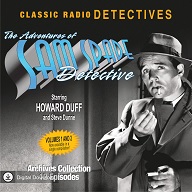
 The Adventures of Sam Spade (1946-1951) aired “The Insomnia Caper” on October 24, 1948 as its 122nd episode of approximately 243, only 74 of which are estimated to be still in circulation (this includes 12 AFRS repeats and 2 rehearsal shows). We have previously aired only eight episodes of this show, the first in 2018, with the eighth just over a year ago in April of 2025. This episode marks only the third since March of 2024. For newcomers, and as a refresher for long time listeners, we reprise the historical notes about the origins of Sam Spade as presented for background to that initial episode, with additional material added on the amazing Lurene Tuttle.
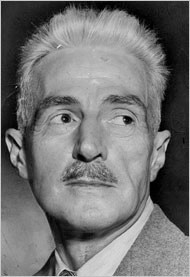
Sam Spade was the private detective and creation of Dashiell Hammett (1894-1961, photo top right). Based on Hammett’s time as a Pinkerton detective from people he knew or had heard about, Spade first appeared in the third of Hammett’s five novels, The Maltese Falcon, in 1930. Only three other stories, all short works, would feature Spade in magazines and all appeared in 1932. One final Spade story was published in 2013, over 50 years after his death in 1961. The Maltese Falcon was brought to film three times: 1931, 1936, and the now film noir classic of 1941 starring Humphrey Bogart, Peter Lorre, Mary Astor, and Sydney Greenstreet.
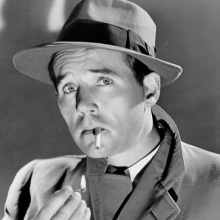 For all but its final radio season Howard Duff (1913-1990, photo at right) would star as Sam Spade and Lurene Tuttle would co-star as Spade’s secretary Effie Perrine. Duff would go on in later years to play various roles in quite a few films, and later with the advent of television would enjoy a lengthy career in many shows as star or character actor (drama and detective primarily) and was an easily recognizable presence on both the silver and small screens. Like Spade’s creator in the late 1940s (pre-HUAC, but Hammett failing to answer a Congressional Committee’s questions under oath stemming from his overt communist dealings), but years later and owing to a different set of circumstances, Duff found himself in the crosshairs of the early 1950s McCarthy-era House Unamerican Activities Committee (HUAC) and was labeled a communist subversive. It was at this point that this soft “blackballing” dovetailed with his burgeoning tv and film career that made it advantageous for him to leave the radio series, at which point Stephen Dunne would take over as the voice of Sam Spade for the series’s final 1950-51 season. According to the writeup by Radio Spirits on their 2014 calendar, on which Duff has the November slot: “A lot of talent came out of the Armed Forces Radio Service at the conclusion of the Second World War. One of the most outstanding examples was an energetic young sergeant named Howard Duff, born on November 24, 1913. A staff announcer for many AFRS features during the war, he was ready for the big time as soon as he doffed the uniform. It didn’t take long for him to land the role of a lifetime, bringing Dashiell Hammett’s legendary private eye Sam Spade to the microphone. In his four years in the role, Duff did the impossible–he replaced Humphrey Bogart’s film version as the definitive embodiment of the Hammett character: tough, yet vulnerable; hardboiled, yet with a sense of humor about his weekly predicaments. Among the legions of postwar radio detectives, Duff’s Spade stood out as one of the few truly originals.”
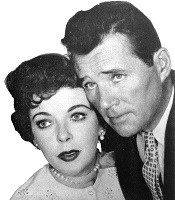 Duff would marry one of the most respected and groundbreaking women actors and directors in film history in 1951, Ida Lupino (1918-1995, Lupino & Duff photo at right). The two would star together in several films throughout the 1950s. As to Duff’s film and television appearances, they are too numerous to mention all of them here, though a sampling may recall him to many a fan of the films and TV shows in which he appeared: Films–The Naked City (1948), While the City Sleeps (1956, with Ida Lupino), and Kramer vs. Kramer (1979); Television–The Rockford Files, The Golden Girls, Knots Landing, Dallas, as “Capt.” Thomas Magnum, II–grandfather of Thomas Magnum starring Tom Selleck on Magnum, P.I. His SF genre credits include an episode of The Twilight Zone and Batman (“The Entrancing Dr. Cassandra” with Ida Lupino).
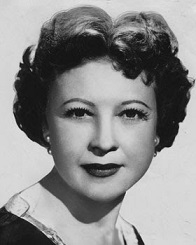
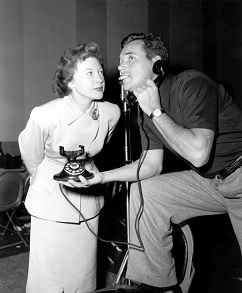 Lurene Tuttle (1907-1986) was known as “The First Lady of Radio,” sometimes appearing in 15 different shows a week. Dragnet, The Whistler, Lux Radio Theater, Suspense, and The Great Gildersleeve were but a scant few of the many shows she would appear in over the years. One of her most memorable roles was as Sam Spade’s secretary Effie Perrine. She also played virtually every other female character on the show as well, a tribute to her immense talent and versatility. She transitioned from vaudeville to radio, and from radio to film and television, appearing in some 50 films (credited and uncredited), and dozens and dozens of television programs, a few of which were Leave it to Beaver, The Andy Griffith Show, Fantasy Island, Dennis the Menace, Little House on the Prairie, Bonanza, Gunsmoke, and I Dream of Jeannie. Lurene Tuttle was honored with two stars on the Hollywood Walk of Fame, one for radio and one for television. She died of cancer on May 28, 1986 in a hospital in Encino, California. Long time Sam Spade co-star Howard Duff delivered her eulogy.
“The Insomnia Caper” begins with Sam unable to sleep, tossing and turning before finally beginning to drift off when one incident after another denies him his much needed rest and he is wide awake again. This time, standing before an open window to catch some air, he notices, in the apartment building directly across from his and on the same floor, a woman being slapped around by a man who looks like a sailor. A while later Sam answers a knock on his apartment door to find the very same woman he saw across the way. She knows of him the same way he was able to spot her, she occasionally sees him walking to and fro in his apartment through his unshaded window. The story she tells him seems like nothing much out of the ordinary, domestic violence not much of a case for a hardened private eye to sink his teeth into. But the woman’s story begins to take on an unusual aspect that gets Sam’s attention, and of course the chase is afoot, leading Sam to a most unusual adventure, one involving an intricately fashioned model sailing ship that makes Sam’s chances of catching up on his much-needed sleep quite impossible, cementing the title of this case appropriately as “The Insomnia Caper.”
(The linked CD at top includes this episode and 11 more, all remastered and restored.)
Play Time: 25:07
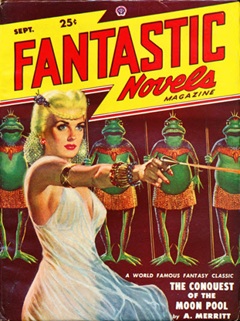
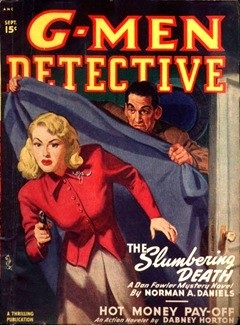
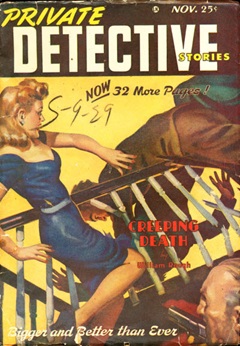
{“The Insomnia Caper” aired on a Sunday evening in late September of 1948. School had started again a few weeks earlier and the neighborhood gang had resigned themselves to their new routine. That said, another routine they were happy to continue was meeting after school at the corner newsstand to pore over the shelves and racks for their favorite SF/F and detective pulps. Fantastic Novels (1940-51) was created to fill a niche. It spotlighted scientific and fantastic classics from the time before there were any science fiction (except for Weird Tales) fantasy or horror magazines. The astute editor, Mary Gnaedinger, found and reprinted some of the best of the early classics, including but not limited to authors like A. Merritt, Ray Cummings, George Allan England, and C. L. Moore & Henry Kuttner, albeit leaning heavily on the absolutely timeless novels of Merritt. It was a bi-monthly in 1948 but managed only 5 issues. G-Men Detective (1935-53) is remembered as the most popular of the magazines running federal agent crime fiction. By 1940 interest had waned and the stories shifted focus to more mainstream detective adventures and ran successfully for another 59 issues. It was a bi-monthly in 1948. Private Detective Stories (1937-50) appeared a few years after the advent of the “Spicy” pulps, those magazines featuring warped criminals as protagonists. The Spicy Detective pulp offered their degenerate protagonists exploits laced with sex to keep readers’ turning pages. It was said that Private Detective was a “lite” version, running slightly less lurid covers and tamping down (slightly) the psychopathological aspects of its main characters. It ran for 134 issues and was a quarterly in 1948.}
[Left: Fantastic Novels, 9/48 – Center: G-Men Detective, 9/48 – Right: Private Detective, 11/48]
To view the entire list of Old Time Radio episodes at Tangent Online, click here.