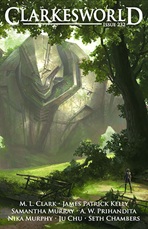
 Clarkesworld #232, January 2026
“The Stars You Can’t See by Looking Directly” by Samantha Murray
“Donor Unknown” by Nika Murphy
“Tomorrow’s Beautiful Dream” by Ju Chu
“Space is Deep” by Seth Chambers
“Down We Go Gently” by M. L. Clark
“Je Ne Regrette Rien” by James Patrick Kelly
“The Desolate Order of the Head in the Water” by A. W. Prihandita
Reviewed by Victoria Silverwolf
In “The Stars You Can’t See by Looking Directly” by Samantha Murray, a substance resembling snow falls everywhere on Earth. All children conceived after this event differ genetically from other people.
This premise makes the story sound like it will concentrate on the children, as in John Wyndham’s 1957 novel The Midwich Cuckoos. In fact, we never see the children, and all we learn about them is that their DNA contains more than four bases. Instead, the plot mostly deals with a woman who conceived after the event after struggling with infertility; her husband, who interprets the event as an alien invasion; and his sister, who conceived before the event.
The story ends before either woman gives birth. Flashbacks portray the courtship of wife and husband. As a character study, this is effective, but readers may wish to learn more about the children. The use of second person narration (you are addressed as the pregnant wife) adds little and runs the risk of seeming affected.
The protagonist of “Donor Unknown” by Nika Murphy is an android who wears the face of a former human owner in public, as required by law or custom. It also speaks in her voice and has her memories in its mind. Although it normally works as a matchmaker, it accepts an assignment to track down a lost painting. The quest involves encounters with anti-android bigots and the relationship between the woman in its mind and the woman who hired it.
This is an overly simplified synopsis of a complicated, if fairly short, novelette. There are also flashbacks to the creator of the android, who gave it the forbidden ability to harm humans. The story contains many allusions to Judaism. The android is called a golem by its creator, the bigots are called Nazis, and the history of the lost painting involves its Jewish owners fleeing the Nazi regime. This gives an unusual flavor to a work that combines science fiction with a detective story.
I found the exact nature of the android’s connection to the woman whose face it wears unclear. I also had to question the motives of the woman who hires it. She conceals vital information from it for reasons I thought were unconvincing. As a minor quibble, I saw no reason why the setting had to be a space station instead of a future Earth.
“Tomorrow’s Beautiful Dream” by Ju Chu is translated from Chinese by Carmen Yiling Yan. The main character is one of many poorly pair laborers who perform mindless tasks while an implant puts them in a trance-like state. This allows them to work stressful jobs for several hours at a time, paying the price later when they come out of their trances.
The protagonist accepts a job from a mysterious company that pays him a much higher wage for the same kind of repetitious chores. He discovers the company’s hidden motive.
The author portrays the desperation of lower-class workers in a powerful manner. The secret agenda of the company is frighteningly plausible, as is the protagonist’s inevitable acceptance of it.
In “Space is Deep” by Seth Chambers, a man and his two wives accept a job on a space station after their house burns down. If they remain in space too long, returning to Earth’s gravity would be fatal. The man faces the dilemma of either going home or marrying a third woman who cannot go back to Earth.
I have not mentioned the story’s strangest element. The man’s feet have changed in some undescribed, mysterious way. In combination with an ending that suddenly becomes mystical, this is likely to be bewildering in an otherwise realistic work.
“Down We Go Gently” by M. L. Clark features a father and son who leave the starship on which they live and land on a colony planet for trade purposes. The boy has never been on a planet, and the story mostly deals with his reaction to a way of life he never imagined.
There is not much of a plot, other than the boy’s change in attitude toward the only world he has ever known. The work is best appreciated as a coming-of-age story or as a slice of futuristic life.
“Je Ne Regrette Rien” by James Patrick Kelly is a lengthy novelette, almost a short novella. A couple of centuries from now, a professor of robotics is invited to pay a visit to a Chinese company to study its most recent development. These are androids that are made to look like humans as closely as possible. They also have advanced artificial intelligence and show signs of experiencing something like human emotions. The professor eventually learns something about the androids that not even the company knows.
The above synopsis may suggest a melodramatic revelation, but this is a calm, leisurely tale, with a climax that is more implicit than spelled out. The author has a very readable style, and the portrait of future China is vivid and plausible. The characters are believably complex. The way that the androids are close to human, but not quite the same, is convincing. The story’s last sentence, spoken by a little girl, offers much food for thought in a subtle way.
In “The Desolate Order of the Head in the Water” by A. W. Prihandita, an artificial intelligence kills about half of the people who are connected to it by implants. Its motive is to preserve the water it needs to cool its supercomputing systems. A married couple and their young son escape the apocalypse by living off the land in the wilderness. When both of his parents disappear, the boy makes his way back to the city, to find that the AI is now worshipped as a god.
The theme of a computer deity is hardly a new one. This example is notable mostly for the bizarre form the AI takes. As the title suggests, it presents itself as a giant head in a pool of water. This is a striking image, although I don’t know why the AI would take on this shape. It may not be giving away too much to note that the situation offers the young protagonist little in the way of hope.
Victoria Silverwolf saw some turkeys near her house this morning.