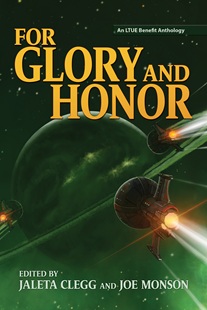
 For Glory and Honor
Edited by
Jaleta Clegg & Joe Monson
(Hemelein Publications, February 2026, pb, 298 pp.)
“Entrapped by Freedom” by Michelle J. Diaz
“Merry-Go-Round” by Liam Hogan (reprint, not reviewed)
“Galactic Service: Stuck on a Milk Run” by Kate Dane
“H.A.R.R.E.: Heuristic Algorithm and Reasoning Response Engine” by Brandon Sanderson and Ethan Skarstedt (reprint, not reviewed)
“To Catch a Foo Fighter” by David Hankins (reprint, not reviewed)
“The Army Ration That Saved the Earth” by Candice R. Lisle
“Maintenance Mode” by John M. Olsen (reprint, not reviewed)
“When the Sleeping Soldier Wakes” by Jacob Pérez
“Orbweaver” by Liz Silverthorne
“Beloved of the Electric Valkyrie” by Scott R. Parkin (reprint, not reviewed)
“The Oysters of Pinctada” by Larry Hodges (reprint, not reviewed)
“Spirit of the Vanguard” by Jenny Perry Carr
“The Flight of Captain Kowalski” by K. Z. Richards
“Jaguar’s Ghost” by Devin Miller
“The Battle of Donasi” by Elaine Midcoh (reprint, not reviewed)
“Tower Farm” by Vonnie Winslow Crist (reprint, not reviewed)
“Hardship Posting” by Ben Beckstrom
“Lagrange Contact” by Joe Monson
Reviewed by Victoria Silverwolf
This is the eighth in a series of anthologies raising money to give students discounted admission to the “Life, the Universe, and Everything” science fiction and fantasy symposium, held annually in Utah since 1983. It is dedicated to the memory of Caroljean Hansen, a librarian and supporter of the symposium who also worked with literacy and animal welfare organizations. The authors have donated all royalties for original and reprinted fiction. The book’s theme is military science fiction, said to be a favorite of the dedicatee.
The narrator of “Entrapped by Freedom” by Michelle J. Diaz is a soldier trying to escape from a war-ravaged planet accompanied by a little girl. Although they manage to get aboard a rescue vessel, the child is soon kidnapped. The narrator undertakes a dangerous mission to save her while dealing with a dysfunctional brain implant that causes loss of memory.
The situation leads to an action-packed story with plenty of suspense. The narrator’s failing memory is the most original and interesting aspect of the plot. I never quite understood why the girl was kidnapped. During the rescue mission a forest fire breaks out that helps the narrator. This seems too convenient to be fully believable.
The protagonist of “Galactic Service: Stuck on a Milk Run” by Kate Dane is the new first officer on a starship. The captain assigns him to what seems like busy work, checking all the ship’s systems. This turns out to be of vital importance. A crisis forces him to cut off part of the ship, including the captain. He has to figure out how to open a door to which only the captain has access, without being able to communicate with her.
The characters have interesting backgrounds. The first officer is trying to make up for the actions of his father, a starship captain who made a decision that doomed part of his crew. The captain seems like a martinet at first but proves to have the good of her crew at heart. The puzzle of how to open a seemingly impregnable door is contrived and has an anticlimactic solution.
In “The Army Ration That Saved the Earth” by Candice R. Lisle aliens attack Earth in order to take the planet’s trees away for their own use. An army private is taken aboard an alien spacecraft. As the title suggests, the solution to Earth’s crisis comes from an unexpected source.
The mood is light, although the story is not openly comic. The way in which the conflict between humans and aliens comes to an end could have happened before the story begins. (It may be too much of me to expect any sentient species to act in a rational manner.)
“When the Sleeping Soldier Wakes” by Jacob Pérez takes place on a planet where invading humans forced the indigenous aliens to retreat to a few islands. Centuries later three humans are found dead and two are missing. An expert on the extraterrestrial culture and an enhanced soldier, revived after generations in suspended animation, go to the alien enclave in an attempt to rescue the missing humans and, if possible, prevent open warfare.
The situation is obviously analogous to colonialism, but the author avoids a simplistic metaphor. Both the humans and the aliens are fully developed characters, with the desire for peace conflicting with aggression in both societies. The two main human characters are a mismatched pair at first, but they eventually learn to respect each other, both having experienced similar tragedies.
In “Orbweaver” by Liz Silverthorne a team of human officers raid an alien facility where human children are drained of a substance that is transformed into an addictive drug. The main human character learns that a large number of children are imprisoned elsewhere. With the help of an alien, he takes part in a rescue mission.
I have greatly oversimplified a lengthy, complex story that is often difficult to follow. The aliens are sometimes very human and sometimes very much like spiders. In contrast, the humans often have enhancements that make them seem like aliens. What exactly is being drained from the children is unclear, and the nature of the enhancements is equally opaque. I cannot fault the author for a lack of imagination, but I could wish for more clarity.
“Spirit of the Vanguard” by Jenny Perry Carr features human soldiers retreating from a disastrous battle with aliens. The main character and his badly wounded buddy rescue another injured soldier and encounter a wounded alien.
The author creates a realistic portrait of heroism and the horrors of war. The story ends with a twist, that readers may appreciate as appropriate or see as something of a gimmick.
“The Flight of Captain Kowalski” by K. Z. Richards takes place aboard a space station orbiting Earth that serves as a facility for disabled veterans. An unexpected threat to the station causes an elderly spaceship captain suffering from dementia and other illnesses to perform heroic actions.
The plot is inspiring, and the reader is sure to cheer on the old soldier as he undertakes a final mission. It may be churlish to note that it is hard to believe that a character with serious mental disability could rise to the occasion so efficiently, given that he confuses past and present.
In “Jaguar’s Ghost” by Devin Miller we find another soldier trying to escape the scene of a disastrous battle. In this case, the scene of the devastation is an occupied moon of an occupied planet. The rulers of the planet attacked rebels on the moon and filled it with semi-organic machines that devour everything in their path. The soldier rescues the daughter of a politician from rebels. Together they have to survive both the vengeful rebels and the deadly machines in order to make their way to the place that offers an escape route.
This is a moody, action-packed tale, almost grimdark in tone. The machines, incorporating both inanimate objects and living things into their bodies as they attack, are the most original and interesting concept. In other ways, this is a familiar tale of conflict and pursuit.
In “Hardship Posting” by Ben Beckstrom two aliens representing opposing forces both seek sanctuary at a human embassy. It seems likely that one will attempt to kill the other, so the human ambassador figures out a way to deal with the situation.
This is a relatively short work with a simple, straightforward plot. It begins and ends with scenes featuring two human guards outside the embassy. These add little to the story.
In “Lagrange Contact” by Joe Monson an astronaut telepathically communicates with beings that have inhabited Earth and the rest of the solar system for millennia. They bring humanity into contact with other aliens, who offer help when the astronaut’s spacecraft is attacked.
This is a science fiction story with the flavor of fantasy. The telepathic aliens are said to have been responsible for legends of dragons, and the others are described as elf-like. There is no explanation for why the spaceship is attacked. Those responsible are vague, generic bad guys. The story reads as if it were intended for young adults.
Overall, the anthology offers a reasonably enjoyable mixture of military science fiction and space opera. If the scenes of battle are inevitably similar, the characters and backgrounds offer some variety.
Victoria Silverwolf has never served in the military.