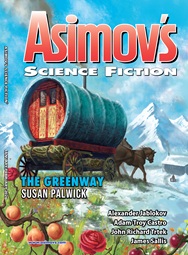
 Asimov’s, January/February 2026
“The Greenway” by Susan Palwick
“Ecobomb” by Alexander Jablokov
“The Man with the Ruined Hand” by Sean Monaghan
“Stay” by William Preston
“Replacement Theory” by Jack Skillingstead
“The Tourist” by R.T. Ester
“The Imaginative Youngster’s Handbook to UFOs” by Will Ludwigsen
“All My Birds” by K.A. Teryna
“The Moribund” by Lavie Tidhar
“As Long As We’re Still Here, We Might As Well Dance” by Adam-Troy Castro
“And We Shall Find Rest” by James Sallis
“The Lady in Camo” by John Richard Trtek
Reviewed by Mina
“The Greenway” by Susan Palwick is an odd story, but it grows on you. The narrator is alone with her two children when the caravan comes bringing the “greenway” with it. We learn that all people eventually begin to sprout plants (a new meaning for “gone to seed”), which slowly kills them. But the sprouting bodies bring a new fertility that is spread every spring by the caravan. The bitter-sweet ending stays with you.
“Ecobomb” by Alexander Jablokov is an invasion story that doesn’t take itself too seriously. The aliens are truly alien, sending “ecobombs” to change the ecosystems on the planet they are invading. But the humans on the Earth adapt to the changes and start working with the new flora and fauna to create hybrids. They create biocomputers and, through cooperation, they not only survive but are ready when the alien invaders arrive. The story grows on you like an unpleasant fungus.
“The Man with the Ruined Hand” by Sean Monaghan starts with a heist in the middle of a desert of a distant planet. Cliff is sent to catch the thief but finds himself in the middle of a double cross. It feels like the author wanted to create a Philip Marlowe vibe, but Raymond Chandler did it better.
By the end of “Stay” by William Preston, the title has taken on at least four meanings — not bad for one word! A dying man tries to create a mechanical replica of himself to keep his dog company after his death. His estranged sister is reluctantly drawn in when it becomes clear that the dog does not accept the mechanical replica. It’s a competently executed idea but it’s impossible to connect emotionally with the characters, which is a big drawback for the reader.
In “Replacement Theory” by Jack Skillingstead, Tyler suddenly starts seeing everyone around him as monsters, including his girlfriend Emma. Does he have a brain defect or is he surrounded by aliens? Then he meets someone else with the same problem. But who can he trust?
In “The Tourist” by R.T. Ester, people can take a trip back to the past to engage in anything they want, including murder, mayhem and debauchery. Or to change something in the past, so that their future will never have existed. With enough money, they can return to a different possible “splinter” of the future. But what if a tourist comes through without the money for the return journey? There are a couple of clever twists in this tale, but I must admit I never warmed to it. Who needs a story to believe that some people care about nothing but their own self-aggrandisement? However, as we live in a world overrun by acronyms, I did enjoy “TPS” (temporal positioning system).
“The Imaginative Youngster’s Handbook to UFOs” by Will Ludwigsen is one of those short stories I really like — a wonderful surprise. What starts off reading like a book for intelligent and imaginative youngsters slowly gains an emotional depth that is truly heart-rending. We begin to care very much about one particular child, who experiences abuse and bullying in their daily life, yet who manages to keep wonder alive inside themselves despite their loneliness. There is gentle humour and questioning of things adults hold to be self-evident but, mostly, there is compassion and a desire not to be a person who hurts others just because you have been hurt yourself. What’s particularly well done is the mix of a child’s logic with adult understanding. I would read this more than twice!
“All My Birds” by K.A. Teryna is an intriguing look at getting over grief. The grieving protagonist is sent to an ornithologist by her doctor, convinced there must be some mistake. Then she begins to vomit live birds. There’s a gentle humour and the acknowledgment that not much in life makes sense. In the end, the only thing that helps with grief is when you can look at it in your rearview mirror as you move forward. Delightful whimsy but never superficial.
“The Moribund” by Lavie Tidhar is very well done but depressing — like proof that if someone is willing to pay for it, it will be made available. Add some side comments on addiction and power, and it’s really grim. A woman pays to experience the dying moments of a man, only to realise that she was an instrumental if unwitting part of his corruption. Can I have a whisky on the rocks now?
“As Long As We’re Still Here, We Might As Well Dance” by Adam-Troy Castro continues our descent into grimness. We watch the last moments of two people who did not flee when the Nihilators arrived to destroy and “repurpose” their city, including anyone left alive in it. We see love and defiance, and an unwillingness to die. The real tragedy is that both protagonists stayed because each in their own way believed they deserved to be damned.
The introduction to “And We Shall Find Rest” by James Sallis tells us it’s trying to capture the feeling of “saudade.” The protagonist co-owns a store that literally sells nostalgia in the form of vintage toys. People are falling dead everywhere for an unexplained reason; this was for me the weakness in the story — it would only take a couple of lines to hint at some reason. The best bit was the protagonist’s conversation with their (life) partner, Carl. And some black humour with bodies and the novel use for the word “retriever.”
“The Lady in Camo” by John Richard Trtek is a detective story with references to Blade Runner, Chandler, and Sherlock Holmes. Jack Twice is hired to find a missing person. It’s a world filled with clones, soft deaths and partial resurrections. I wanted to like this story but just couldn’t fully engage with it. The last few lines are good, making you wish the rest of the story had lived up to them.