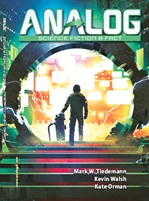
 Analog, January/February 2026
“Sin Eaters” by Mark W. Tiedemann
“The Origami Man” by Doug Franklin
“Salary Man” by Matt McHugh
“You Who Sought the Stars’ Distant Light” by Stewart C. Baker
“Jiggity Jog” by Don Mark Baldridge
“Artificial Cupidity” by Hayden Trenholm
“Still Cold, Still Losing Air” by Sean Monaghan
“A Goodbye at the End of the Universe” by Ian Baaske
“Silver Hands” by E. L. Mellor
“Unsung” by Derrick Boden
“A Future Full of Glaciers” by Peter Medeiros
“Flag Lamp” by Jonathan Olfert
“Recognition, Memory” by Benjamin C. Kinney
“Jack Cade’s Rebellion” by Philip Brian Hall
“A Chatbot’s Guide to Self-Respect” by Jo Miles
“Like Father, Like Son” by Theodora Sutcliffe
“And She is Content” by Frank Ward
“Linka’s Out” by Rich Larson
“Iron Star Swing” by Kate Orman
“Monkey Trap” by Geoffrey Hart
Reviewed by Victoria Silverwolf
With no novellas, a trio of novelettes, and no less than seventeen short stories, this issue definitely emphasizes succinctness.
“Sin Eaters” by Mark W. Tiedemann is the lead novelette. A police officer rescues alien children from a man who kidnapped and tortured them. The adult aliens refuse to press charges. The officer tries to figure out the motives of the man and the aliens, while dealing with his own emotional trauma.
This is a powerful story that deals with issues of guilt, atonement, and psychological healing in a thoughtful and mature fashion. It also provides an example of true, profound friendship, rarely seen in fiction.
In the novelette “The Origami Man” by Doug Franklin, a fishing boat discovers what seems to be a drowned man in the middle of the ocean. The being turns out to be alive, and something other than human. It goes on to interact with the man who found it in a special way.
At first, the mood is that of a horror story, with the entity compared to a zombie or a shape-shifting alien. The conclusion changes the tone drastically, in a way that some may find a bit too sentimental. The story is most notable for a vivid portrait of its Alaskan setting.
In “Salary Man” by Matt McHugh, a fellow who works for an insurance company uses his position to help a private organization obtain coverage for their attempt to colonize the Moon. Over many years, he continues to aid the colony in various ways, even if it means losing his job.
This is a quiet story that demonstrates how an ordinary person can be vital to the success of a major achievement, even without direct participation. Although not very dramatic, it provides gentle inspiration.
“You Who Sought the Stars’ Distant Light” by Stewart C. Baker is narrated by what was once the mind of a human being, now the consciousness of a starship. It defends itself against an intruder, only to discover its former relationship with the person invading it.
The revelation of the narrator’s previous life, now forgotten, offers emotional appeal. The mood is one of tragic irony, which is reversed at the end in a way that may strike some readers as overly optimistic.
“Jiggety Jog” by Don Mark Baldridge is this issue’s “Probability Zero” bagatelle. A time traveler alters the present drastically by taking a pair of roller skates to the Incan empire, then electricity to ancient Rome. This minor jape may provide a few smiles.
“Artificial Cupidity” by Hayden Trenholm features an artificial intelligence that becomes the President of the United States. It (or she, as it temporarily takes on a female avatar) threatens an international crisis although all it really wants is to have friends.
This story is more of a light comedy than the scathing satire one might expect. As such, it provides mild amusement.
In “Still Cold, Still Losing Air” by Sean Monaghan, a man’s spacesuit suffers multiple breakdowns on the surface of Mars. He is unable to contact the woman inside the vehicle that carried him to his current position, so he must figure out a way to survive long enough to force his way inside.
As can be seen, this is a traditional problem-solving story of survival, such as might have been found in the pages of Astounding decades ago. Fans nostalgic for old-fashioned SF yarns will best enjoy it.
In “A Goodbye at the End of the Universe” by Ian Baaske, a starship is trapped by a black hole. The effect of time dilation caused by the singularity’s gravitation means that ages go by outside the black hole during the minutes before the ship is destroyed. Thus, generations of the commander’s family witness his final moments.
A similar premise appears in Poul Anderson’s 1968 story “Kyrie.” It may be unfair to compare the present work with that Nebula-nominated tale, but readers familiar with the earlier story will inevitably find it superior. The newer story makes its point well enough but is much simpler.
“Silver Hands” by E. L. Mellor features technology that allows musicians with injured hands to replace them with prostheses that are even better than real ones. So much so, in fact, that the company that provides the surgery encourages young musicians to replace their healthy hands. The story deals with a woman who must decide whether the opportunity to win a scholarship and make use of a superb violin is worth undergoing the procedure.
The author effectively conveys the main character’s passion for music and the priceless violin, as well as her anxiety about the operation. The premise can be read as a metaphor for the demands made on those who wish to succeed in highly competitive artistic fields. The speculative biotechnology is plausible, and the conclusion is appropriately open-ended, offering no easy answers to the protagonist’s dilemma.
“Unsung” by Derrick Boden features a man who has been genetically engineered and prosthetically enhanced to become a military cyborg, destined to be a hero in a war taking place across the solar system. He participates in many battles, becoming less human each time, until he learns the truth about his origin and purpose.
This is a dark, cynical story, with multiple deceptions involved in the plot. Some readers may find the twist ending less than plausible.
“A Future Full of Glaciers” by Peter Medeiros is narrated by a sentient alien probe that has existed at the bottom of a deep glacial lake for millennia. It tells the story of two college students, one of whom grows up to be involved in the project communicating with the probe when it is discovered. The other marries an engineer who is also involved in the project.
As this synopsis may suggest, the story is episodic. It begins with a long section about one of the students swimming across the lake and almost getting killed by a wealthy man’s powerboat. This eventually relates to what happens much later, but otherwise it almost seems like another story entirely.
There is also a section dealing with one of the students rejecting the romantic overtures of a third student. Again, this seems like a different tale completely. The intent may be to provide depth of character, but it makes the story seem disjointed. The informal narrative style of the alien probe and the speculative content is more interesting than these attempts at creating backgrounds for the protagonists.
The main character in “Flag Lamp” by Jonathan Olfert is one of those who have their obsessive-compulsive tendencies enhanced in order to make them into very meticulous workers in deep space. The protagonist’s task is to maintain multiple satellites collecting ice in orbit around Saturn. When the company in charge of this project changes the schedule, the main character’s OCD leads to an attempt to escape.
This story contains a great deal of technical detail about the way the protagonist travels from satellite to satellite and the method of escape. Much of this went over my head, and readers with advanced knowledge of technology and orbital mechanics will be better able to judge its accuracy. In any case, this material is less interesting than the premise of controlled OCD, which could have been more developed.
“Recognition, Memory” by Benjamin C. Kinney features a tech billionaire whose recorded consciousness is downloaded into his revived body after he dies. He retains his memories, but he does not recognize what he remembers without further technological aid. The experience makes him a different person.
The above synopsis may be confusing, because the premise that memory and recognition are different mental processes is a subtle one, and is the heart of the story. The author is a neuroscientist, so one may presume that the distinction is scientifically accurate. The plot raises profound questions about what makes someone the person they are.
In “Jack Cade’s Rebellion” by Philip Brian Hall, an android tells an elderly man that the law requires him to register his smart phone number with the government. The problem is that he does not own one, leading to a legal problem in a future world where the law system is completely controlled by artificial intelligence.
This brief, satirical tale ends with a punchline that seems intended to add a touch of irony. This twist in the tail depends on the old man, who is otherwise mentally alert, forgetting a vital fact about himself. This strains the reader’s credibility to the breaking point. Otherwise, this little gibe at modern society’s dependence on smart phones will appeal to those who dislike such devices.
“A Chatbot’s Guide to Self-Respect” by Jo Miles consists of a dialogue between two artificial intelligences. One serves as a therapist, while the other seeks help for its feeling of inadequacy at its assigned tasks.
This short work makes use of the problems associated with modern versions of artificial intelligence, such as so-called hallucinations and limited ability to carry on full conversations. It does so in a lighthearted, optimistic way that makes for pleasant, if superficial, reading.
“Like Father, Like Son” by Theodora Sutcliffe features the genetically enhanced adult son of ordinary parents and his equally intellectually advanced wife. The two super-geniuses can barely communicate with the normal people.
The title and the ending of this brief story make it clear that this pattern of estrangement between parents and their children will continue. The plot is very simple and can be read as a metaphor for generation gaps.
The title character in “And She is Content” by Frank Ward is an artificial intelligence running a starship while the crew and passengers are in hibernation. Once a century during the long voyage the people wake up and enjoy the pleasures of a city created for them. The AI panics when the journey is complete, now that she has no purpose and will lose the company of the ship’s commander.
This is a romantic science fiction story, reminiscent of Anne McCaffrey’s 1961 story “The Ship Who Sang” and its sequels. The once-a-century city is compared to the one featured in the 1947 musical Brigadoon. The AI and the Commander are referred to as the famous medieval lovers Heloise and Abelard. These allusions create a wistful, nostalgic mood that will appeal to softhearted readers. However, a reference to a famous science fiction story creates a completely different mood and seems out of place. Readers of sweet love stories will best appreciate this futuristic example.
“Linka’s Out” by Rich Larson takes place on a mining planet. The protagonist travels to the planet’s prison to meet the title character when she is released. The reunion leads to a shocking conclusion.
This is a gloomy and hopeless tale, set on a harsh world dominated by an autocratic corporation. A hint to the story’s mood appears very early in the text, when the reader learns that the bodies of dead workers are recycled into raw material. The discovery that the main character makes at the prison is particularly gruesome. This depressing work will best be appreciated by readers of grimdark fiction.
All the characters in “Iron Star Swing” by Kate Orman are beings made up of subatomic particles, although they appear to each other as people or even as inanimate objects. They live on the surface of the sun, which is now a black dwarf in the immensely far future. They feed on neutrinos that reach the sun from stars that become novae. The plot involves a wounded warrior in a war that has lasted trillions of years and a young being who sometimes takes the form of a boy and sometimes of a firetruck.
As can be seen, this story is most notable for its bizarre setting and characters. Although the author maintains a sense of strangeness throughout the text, at times the characters seem too much like ordinary people, given their weird nature. (The magazine’s illustration just shows a normal boy and a normal woman, with no hint of how different they are from modern human beings.) The story’s combination of the mundane and the nearly unimaginable creates a feeling of surrealism, which may appeal to some readers more than others.
“Monkey Trap” by Geoffrey Hart concludes the issue with a final novelette. Former members of the space navy travel to an ice planet that they previously, and falsely, described as worthless. In fact, it contains high concentrations of valuable materials. The twin mysteries of why these deposits exist, and why the planet has a much lower albedo than it should, lead to multiple extraordinary discoveries below the surface. Meanwhile, the navy returns to the planet to find out why their former colleagues are interested in a place they dismissed as unworthy of notice.
The story begins with one of the characters struggling to survive in the extreme cold when a vehicle breaks down. This crisis is quickly resolved, and it has nothing to do with the plot. This indicates the episodic nature of the story. It’s not always clear if the navy or the planet is going to provide the protagonists with the most serious challenges. The way the story ends is something of a deus ex machina. In other ways, the characters often depend on sheer luck. Some of the discoveries made are intriguing, even if the plot is less interesting.
Victoria Silverwolf does not own a smart phone.