
Suspense is compounded of mystery and suspicion and dangerous adventure. In this series are tales calculated to intrigue you, to stir your nerves, to offer you a precarious situation and then withhold the solution… until the last possible moment when we again hope to keep you in…Suspense!
Suspense (1942-1962) aired “The Dark Tower” on May 4, 1944 as the 90th of its 945 episodes.
As recounted in the introduction to the just shy of 60 episodes of Suspense we’ve shared over the past seventeen years, it was such a rich goldmine of superior stories that we found each one has had something unique to offer. Suspense was one of the most well produced, written, acted, and critically acclaimed of all radio shows during the Golden Age of Radio, many a film star jumping at the chance to perform in an episode, among them Cary Grant, Orson Welles, Jimmy Stewart, Susan Hayward, Vincent Price, Charles Laughton, Loretta Young, Peter Lorre, and Rita Hayworth. After many another radio show had gasped its last breath during the 1950s, Suspense (along with Yours Truly, Johnny Dollar) finally closed shop in September of 1962 whereupon radio historians proclaimed the Golden Age of Radio dead, television having become the medium of choice in America.
“The Dark Tower” turns out to be an entertaining but decidedly odd duck. It stars Orson Welles (1915-1985) as Damon Wellington, a prominent member of a theatrical family who owns the rights to a play called The Dark Tower. Their family, like many another in show business, is of a decidedly dysfunctional nature, prone to backbiting, highly sensitive egos, and ripe with what they consider to be witty putdowns against one another and the Hollywood scene in general. One of my favorite bits is when someone suggests that quitting drinking would make Damon less of a ham actor. To which he replies that if he were then forced to survive only on food he would in due time approach the ponderous bulk of Orson Welles, and that wouldn’t do. It’s all great fun with these insider jokes (though the barbed wit is serious at times), and when Damon’s emotionally fragile sister’s husband (a psychoanalyst she met on a visit to Hollywood) is murdered, the strain became too much for her and she has been in a sanitarium for the past two years recovering. If this sounds like the elements of a prime time soap opera, it is. Especially so when Jessica is released from the sanitarium, is rehearsing for her role in a new performance of The Dark Tower, and her presumed deceased psychoanalyst husband Stanley appears out of nowhere. His sudden and shocking appearance upsets the already precarious family dynamic, mainly because everyone except Jessica hates him. Stanley then convinces Jessica to sell her substantial share of the play to a stranger, but Damon owns half and refuses to sell his equally substantial interest in the family business. So we are at loggerheads. Does the stranger make Damon an offer he can’t refuse? Or is there some other form of hidden skullduggery at work forcing certain parties to sell or keep the family business in the family for good. As all well written soap operas are known to do, there are enough loose ends to keep the reader, watcher, or listener guessing until all is revealed. And for very well written soap operas there might even be something to surprise everyone that no one saw coming. Such is the case here, as we watch this oddly constructed clown show of murder, satire, and sharp wit unfold under the long shadow of “The Dark Tower.”
(The linked CD at top includes this episode and 11 others, all digitally remastered and available for download.)
Play Time: 29:49
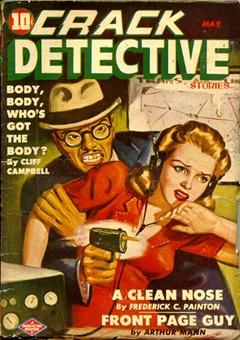
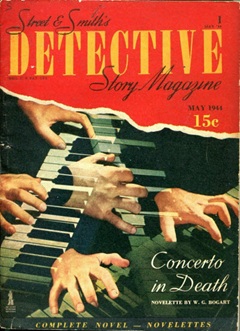
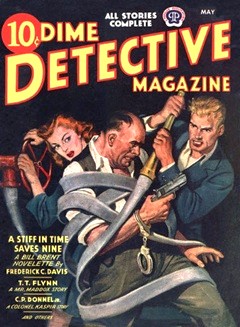
{“The Dark Tower” aired on a Thursday evening in early May of 1944. With less than a month from their summer vacation, the neighborhood gang broke for the nearby newsstand the next day after school in order to stock up for the weekend with some of their favorite pulps. Crack Detective (1938-57) ran under 8 different titles in its 19-year history, and in one way or another kept detective fans coming back for more. It was a bi-monthly in 1944. Street & Smith’s Detective Story (1915-49) was the first pulp magazine devoted exclusively to detective fiction, publishing an amazing 1,000+ issues during its 34-year run. It was a monthly in 1944. Dime Detective (1931-53) ran as a monthly for all but the last couple of its years, racking up 274 issues as the most popular detective pulp in Popular Publications line of detective pulps. It was a solid monthly in 1944.}
[Left: Crack Detective, 5/44 – Center: S&S Detective Story, 5/44 – Right: Dime Detective, 5/44]
To view the entire list of weekly Old Time Radio episodes at Tangent Online, click here.