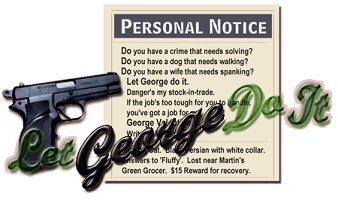
 Personal Notice:
Do you have a crime that needs solving?
Do you have a dog that needs walking?
Do you have a wife that needs spanking?
Let George do it. Danger’s my stock-in-trade.
If the job’s too tough for you to handle,
you’ve got a job for me,
George Valentine.
Write FULL Details
Let George Do It (1946-54) aired “The Four-Sided Triangle” on March 21, 1949 as the 132nd of its 414 original episodes. This is but the fifth episode of the show we have offered, the fourth coming just over a year ago, so I felt it was time to reprise the initial introductory notes for newcomers to this popular program. The George of the title was an ex-GI now home and trying to find his place in civilian society after the war. Intentional or not, George Valentine, as an “everyman” character the common man could relate to, who exhibited no special abilities to speak of, found his calling as a freelance investigator, but not the usual hardboiled gumshoe in the mold of Mickey Spillane or Sam Spade. Like the character Dan Holiday of the radio program Box 13, who placed a classified ad in the newspaper soliciting his services, George used the same approach—see the Personal Notice above and in the ad below. While the first few lines of the ad would change from time to time the ad always ended with the lines: “Danger’s my stock-in-trade. If the job’s too tough for you to handle, you’ve got a job for me, George Valentine. Write FULL Details.” George’s cases ran the gamut as did those of other private investigators or detectives: theft, blackmail, abduction, scams, political malfeasance or worse, and of course murder. But there were also the oddball cases that provided a welcome freshness and change of pace to the program which would make George Valentine one of America’s more popular radio characters.
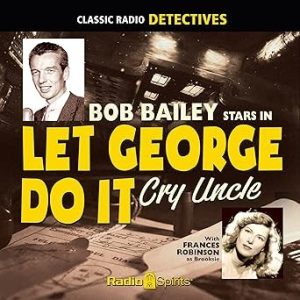
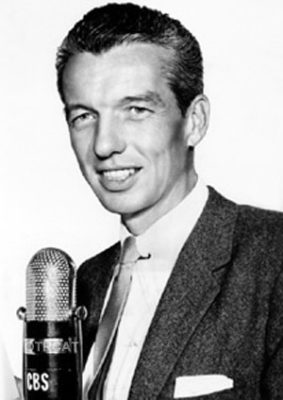
George Valentine was played by none other than Bob Bailey (1913-1983, photo top right), who would go on to be the star in one of radio’s most beloved programs, Yours Truly, Johnny Dollar (1949-62), where he would become the most famous of Dollar’s voices from 1955-60. Though he had been a supporting or bit actor in numerous shows before he hit it big as the star of Let George Do It, this was Bailey’s first starring role in a major program, and he made it his own, stepping down for only the final 37 shows (January through September of 1954).
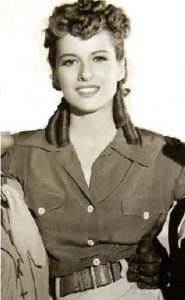 George Valentine’s loyal assistant/secretary and love interest was Claire Brooks, affectionately known as “Brooksie,” who was perfectly played by Frances Robinson (1916-1971, photo at left), and then others including Virginia Gregg who would follow Bailey to Yours Truly, Johnny Dollar as his secretary Nancy Turner. Both Robinson and Gregg would play Brooksie as “smart and sassie” as one source characterized their interpretation of the role, but it was Robinson’s little touches that made her Brooksie priceless, as when she made it clear on more than one occasion that “the case he was the most off base on was the ‘Case of the Missing Engagement Ring.’” The charming way she presented Brooksie to the program’s loyal listeners was evident, which led one critic to comment that “Frances Robinson’s Brooksie remains one of Radio’s most endearing and versatile sidekicks. Lilian Buyeff, Shirley Mitchell and Virginia Gregg would later replace Frances Robinson over the years, but despite their own considerable talents, could never completely erase the memory of Frances Robinson’s absolutely letter-perfect characterization of Brooksie.” Robinson also enjoyed a film and TV career, appearing in more than a dozen films, a couple of interest to science fiction fans include The Invisible Man Returns (1940) and 1941’s Dr. Jekyll and Mr. Hyde. She would die of an apparent heart attack at the much too early age of 55 on August 16, 1971.
“The Four-Sided Triangle” begins as a rather ordinary case, the sort not quite at the level George is used to handling. A man thinks his wife is cheating on him and asks George to find out if it is true or not. A usually tired, run of the mill case George rarely bothers with at this stage of his career, he accepts it anyway. But soon enough the case turns sideways from its mundane origins and we have a murder. So far, so good, but nothing really spectacular. But what freshens the usual storyline of a simple love triangle is the clever imposition the script writer adds to spark interest in the otherwise predictable tale, that of an author whose work in progress follows much of the identical story arc of this tale, and now we have the unexpected pleasure of following both parallel stories in progress. How this strange coincidence works itself out may not be what it seems on the surface, for only in the unknowable depths of the mathematics of love can we hope to find “The Four-Sided Triangle.”
(The linked CD a top includes this episode and 15 others, all remastered and restored.)
Play Time: 29:45
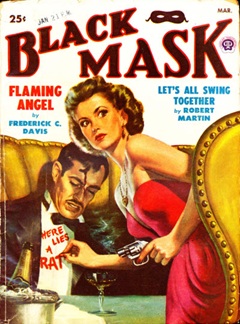
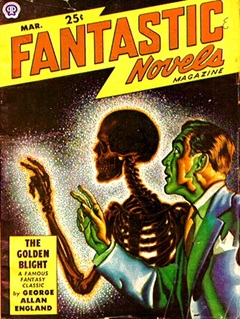
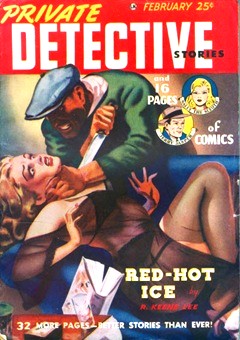
{This episode of Let George Do It aired on a Monday evening in late March of 1949 at 10 PM Central time. A love mystery (even though it included a murder) was not exactly of the dangerous variety the neighborhood gang was hoping for from a detective show, so when they gathered at the local newsstand the following afternoon after school they looked immediately for the magazines they knew held the stories of adventure and danger they craved. Black Mask (1920-51) came to be known as “the finest detective pulp magazine ever published,” in no small part due to publishing stories like Dashiell Hammett’s classic The Maltese Falcon as a five-part serial beginning with its September 1929 issue and running through its January 1930 issue. Black Mask was a bimonthly in 1949. Fantastic Novels (1940-41/1948-51) was the brainchild of editor Mary Gnaedinger as an answer in part from fans who requested stories of the scientific and fantastic variety from previous decades before the advent of more than one or two SF or Fantasy magazines. It was a solid success despite its relatively short run. It was a bimonthly in 1949. Private Detective Stories (1937-50) came to be known as a somewhat sanitized version of the much racier Spicy Detective, but with less sexually suggestive covers and a toned down psychopathology element to the stories (but not by much according to at least one account). Its final two years saw it adding 16 pages of comics (from psychopathology to comics—go figure) and dropping the “Stories” from the title with the September 1949 issue. Though a bimonthly in 1949 it managed only 5 issues.}
[Left: Black Mask, 3/49 – Center: Fantastic Novels, 3/49 – Right: Private Detective Stories, 2/49]
To view the entire list of weekly Old Time Radio episodes at Tangent Online, click here.