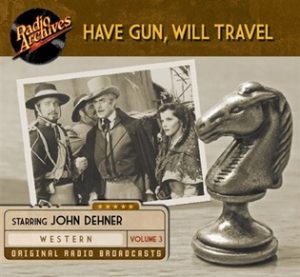
 Have Gun–Will Travel (1958-60) aired “Treasure Hunt” on September 13, 1959 as the show’s 43rd episode out of what would be a total of 106 over its two year run. This is only the ninth episode we have shared of this much loved western, the first being in September of 2019, with this episode being only the third since 2021. A recap of the backstory of the program is in order for newcomers.
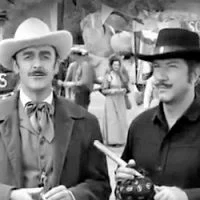
The very existence of the radio show is an odd duck, in that while not unique it was one of the very rare radio shows to be a spinoff of a successful tv show, which is backwards from the usual sequence of events, with the radio show coming first, then the tv show (for examples of the usual order, see Gunsmoke, Dragnet, and The Lone Ranger). In this case, Have Gun–Will Travel on television first aired in 1957 and its radio counterpart aired its first episode just over a year later in 1958. The original CBS tv series would run from September 1957 through April of 1963 and proved quite popular. Richard Boone (1917-1981) starred as Paladin, a cultured, educated, gun-for-hire living in San Francisco’s swanky Carlton Hotel during the period following the Civil War to approximately 1875 as a well-appointed man of wealth and sophistication, who earned his living by putting ads in local newspapers as a high-priced gunslinger with the simple calling card of “Have Gun–Will Travel.” While expensive to hire ($1,000 per day plus expenses) and ready, willing, and able to use his trademark gun when necessary, he often was a master at settling disputes or resolving issues in a diplomatic and bloodless manner.
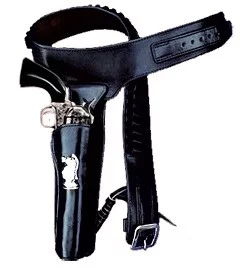
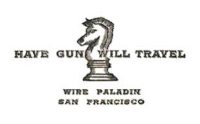
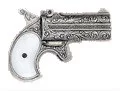 The term “paladin” itself has several meanings, among them “champion of the realm” or “trusted military leader” or even “a knight without armor in a savage land.” You get the idea. Paladin’s trademark is the iconic chess character of the knight, which he showcases on his signature black holster and on his business card. As backup to his handgun, Paladin also carried a double-barreled derringer behind his belt.
Famed radio director of such shows as Suspense, Escape, and later the popular tv westerns such as The Virginian and Gunsmoke, Norman Macdonnell championed the idea of spinning off a successful tv show to radio, and Have Gun–Will Travel on radio was born. One of my favorite radio and tv actors, John Dehner (1915-1992), was cast as radio’s Paladin, his resonating baritone perfect for the role. Dehner himself was in many ways like the character he played, for his father traveled a lot and Dehner went to school and was educated mostly in Europe (though he was born in New York). Along the way, he learned to speak four languages fluently and others to a lesser degree (including Norwegian, French, Spanish, Italian, Swedish, and even some Hopi Indian). In the early 1940s Dehner worked for Walt Disney Studios as an animator and did work for such iconic animated features as Fantasia (1940), Bambi (1942) and some Pluto, Donald Duck, and Mickey Mouse cartoons. After a stint in the Army during World War II he held jobs as a radio news editor and disc jockey, then graduated to numerous acting roles of various sizes, including, but not limited to shows such as The Hermit’s Cave (as host), and supporting roles in The Whistler, Gunsmoke, Suspense, Escape, Philip Marlowe, Frontier Gentleman (star), and the week following the demise of Frontier Gentleman, the star of Have Gun–Will Travel.
John Dehner’s television and film roles are far too many to list here, but he appeared in 125 feature films and shorts, and in well over another 100 tv roles from mystery to western to science fiction and is easily recognizable for his blue eyes, moustache, and again his iconc baritone that Radio Life Magazine said was the industry’s “best radio voice.” Of interest to SF fans, Dehner appeared three times on the original The Twilight Zone: in the first season as Captain Allenby in “The Lonely,” as engineer Alan Richards in “The Jungle” in its third season, and in its fifth and final season as Jared Garrity in “Mr. Garrity and the Graves.”
 Of interest is that Norm Macdonnell was not only the champion of spinning off a radio program from its parent television show, but his idea to rewrite as closely as possible for radio the original tv scripts, thus, the initial 30 episodes of Have Gun were lifted from the already aired tv shows. [After that, Macdonnell would leave the show and go on to direct and write for television’s Gunsmoke, tv’s longest running (to that time, 1955-75) continuous prime time show in history.]
Last but not least, from an article in AVClub from 2014 by Brandon Nowalk titled “The Adult Western Peaked with Have Gun–Will Travel”: “…the adult Western, nominal or otherwise, is what TV audiences were looking for in the late ’50s. Have Gun – Will Travel wasn’t the first, it wasn’t the most popular, and it didn’t last the longest. But it was the best. Have Gun picked up the pieces of the adult Western and assembled them into something greater. There was Gunsmoke’s dramatic power, Earp’s pretension, and Cheyenne’s rootless energy. And where those others lost cast members, dipped in quality, or completely transformed, Have Gun stayed steady, a strong half-hour black-and-white adventure leading into Gunsmoke every Saturday night for six years.” Though it is true that Have Gun wasn’t the most popular show of its time, Nielsen ratings confirm that it ranked near the very top of the heap with a #3 or #4 rating for its first four years. (Gunsmoke would take top honors as the #1 show for four years, from 1958-61.)
“Treasure Hunt” begins as usual in 1875 San Francisco, with Paladin relaxing in his hotel residence awaiting the arrival of one J. Wellington Merriwether from Boston, to discuss a business matter. When his guest arrives early Paladin is taken aback to discover that J. Wellington Merriwether is a young boy of 14 who has run away from home and stowed away on the ship that has brought him to San Francisco all the way from Boston, and that the boy’s parents are dead and he has been living with his aunt and uncle. The purpose of his visit is a map his father left him, but it is not entirely clear what the map points to, though the deed to a gold mine is guessed. Paladin agrees to help the boy follow the map and discover if indeed it is to a gold mine, where it is presumed his late father had finally hit it big. Soon enough it is clear that an unknown man has followed the boy and also knows something of the map and desires it at all costs, even if it involves hurting young Merriwether and threatening anyone else who stands between him and the riches the map promises. Things get interesting as Paladin and Merriwether meet a certain person mentioned in the map who knew the boy’s father, but though helpful, it does not stop a dangerous confrontation that awaits both Paladin and the boy, a confrontation that involves extreme violence and a revelation about the gold mine. The upshot of this harsh situation is that our young J. Wellington Merriwether learns that the worth of a man is not measured by his physical wealth but by an even more valuable kind of treasure. This is another fine episode of Have Gun–Will Travel, where the life lesson learned is more important than any such found at the business end of a gun.
(The CD linked above includes this episode and 11 others, all digitally remastered and restored.)
Play Time: 24:28
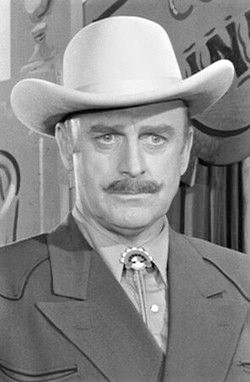
[Below: Paladin on radio, John Dehner, left — Paladin on TV, Richard Boone, right]
[Below: Paladin’s iconic business card]
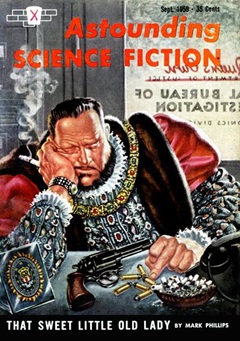
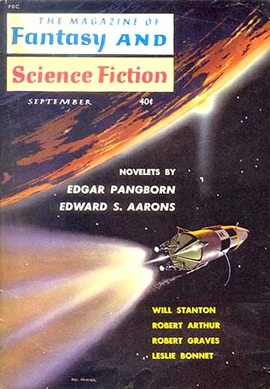
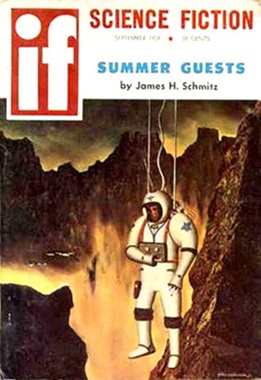
{“Treasure Hunt” aired on a Sunday evening in early September of 1959. The neighborhood gang was still getting used to being back in school but their anticipation to meet at the nearby newsstand after school the next day was still strong. Astounding SF (1930-present, now Analog) was still, as always, a favorite among their SF/F pulps and with tantalizing covers like the Kelly Freas on the issue below it was easy to see why. ASF was a monthly in 1959. The Magazine of Fantasy & Science Fiction (1949–to the present, though no new issue has been seen since the middle of 2025) was now an established presence at newsstands and was celebrating its 10th year and going strong. It was a monthly in 1959. If Science Fiction (1952-1974) was sold shortly after its first few issues and became a companion magazine to Galaxy. If went through a number of editors early on due to several reasons (Paul W. Fairman, Larry Shaw, and even Damon Knight briefly), at one point both magazines being edited by H. L. Gold. Frederik Pohl became If‘s editor from 1962-69 and from 1966-68 it won the Hugo award for Best Professional Magazine three years in a row. If was a bimonthly in 1959 though it managed only 4 issues.}
[Left: Astounding SF, 9/59 – Center: F&SF, 9/59 – Right: If, 9/59]
To view the entire list of weekly Old Time Radio episodes at Tangent Online, click here.