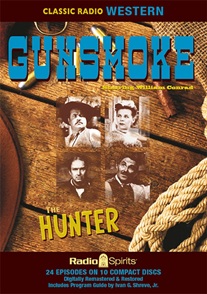
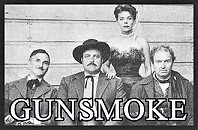
 Gunsmoke (April 26, 1952–June 18, 1961) aired “Doc’s Revenge” on January 8, 1956 as the 196th of its 480+ original episodes. This is the sixth episode of Gunsmoke we’ve showcased, the first coming in early January of 2020, with the last appearing in early January of 2023, a full 3 years ago. Thus, a reprise from that initial offering of the basic history and background of this excellent radio program is in order for newcomers.
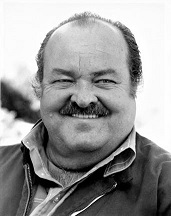
The show took place during the post-Civil War era (circa 1870) in Dodge City, Kansas during the expansion and settling of the Old West. On radio William Conrad (1920-1994, photo lower left) played Marshal Matt Dillon. On television Marshal Dillon was played by James Arness. On radio Parley Baer (1914-2002) played Dillon’s “assistant” Chester Wesley Proudfoot. On television Chester was played for the first couple of years by Dennis Weaver. On television, Chester’s last name was changed from Proudfoot to Goode. On radio Howard McNear (1905-1969) played Dr. Charles Adams. On television Doc was played by Milburn Stone. On radio Miss Kitty was played by Georgia Ellis (1917-1988, photo lower right). On television Miss Kitty was played by Amanda Blake. While the radio program ran for a solid 10 years (1952-61), the television program ran for 20 years (1955-75) and overlapped with its still airing counterpart on radio, and until programs airing after the television show’s demise, television’s Gunsmoke ranked as the longest running original live action (as opposed to animated) show of all time.
 As to the origin of Gunsmoke on radio, the story goes that in the late 1940s legendary CBS chairman William S. Paley, who was a fan of the Philip Marlowe detective series on radio, asked the head of programming to develop “a hardboiled Western” about a Marlowe of the Old West. Though an attempt was made, complications arose and the project was shelved. Enter producer Norman MacDonnell and writer John Meston a few years later, who discovered the shelved project while in the process of creating an adult Western of their own for radio (in contrast to radio westerns such as The Lone Ranger or The Cisco Kid, who were aimed primarily at a younger audience).
Gunsmoke on radio was a critical and popular success, noted for its realism and willingness to tackle adult and/or explicit subject matter such as opium addiction, scalpings, and massacres among other adult situations and themes (Marshal Dillon, having saved a prostitute from rapists in one episode, was yet unable to dissuade her from her chosen profession). The show was not all dark and somber, however, and evolved over time into a genuinely warm and sometimes humorous “celebration of human nature.” To reinforce the realism of the excellent scripts and often times gritty subject matter, the show also rose above others due to its special effects, which brought the listener even deeper into a dusty, crowded, Dodge City, where children could be heard playing a block away, or a dog barking nearby. It was a total immersive experience for radio, and solidified the claim of the program as the first truly adult Western series on radio.
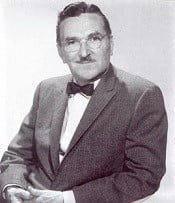
 Those familiar with the original The Andy Griffith Show (1960-68) on television will recognize the names of Parley Baer (photo at left) and Howard McNear (photo at right). They would find themselves teamed up again as they were on radio’s Gunsmoke, with Baer playing the character of Mayberry Mayor Roy Stoner, and with McNear playing Floyd the Barber. Sometime shortly after he was cast as this recurring character McNear had a stroke, almost completely paralyzing the left side of his body. He took more than a year off, but when asked by Andy Griffith to return he rejoned the cast in 1964, though camera angles and his poses had to be adjusted for. His condition deteriorated so much that after time he could no longer remember his lines. Frustrated, McNear left the show in 1967. He passed away from complications of pneumonia following another stroke on January 3, 1969. Parley Baer, his longtime friend from both Gunsmoke on radio and The Andy Griffith Show on television, read his eulogy.
“Doc’s Revenge” begins with Doc leaving Dodge to visit a patient, when on his way out he spots a man from his past just entering town. Breaking off his conversation with Chester who is excitedly showing off a bottle of some cure all he has just purchased which claims to alleviate all manner of ailments, Doc abruptly tells Chester he is going to kill that man if it is the last thing he ever does. Alarmed at this uncharacteristic behavior from Doc, Chester alerts Matt who confronts Doc. He tells Doc that even though he is Dodge’s only doctor and the entire town relies on him that he will arrest him if he proceeds with his plan. Doc is unswayed and promises to kill this man from his past. Chester and Matt are frustrated at Doc’s behavior and have no idea who this stranger is, or what long ago event or tragedy has awakened Doc’s hatred and sworn promise to kill the man (especially since the man refuses to defend himself). It is such an unsettling affair surrounding someone they have grown to love and trust, that Matt and Chester are beside themselves as they must wait to discover the reason for “Doc’s Revenge.”
(The linked CD a top includes this episode and 23 others, all digitally remastered and restored.)
Play Time: 24:49
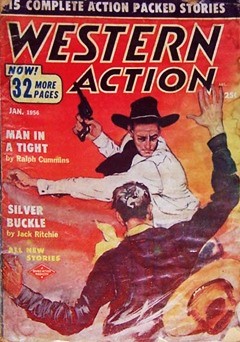
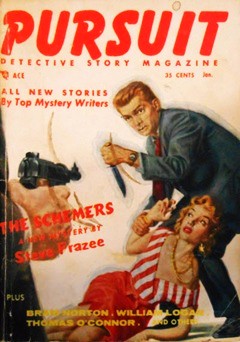
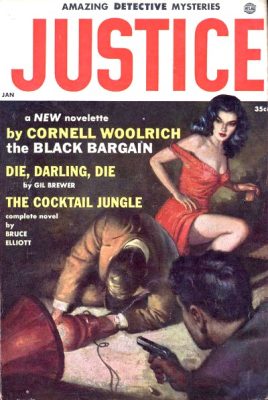
{Airing on a cold Sunday night, this episode of Gunsmoke left the neighborhood gang in the mood for more, so after school the next day off they went, all bundled up against the cold to their nearby newsstand. There weren’t many western pulps still around in 1956 so the gang split their time looking for detective pulps as well, and were in luck on both fronts. Western Action (1936-60) enjoyed a long run though it changed its title and numbering system a couple of times. The changes were obviously successful, witness its longevity. It held to a mostly bi-monthly schedule which included 1956. Pursuit Detective Story Magazine (1953-56) was an odd duck re its short publishing history. After about half a dozen bi-monthly issues the publisher decided to go monthly, but instead of filling in every other month with an issue of Pursuit, he began a new magazine with the title Hunted and inserted it in between issues of Pursuit. The “odd duck” factor arrives in that both magazines were identical save for their titles, Thus, Pursuit ran from 1953-1956 end ended with 18 issues, while Hunted ran from 1955-1956 with 12 issues, at which time in late 1956 both magazines folded. Justice, Amazing Detective Mysteries (1955-56) lasted but 4 issues, though it published some fine material from some of the detective and mystery field’s top authors, including Cornell Woolrich, John D. MacDonald, and surprisingly enough a complete novel by none other than Richard Matheson. It was a bi-monthly for its brief lifespan.}
[Left: Western Action, 1/56 – Center: Pursuit Detective, 1/56 – Right: Justice Detective, 2/56]
To view the entire list of weekly Old Time Radio episodes at Tangent Online, click here.