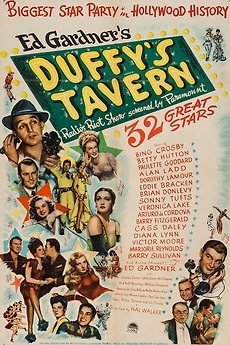
 Duffy’s Tavern (1941-1951) aired “Guest — Charles Laughton” on April 18, 1944 as the 126th of its 425 episodes. This is only the second episode of Duffy’s we have run, the first coming just over two years ago in December of 2023.
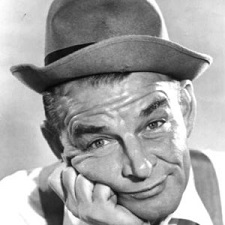
Duffy’s Tavern was created and hosted by radio veteran Ed Gardner (1901-1963, photo at right). Though the low rent tavern located on Third Avenue and 23rd St. in New York is owned by Duffy (who never appears), it is run by Archie the Manager, whose catchphrase is “where the elite meet to eat, Duffy ain’t here, Archie the Manager speakin’…” This radio sitcom often featured a celebrity guest, among them the likes of Boris Karloff, Dinah Shore, Gene Tierney, Mickey Rooney, Lucille Ball, Shelley Winters, and of all people Marlene Dietrich. Archie spices up each humorous situation he finds himself in—or has gotten himself into—with his comic malaprops, a linguistic device used to great effect by such as the standup comedian Norm Crosby ([1927-2020] “a standing ovulation” & “the pinochle of perfection” are two of his more memorable examples), and made a standard part of Archie Bunker’s linguistic antics on the long-running TV sitcom All in the Family. An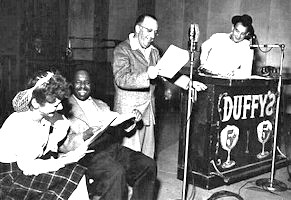 interesting sidebar is that when this famous sitcom came to an end, a spinoff began with the title Archie Bunker’s Place. This show, while differing in certain respects from Duffy’s Tavern, is similar in setting (a working man’s bar in New York) wherein humorous situations occur weekly, and the guy who runs the bar is also named Archie, and both succeed in mangling the English language to great effect. Of possible interest is that while there were several regular characters in Duffy’s Tavern episodes, the actress portraying Duffy’s scatter-brained daughter was none other than Shirley Booth (1898-1992). Booth would go on to star in several Hollywood films (winning a Best Actress Oscar for her performance in 1952’s Come Back, Little Sheba, starring Burt Lancaster). Of course, most folks today remember her for the popular TV show Hazel, where she played a maid to the Baxter family. For the aforementioned 1952 film, her TV role as Hazel, and as the star in the 1952 Broadway play The Time of the Cuckoo, Booth would become one of the very few to win an Oscar, a Grammy, and a Tony award. Shirley Booth was married to Ed Gardner of Duffy’s Tavern fame from 1929-42. They remained friends, though they had no children.
At the height of Duffy’s radio popularity it was suggested that a movie would be a good idea (for obvious reasons). Debuting in September of 1945, it featured a literal galaxy of film stars (32 by count) and was one of the top 15 highest grossing films of 1945. Estimates of feature Hollywood films by the major studios released in the U.S. in 1945 range from 400-500 making the Duffy’s Tavern film’s commercial success even more remarkable. Just a few of the stars appearing in the film were Bing Crosby, Dorothy Hutton, Alan Ladd, Dorothy Lamour, Brian Donlevy, Howard da Silva, Paulette Goddard, William Bendix, and Veronica Lake. While certain critics gave it mixed to negative reviews (thin plot, and was hard to make a decent movie when 32 stars were crammed into a single picture), audiences loved it and yucked it up seeing many of their favorite movie stars together on the big screen. Also possibly accounting for the film’s popularity was the fact that after 4 years of the Wars in Europe and Japan, the United States was finally at peace. Four years of constant news of bloodshed, death, destruction, and hardship at home (rationing) were over, and a film with nothing but laughter as its goal was just what the doctor ordered.
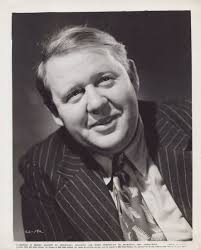 This episode features renowned stage and screen actor (The Hunchback of Notre Dame, Mutiny on the Bounty, and Witness for the Prosecution, among many other classics), Charles Laughton (1899-1962). Archie somehow convinces Laughton to visit Duffy’s Tavern in the hope of convincing him of his scheme to turn Duffy’s Tavern from the dive bar it is into a classy nightclub type of joint. Archie is convinced that if he can persuade Laughton into becoming the new joint’s first club member it will attract his fellow (rich) actors and friends to become members, thus financing Archie’s dream of turning Duffy’s into something respectable. But therein lies the rub, of course, the task at hand comprising the bulk of the episode as Archie–with his hilarious malaprops–is constantly being made fun of by Laughton, Shakespearian actor and master of the English language that he is, with his droll sense of humor that often flies right over Archie’s head. It’s a good bit of fun and easily worth a chuckle or two listening to Laughton go through his paces for this somewhat short (22 minutes) episode. The final 6-7 minutes are filled with a couple of musical numbers that I suspect were added because this is an Armed Forces Radio Service (AFRS) rebroadcast where all commercials are removed so as not to favor any sponsors from wherever in the States the original broadcast was first aired. Short though it may be, a few quick chuckles are virtually guaranteed if you’re a fan of clever wordplay.
Play Time: 29:55
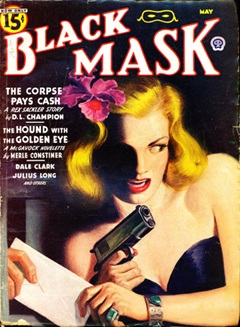
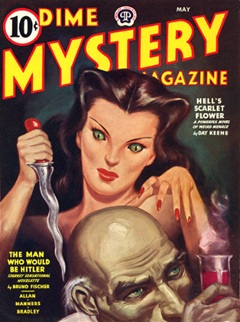
{This episode of Duffy’s Tavern was broadcast on a Tuesday evening in mid-April of 1944. Though a lighthearted show, the neighborhood gang soon decided they still preferred more adventurous fare when it came to their reading, and the next afternoon after school found them once again perusing the shelves at their nearby newsstand for hard-hitting or even creepy stories. It was a good month for several of their favorite detective and mystery magazines so the gang was in luck. Black Mask (1920-51) was the king of the detective pulps with good reason and was bought without reservation at first glance. It was a bi-monthly in 1944. Dime Detective (1931-53) was a best-selling detective pulp and managed over 270 issues during its profitable run. It was a monthly in 1944. Dime Mystery (1932-50) began by including novel-length stories between its covers, but the publisher learned quickly that this was not a winning formula so switched after only a few issues to running short stories and novelettes, while re-directing the magazine’s focus to “weird menace” tales. This proved a popular change with fans, witness the magazine’s continuation for another 144 issues. It was a bi-monthly in 1944.}
[Left: Black Mask, 5/44 – Center: Dime Detective, 4/44 – Right: Dime Mystery, 5/44]

To view the entire list of weekly Old Time Radio episodes at Tangent Online, click here.