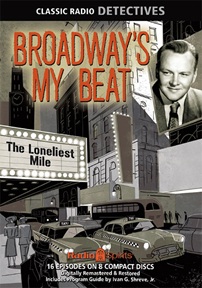

Broadway is sleeping now…the furious avenues of the night are still…only the sleepwalkers are there…the seekers, the sodden…
From Times Square to Columbia Circle—the grandest, the most violent, the lonesomest mile in the world.
Broadway Is My Beat (1949-1954) aired “The Hilda Bruce Murder Case” on August 8, 1953 as the 177th of its 296 episodes. This is the first episode of this program we have offered, so a sketch of its background is in order.
Broadway Is My Beat aired its first episode from New York on February 27, 1949 and its last from New York a mere three months later on May 29, 1949. Anthony Ross played Danny Clover, the detective who walked the Broadway beat of the title. The show then moved to the west coast and Hollywood, airing its first episode on July 7, 1949, but now with Larry Thor (1916-1976, photo top right) as the cynical detective walking the beat from Times Square to Columbia Circle. The show would remain on the west coast for the remainder of its run, its final episode airing on August 1, 1954.
The show has been described by several sources as definitely in the hardboiled detective end of the gumshoe spectrum. It sports direct, no nonsense dialog for the most part, while every now and then showing an ability for Chandleresque descriptive metaphor. The stories themselves focus on murder as the principal storyline and can be, at times, of a grisly nature, though not at the level to deter listener interest, which is easily maintained by the various routes Clover must take when comparing possible suspect testimonies along with following what clues he is able to uncover along the way as he builds a case. Not an easy set of tasks sometimes, but the writers manage to keep listeners guessing as they try to match wits with Clover. What helps Clover as he patrols the Broadway corridor is the street knowledge he acquired as a youth growing up in this rough and tumble part of town, the district he is now responsible for protecting as a seasoned detective. This hard won knowledge keeps him, depending on the circumstances, a step ahead of those who think nothing about taking the life of another.
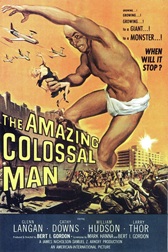
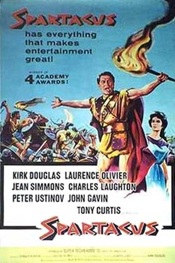
As to Larry Thor, following his work in radio, he would appear in nearly thirty feature films over his almost two decade (1953-70) Hollywood career. A few of the major (or popular) films in which he had supporting roles were The Amazing Colossal Man (1957), The Hunters (1958), Spartacus (1960), and Tora! Tora! Tora! (1970). Thor even dipped his toe into TV with appearances on Perry Mason (1957 & 1973), Sea Hunt (1958), Wagon Train (1958), The Andy Griffith Show (1964), and The Man From U.N.C.L.E. (“The Thor Affair”-1966) among others.


“The Hilda Bruce Murder Case” is a prime example of one of the many types of cases Clover encounters from time to time. A woman is found murdered in her apartment with her son standing over her, he having recently entered the room and discovered her body. Clover and at least one other official begin to piece the scene and surrounding circumstances together, including the story from Jimmy Bruce, the deceased’s son. A number of leads and suspects soon emerge and the hunt begins in fine whodunit fashion, pointing to one suspect and then another, as the writer knows how to fairly lead the listener toward the real killer. It’s a solid bit of entertainment and worth a listen, especially with the realistic background sounds lending an air of verisimilitude to the noir-drenched Broadway cityscape.
(The linked CD at top includes this episode and 15 others all remastered and restored in an 8 disc set.)
Play Time: 29:18
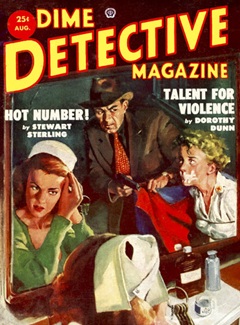
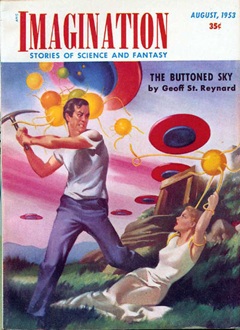
{Airing at 7 PM on a Saturday evening in early August of 1953, this episode of Broadway Is My Beat got the neighborhood gang in the mood for more danger and drama they hoped to find in some of their favorite pulp magazines. So the next day after church and a quick change of clothes found them at the nearby newsstand. They found what they were looking for in the following detective and SF pulps. Dime Detective (1931-53) was one of Popular Publications’ line of detective pulps, and the most popular, publishing a total of 274 issues in its 20+ year run, mostly as a monthly. It was a bimonthly in 1953. Imagination (1950-58) began as one of Raymond A. Palmer’s many SF pulp forays, but Palmer sold it to William Hamling who took over as editor with the third issue, remaining at the helm throughout the magazine’s 8-year run. It was a monthly in 1953. Thrilling Wonder Stories (1936-55), along with Planet Stories and Startling Stories formed a loose triumvirate of SF pulps known for their colorful escapist adventure stories set on other worlds. Page-turning, action-oriented storylines ruled the day as did a wink and a nod at accurate science, unfettered imagination taking precedence and on an equal footing with the heroes, damsels in distress, the wonders of far flung science, and assorted bad actors, including the beloved and favored among the young readership—bug-eyed monsters (BEMs). TWS was a bimonthly in 1953 though it managed only 5 issues that year.}
[Left: Dime Detective, 8/53 – Center: Imagination, 8/53 – Right: Thrilling Wonder Stories, 8/53]

To view the entire list of weekly Old Time Radio episodes at Tangent Online, click here.