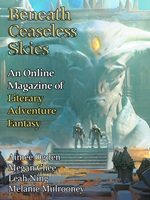
 Beneath Ceaseless Skies #451, February 19, 2026
“Hollow in the Hope” by Aimee Ogden
“To Atone for Evil” by Megan Chee
“What Might Come of Today” by Leah Ning
“Bloom Where You Are Planted” by Melanie Mulrooney
Reviewed by Victoria Silverwolf
As part of its special Science-Fantasy month, the magazine offers a double-sized issue of stories mixing futuristic concepts and settings with the supernatural.
“Hollow in the Hope” by Aimee Ogden alternates two sections of text that take place on different planets and millennia apart in time. In one part, the adult child of a planet’s ruler is to be sacrificed because of a vow made to a god. In the other, set ages ago, a woman faces a similar fate. The sections interact through the fact that, in the present, the doomed child speaks with a simulation of the victim of the past.
The fate of the earlier victim is reminiscent of the ancient Greek myth of Iphigenia, sacrificed to the goddess Artemis by her father Agamemnon. The later victim’s story is similar to the Biblical account of Jephtha, as recorded in the Book of Judges, who vowed to sacrifice whatever came out of his house first, which turned out to be his daughter.
Although there are no surprises in the plot, given its double inspiration, the author manages to create two very different worlds in imaginative detail. Readers may find the story’s conclusion either disappointingly predictable or appropriately logical and inevitable.
“To Atone for Evil” by Megan Chee is narrated by a member of a predatory alien species, now conquered by an empire that enforces universe-wide peace. The narrator is in a state between life and death, accompanied by an incorporeal representative of the peacekeeping empire.
They travel together throughout the cosmos, in an attempt to have the narrator atone for attacking and feeding on other sentient species. The plot deals with the pair visiting a planet of winged aliens where the empire eliminated an oppressive social structure by forcing all the inhabitants to give up flying.
As may be evident, this story deals with the eternal struggle between freedom and the quest for a just, peaceful society. It seems to suggest that there should be some kind of balance between unrestrained exploitation (the predators hunting other sentients, or the upper-class flyers oppressing the lower class) and complete loss of freedom (the peacekeepers.) One cannot argue with the theme, even if the story adds little new to it.
“What Might Come of Today” by Leah Ning takes place at a time when robots that are almost impossible to tell from human beings exist. After a certain amount of time the robots go berserk and attack people. The protagonist becomes an apprentice of the leader of a group that destroys robots that are about to go berserk. The method they use causes robots to experience great pain. The protagonist, who has secretly befriended a robot, hopes to execute the robots without so much suffering.
Even in a story that mixes fantasy elements into a science fiction premise (the method used to kill the robots is more magical than technological) it is difficult to accept the fact that the robots are so human-like in all ways. One character even finds out that what he thinks of as his sister is a robot. It’s hard to imagine how this could have happened.
The story jumps back and forth in time, and the author uses an unusual technique to mark these transitions. A section ends with a character about to say something, then the next begins with the words that were said, but at a different place and time. This quirky narrative technique is likely to seem gimmicky.
“Bloom Where You Are Planted” by Melanie Mulrooney takes place in a world where people produce plants from their bodies. The type of plant determines one’s social status. The narrator’s sister produces roses, which are the most valued. The narrator meets a young woman who produces what are thought of as weeds, so they are painfully removed from her body. She and the narrator plan to go away together to where they can be free to be themselves, regardless of what plants they produce.
This is a simple little fable with an obvious point to make. It is easy to predict that the narrator and her friend will escape their repressive society and live happily ever after. The story makes for pleasant, if unexciting, reading.
Victoria Silverwolf is currently reading Bellwether by Connie Willis.