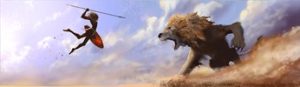
 Heroic Fantasy Quarterly #67, February 2026
“The Dying of the Light in Darkness” by Dennis Conrad
“Melkart and the Monkey Men” by Mark Mellon
“Erase the Slate” by Jonathan Olfert
“The Palimpsest of Memory” by Deborah L. Davitt
Reviewed by Eric Kimminau
According to Editors David Farney and Adrian Simmons, Heroic Fantasy Quarterly is a premier digital publication that revives the tradition of high-stakes, action-oriented storytelling through a curated collection of prose and poetry focused on visceral pacing rather than internal monologue. Rapid, physical action and immediate sensory impact to keep the reader intensely engaged. Lets Go!
“The Dying of the Light in Darkness” by Dennis Conrad is a visceral exploration of cyclic torment, where an amnesiac knight wanders an eternal subterranean nightmare, battling grotesque entities while his own humanity literally erodes. Bound to a sentient, mutating greatsword that feeds on the blood of the fallen, the protagonist struggles to maintain his sanity while reliving fading memories of a surface world that may no longer exist. A suffocating atmosphere of psychological and physical decay, emphasizing the blurred lines between a holy quest and a monstrous descent. The prose captures the agonizing weight of “existential fatigue” as the warrior navigates a world where each death is merely a painful transition to a further corrupted rebirth. As the protagonist eventually encounters a figure from a different era, the story shifts toward the tragic irony of perspective and the inevitable transformation of the hero into the very antagonist he once sought to destroy. It is a grim meditation on the loss of self and the relentless nature of survival and some of the best writing I have experienced in a very long time!
In “Melkart and the Monkey Men” by Mark Mellon, a weary traveling warrior named Melkart seeks refuge from the constant hustle of a cramped, confined life on a small island by venturing into the rugged White Mountains to hunt, mostly for sleep, but also for the adventure. His journey begins with a moment of welcome hospitality from a goat farmer, where he is warned of bandits and of “miserable, chicken stealing, kid killing” forest spirits, and the Monkey Men. The story balances moments of lighthearted whimsy with high-stakes action as Melkart finds his survival dependent on the very creatures he initially viewed as a nuisance.
Through vivid descriptions of the ancient cedar forests and the brutal reality of mountain combat, the text explores themes of honor and the unexpected friendships formed in the wild as well as the crucible of danger. I felt the writing in the first half flowed smoothly and grabbed the reader but as it neared the close, it began to stumble. A decent story that could use a good editor to make it into something much better. I enjoyed the initial character construction and hoped it would have carried through.
In “Erase the Slate” by Jonathan Olfert, a world strictly governed by the Fivefold Church presents a tithe collector named Ander Carmora, who risks his standing to grant a poor man a proper burial, sparking a violent confrontation with a corrupt local priest who utilizes mental sorcery to enforce obedience. As the priest uses a mystical artifact to forcibly wash away Carmora’s memories and defiance, Carmora and his unstable partner must struggle to maintain their own will against a religious hierarchy that demands absolute, mindless devotion. While the narrative initially presents a compelling and well-structured depiction of a unique cultural landscape, it eventually descends into a disorienting, psychedelic blur that alienates the reader. The story unfortunately ignores the wisdom of Tropic Thunder’s Kirk Lazarus by leaning too far into “full” narrative incoherence, causing the plot to derail so significantly that even the implication of a mind-wiping sorcerer cannot salvage the reader’s basic understanding of the events.
Brother Thomas is a weary former soldier seeking spiritual asylum within a monastery in “The Palimpsest of Memory” by Deborah L. Davitt. He finds himself relegated to the menial task of copying mystical texts, yet he is strictly forbidden from learning to read. His struggle to adapt to the delicate life of a scribe is constantly undermined by the disdain of his superiors and the “palimpsest” of his violent past, which bleeds into his new identity despite his desire for peace.
The narrative shifts abruptly when his old life and his new world collide during a brutal raid, forcing Thomas to reconcile his lethal skills with his monastic vows. This character study explores the tension between who we were and who we hope to become, ultimately questioning whether true transformation is possible in an environment built on restriction rather than growth. I had to find the definition of palimpsest: A palimpsest is a manuscript page, typically made of papyrus or parchment, that has been scraped or washed clean so that it can be reused for new writing, though often leaving faint traces of the original text visible underneath. I clearly understood the message but explaining it to the reader, perhaps as a side discussion between elder monks, would have added some much-needed clarity. I enjoyed the direction but would have enjoyed just a bit more character development.
I have enjoyed this issue of Heroic Fantasy Quarterly, especially the artwork that accompanied each story. It added to the images evoked in my imagination. I sincerely enjoyed “The Dying of the Light in Darkness.” It left me deeply impressed, as well as “Melkart and the Monkey Men” compelling yet faltering toward the conclusion.
While Heroic Fantasy Quarterly successfully delivers on its promise of high-stakes action and immediate sensory impact, the issue’s overall quality remains inconsistent, ranging from profound literary achievement to narratives that struggles with structural clarity and cohesion. I would still enjoy a future visit.
Eric Kimminau is a BBS geek turned IT professional seeking the next Great Adventure. Let’s Go!