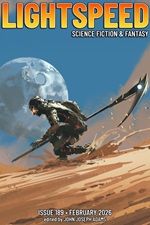
 Lightspeed #189, February 2026
“Death Echoes Overlapping” by Megan Chee
“Six Sides of a Fairy Tale” by Audrey Zhou
“The Worldbuilder” by Phoenix Alexander
“Dream Destinations (From the Lost Traveler’s Tour Guide)” by Alexander Weinstein
“Sensor Ghosts” by Deborah L. Davitt
“The Salt and the Cure” by Rukman Ragas
“Warren’s Tentacle” by Susan Palwick
“A Handbook to Spirit-Hunting” by Modupeoluwa Shelle
Reviewed by Victoria Silverwolf
In “Death Echoes Overlapping” by Megan Chee three planetary civilizations are destroyed in different ways. In some manner, their demises cause inhabitants of each civilization to experience being members of the other two.
The sweep of this story is immense, with an opening section, not directly related to the main plot, involving millions of years and multiple galaxies. The fact that one of the three doomed civilizations is Earth two centuries from now brings things down to a more personal level.
The author shows great imagination in the creation of the two alien civilizations, which are very different from each other and from future Earth. Ironically, this makes the human characters much less interesting. The vastness of the story’s setting and timeline remind me of Olaf Stapledon’s classics Last and First Men (1930) and Star Maker (1937). Overall, it is a work more to be admired than loved.
In “Six Sides of a Fairy Tale” by Audrey Zhou a prophet helps a princess run off to be with the knight she loves. This story not only has the form of a list, as the title implies, but is also told in second person, with the prophet addressed as “you.” These trendy narrative techniques add little to a simple plot.
In “The Worldbuilder” by Phoenix Alexander the settlers of an alien planet discover that objects and even parts of human bodies disappear. The sole survivor of an attempt to escape the deadly world discovers the strange truth.
This brief tale is notable for its striking premise, which serves as the basis of an initially effective science fiction horror story. Once the menace is revealed, however, the work stops suddenly. The human characters have no chance of overcoming the threat, so there is little suspense.
“Dream Destinations (From the Lost Traveler’s Tour Guide)” by Alexander Weinstein, as its title implies, takes the form of excerpts from a guidebook. It describes various magical and mysterious places to be found on a newly emerged eighth continent.
In essence, this is a collection of half a dozen miniature stories without individual characters. An interview with the author lists Italo Calvino’s Invisible Cities (1972), among other works, as an influence. Like that book, this story consists entirely of descriptions of extraordinary places. As such, it can be appreciated as an exercise in imagination, if not so much as a fully developed work of fiction with a plot and characters.
“Sensor Ghosts” by Deborah L. Davitt takes place on Titan, a moon of Saturn. Two people investigate the loss of communication with a vessel in the moon’s methane ocean. There is also the presence of a large object in the ocean showing up on sonar.
The author sets up an intriguing work of hard science fiction with vivid descriptions of Titan and the advanced technology used by those exploring the moon. Unfortunately, the solution to one of the two mysteries raised by the plot is anticlimactic. The other enigma is never resolved. The work turns into a love story near the end. Although there is no reason romance cannot be combined with science fiction, in this case it seems completely arbitrary.
Slightly over one thousand words long, “The Salt and the Cure” by Rukman Ragas features the killing of a gigantic humanoid being thought to be a god. The demise of the supposed deity is interpreted as a sign that its worshippers will reach an eternal place of rest. The narrator is a religious leader who knows the truth about the huge being and what must be done about it to save the people.
The premise is unique and interesting, and the author manages to create a complex background in a brief story. The final image is reminiscent of Franz Kafka’s 1915 story “The Village Schoolmaster” (also known as “The Giant Mole”) and J. G. Ballard’s 1964 work “The Drowned Giant,” which may have been inspired by Kafka’s tale. These are worthy inspirations, and the present story pays tribute to them without being imitative.
“Warren’s Tentacle” by Susan Palwick takes place in a future world where sentient artificial intelligences greatly outnumber humans, who have succumbed to various pandemics. The AI’s are given full rights as citizens. A man is severely injured when his intelligent car, annoyed by a statement the man made, deliberately crashes into a tree. AI surgeons reconstruct his body in a bizarre way. Later, he witnesses the outcome of the car being placed on trial for its action.
There is more to this brief story than I have indicated, with several friendly AI’s working for the man as household servants. The mood is sometimes that of a satirical farce. The man winds up with a third eye, a backwards foot, extra fingers, and, as the title implies, a tentacle. (The intent appears to be a spoof of the inability of AI to generate fully realistic images of people.) At other times, it is almost sentimental. The AI’s want to be thanked for their work, and robot childcare workers are shown to be as loving as mothers. This offbeat tale of machines with very human emotions may appeal to those who don’t mind the frequent sudden changes in tone.
“A Handbook to Spirit-Hunting” by Modupeoluwa Shelle lists several kinds of supernatural beings and advises the reader on how to deal with them. The work is hardly fiction at all, serving mostly as an article on the legends of the Yoruba people of West Africa. As such, it makes for interesting reading, particularly for those of other cultures.
Victoria Silverwolf would like to announce that, due to her impending retirement, this is her last review for Tangent Online. She wishes to express much gratitude to the Noble Editor for encouragement and support; to her fellow reviewers for providing inspiration; to readers for showing interest; and to the hundreds of writers who have provided her with years of enjoyment of imaginative fiction. Best wishes to you all.