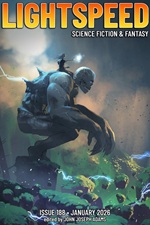
 Lightspeed #188, January 2026
“Mother’s Hip” by Corey Jae White and Maddison Stoff
“Choose Your Own Damnation” by Kehkashan Khalid
“Bots All the Way Down” by Effie Seiberg
“Where the Chicken-Footed Dwell” by Marisca Pichette
“Hunter, Hunter” by Oluwatomiwa Ajeigbe
“Academic Neutrality” by M. R. Robinson
“A Brief Public Announcement” by Eli Brown
“The Moving Finger” by Adam-Troy Castro
Reviewed by Victoria Silverwolf
The main character in “Mother’s Hip” by Corey Jae White and Maddison Stoff is cybernetically connected to a military aircraft that releases a huge number of drone weapons against the enemy. She is programmed to think of these weapons as her children. Alternating sections of text deal with her life after she is disconnected from the aircraft, when she performs songs dealing with her previous existence.
The story’s binary structure may reflect the fact that it has two authors. If so, they have managed to integrate their styles smoothly and effectively. Both the military scenes and the quieter scenes are vividly realized. The main character’s emotional trauma after she feels as if she has lost her children is particularly powerful.
In “Choose Your Own Damnation” by Kehkashan Khalid a student gets in trouble for getting a bad grade and for an inadvertent act of shoplifting. The attempted solution to these problems involves a gate to Hell.
As the title implies, this brief tale is structured as if it were a choose-your-own-adventure text. The student’s wiser choices are crossed out, so the reader does not really have the option to change the story’s outcome. Readers may find this structure clever or gimmicky.
“Bots All the Way Down” by Effie Seiberg features an artificial intelligence that fails to attract enough users to the website for which it works. It finds out that most of the entities on the internet are also AI’s.
This tiny story is narrated as if it were a bedtime story for AI’s. The mood is very light, with a touch of satire of the way that companies try to attract users to their websites.
In “Where the Chicken-Footed Dwell” by Marisca Pichette a young woman goes into the forest to find a witch who will cast a spell to make people leave her alone. She discovers several magical houses and joins them.
As the title makes clear, the main house in this story is taken from folk tales about the witch Baba Yaga. Other mythical houses appear, such as the candy house visited by Hansel and Gretel. The story’s most original concept is that these houses are themselves witches, without inhabitants. Otherwise, the work is a pleasant, if familiar, fairy tale.
“Hunter, Hunter” by Oluwatomiwa Ajeigbe takes place aboard a giant starship carrying survivors of a doomed Earth to a new world. During the long voyage, a virus transforms some of the inhabitants into dangerous mutants. The main character battles the mutants, nearly losing her life in the process. After the fight, she learns something new about the voyage and her role in it.
As this synopsis may suggest, the story blends several familiar elements from space opera. The author creates an interesting background, but the plot is melodramatic. The climax is very sudden, with a revelation about the character’s future that comes out of nowhere.
In “Academic Neutrality” by M. R. Robinson, a university has inadvertently signed an agreement with the Devil. When students protest, a curse placed on the agreement causes them to kill themselves in gruesome ways.
The story appears to be a grim satire on educational institutes compromising themselves to obtain grants from donors. It is best appreciated as a bloody horror story.
Well under four hundred words long, “A Brief Public Announcement” by Eli Brown relates how the first humans on the Moon were destroyed by the ruler of that satellite, who went on to take over Earth. There is not much more to this miniature work than its unusual premise.
The narrator of “The Moving Finger” by Adam-Troy Castro is a being that causes those who relate to it to vanish completely; so much so that they have never existed at all. In the form of a human male, he briefly becomes a woman’s lover, but her fate is inevitable.
The fantasy premise is original and has a great deal of emotional power. There is little plot other than the narrator’s relationship with the doomed woman, a meeting with another being of the same kind, and an encounter with children. The narrator’s acceptance of a nature that cannot be denied or controlled comes across effectively, but this full-length short story might have worked better as flash fiction.
Victoria Silverwolf saw several turkeys near her house recently.