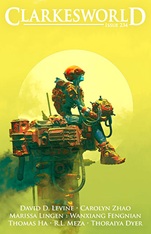
 Clarkesworld #234, March 2026
“Bend Like the Palm” by David D. Levine
“First Human Ghost on Mars” by R.L. Meza
“Crosstalk, Elysium” by Carolyn Zhao
“Scion” by Thomas Ha
“Scion: Afterword” by Thomas Ha
“Those Who Left History” by Wanxiang Fengnian (translated by Stella Jiayue Zhu)
“You Are Invited to Our SPRING CELEBRATION” by Thoraiya Dyer
“Person, Place, Thing” by Marissa Lingen
Reviewed by Axylus
“Bend Like the Palm” by David D. Levine presents a mostly-optimistic take on an island full of people whose lives are spent coping with the negative effects of climate change (rising tides and increased storm activity). Each house has solar panels and a desalination unit, they are scrupulous about conserving and sharing resources, and so on. The small society is extremely communitarian, and their government tends to be decentralized far more often than not. The striking thing is how inherently noble everyone seems to be, in an everyday sort of way. They take this whole community-over-individual thing very seriously, as codified into “Four Principles that govern our republic to this day: Interdependence, Adaptation, Cycling [of resources], and Succession.” [If you do an Internet search on those terms, you’ll be directed to a textbook on “Introduction to Community Psychology.”] This is not a story with a plot or any kind of conflict that comes to a resolution. Specifically, “Bend Like the Palm” is an anecdote that shows how communitarian-minded people plan to deal with an impending typhoon that will perhaps seriously damage their island community. You can’t really say that any of the characters’ actions have consequences, because they don’t take any actions. They just decide what they will do. Moreover, their solution is mundane rather than compelling. As I have noted before in other reviews, emotions are the core component of entertainment value, and I value entertainment more than the author’s evident desire to present a communitarian philosophy. This tale barely registers on that scale.
I have to give props to “First Human Ghost on Mars” by R.L. Meza for its very entertaining concept (the title tells it all). There are several “spirits in space” or “spooky planet” stories, but I don’t remember any human ghosts on other planets (with the traditional definition of “ghost” as the mostly-incorporeal spirit of a deceased human, not a human sentience that inhabits a machine, an AI, an alien life form, etc). “First Human Ghost on Mars” is essentially a puzzle-solving story: how can the ghost of a space ship’s deceased captain save the lives of his crew in their crashed vessel? Along the way, the story offers satisfying and occasionally vivid descriptions of the captain’s thoughts and perceptions as he faces the predicament at hand, the environment of Mars and (spoilers!) Martian ghosts and the spirit of the planet itself. “First Human Ghost on Mars” has an intriguing premise, but it also has logical inconsistencies, and the protagonist didn’t come alive enough (irony noted) to stay with me. Finally, the near-complete lack of dialog, necessitated by the plot, was at times distracting, making the reading experience emotionally detached.
“Crosstalk, Elysium” by Carolyn Zhao is built on one or more plot twist(s), and I’m not gonna give away any spoilers. The protagonist (Dolly) is the pilot of the Karnarian spaceship Elysium, which at its core is an AI being. In all Karnarian ships, the pilot’s first duty is to keep the ship’s AI engaged with interesting stories or riddles so that it will not sulk or drop into a slumber which might leave the crew stranded in space. With the AI duly engaged, the pilot can set a trajectory. The ship’s other two crew members, who are not Karnarian, are its engineer (Harth), and one whose role is enigmatic (Mori). There are also two passengers, a pair of Karnarians who had been pilot and engineer of another ship that was destroyed in battle. Finally, Mori is not the only character in this story whose role is enigmatic, and even the ship’s mission is not made completely clear.
One thing that eventually does become clear is that Dolly is haunted by past trauma, and consequently is an unreliable narrator. However, as the tale goes from clear to unclear and back again, nothing ever suggests what Dolly wants or why she wants it, or how that desire creates stakes that are important to her. Its conclusion then deals with a fateful choice that Dolly makes, but since we were never given any insights into what motivates her, the ending loses much of its potential emotional power.
Obscurity does not automatically create tension; the latter emerges when goals with meaningful stakes (and thus emotional freight) come into contact with opposition, perhaps from within the protagonist. Much as the Karnarian ships in “Crosstalk, Elysium” need an engineer-pilot dyad to function, stories need a paired setup and resolution, stakes and payoff, creation and release of tension. The former creates context, meaning, and emotional significance for the latter. Additional insights into Dolly might also have helped readers share in whatever deep psychological impact the outcome had to her.
I’ve been reviewing at Tangent Online since July of last year (which is admittedly not long), and “Scion” by Thomas Ha is quite easily my favorite story so far. This story begins with the scion of a genetically engineered dynasty (Levinites) scrambling to survive a worldstorm that rocks the mansion where his extended family lives. Many of an inferior race of servants called su have taken semi-permanent shelter in the mansion as well, and are also in peril. They live on a world of unstable atmospheric violent storms that cause dangerous excess radiation, but have adapted over generations, with the aid of halotolerant bacteria. As the young lord goes through the house, he eventually learns he must face his dying father, the ruler of this planet, who can shape the storms. The scion must deal with his scheming cousin Dian, his powerful uncles Biku the Wolfshead and Yom the Beautiful, the oppressed su, and a mysterious monstrous beast. He faces a choice of how to interact with all of these in the present and future.
“Scion” does at worst a creditable and at best an admirable job at almost everything one could look for in a story, including plot, pacing, action, agency, characterization, change, conflict, theme, tension, setting/milieu, and stakes. The penultimate one there (milieu) is perhaps the strongest aspect—fascinating, complex, detailed, multilayered, rife with simmering conflicts and fraying loyalties, it has echoes of the ghost of Gene Wolfe. The story’s weakest point is perhaps its lack of depth in characterization. Potentially interesting characters appear as bit players and are quickly ushered offstage. Rather than letting the story breathe and flesh out its cast and their world, the tale usually sticks to the plot. This is probably a function of length constraints imposed by the publication format. The cost of relative brevity is that although I was very interested in the protagonist and his world, I never felt myself coming wholly alongside him for the journey, until perhaps near the very end. At that point, as bittersweet reflection on a deceased parent comes to the fore, the story takes on more depth. If “Scion” were expanded into a book-length novel, I would definitely label it “seek out and procure.” If it retains its present level of quality, I would probably praise it to friends. If it expands its palette of emotions a little further, fleshing out its characters’ thoughts and feelings, occasionally taking a moment (like Gene Wolfe or Mervin Peake) to explore little antechambers and minor vignettes that offer telling insights into the world and its inhabitants, I would look for it on awards lists. Also maybe a few more sensory words: did that monster have a smell? Strongly recommended.
“Scion: Afterword” by Thomas Ha is exactly as its title advertises: an afterword to the story reviewed above. Despite being much briefer, it does delve more deeply into its characters. I grinned at the Easter egg references to the sunken continent of Lemuria, the TV sitcom Andy Richter Controls the Universe, and the winking self-reference slipped into an homage to seminal authors: “Dr. [Mervin] Peake and others, including Dr. [Gene] Wolfe and Dr. Koji [Suzuki, I presume], think this cenotaph-account is nothing more than a work of simulated fiction.” [I do hope “simulated” doesn’t suggest “AI generated.” Say it ain’t so…] This piece functions extremely well in its role of backfilling gaps in the previous story, with additional insights and enjoyable nuggets of info. However, it does not serve as a stand-alone tale.
It is a dangerous venture to put words in the mouths of other people, or to assume that one understands their motives. Therefore, my take on “Those Who Left History” by Wanxiang Fengnian (translated by Stella Jiayue Zhu) is offered with an armload of caveats. In this tale, a technological advance allows a small number of people to purchase ultra-expensive houses that escape history through “…spatial closure, which involves folding the edges of a small space inward until it closes and disappears from the world… [each house] continues to exist in its own time and place but no longer interacts with the universe.” From the residents’ perspective, they age at the normal rate, but they skim outside of spacetime and live for well past a thousand years relative to us. One catch is that each house is in some way anchored to a specific point on the surface of Earth. In the far-flung future, humans flee Earth in the face of a planetwide catastrophic event, then return and turn the planet into a tourist spot. Finally, they seek to dismantle it piece by piece. Doing so would untether the houses from their geographical anchor on Earth, causing the residents to drift into the galaxy, alone and lost to time. There is an official hearing, with one participant facing down a mass of officials and offering rather pointed philosophical arguments against abandoning those who are lost outside of time. The naysayer prevails.
My interpretation of this story by Wanxiang Fengnian (a pen name which means something like “May all things be prosperous and bountiful”) is that it is a political protest story. Specifically, it seems to be pointed very directly at the criminalization (in China) of “historical nihilism.” A Foreign Policy article from 2022 gives a quick grasp of the issue:
China’s War on History Is Growing—The government is inviting snitches to report on “historical nihilism.”
https://foreignpolicy.com/2022/09/23/china-historical-nihilism-li-jiaqi-ccp/
Two lines of that article are:
* “History either is official history, or it’s nothing, nonbelief, nihilism.”
* “[Xi Jinping believes] that tolerating contested histories threatens the legitimacy and stability of the regime.”
That has very direct parallels in the story:
* “The engineering committee argued that it had no reason to recognize the existence of a hypothetical history…”
* “…the presiding judge reminded me that if I wished to persuade the committee and the panel, I would have to give a clear account of the benefits and risks to society.”
The story concludes with an argument to the effect that “the eyes of history are on us” (echoes of Hamilton). This line of argument silences his opponents and successfully refutes the bureaucratic attempts to deny or erase history. By analogy, that might be seen as suggesting that the Chinese Communist party’s interdiction of historical nihilism is on the wrong side of history, and by extension, of moral standards that should guide human behavior. If my guess is correct, then Wanxiang Fengnian has my sincerest respect as a human being. Speaking as a reviewer of genre fiction, however, this story doesn’t quite pull the rabbit out of the hat.
“You Are Invited to Our SPRING CELEBRATION” by Thoraiya Dyer is a story of first contact between humans and a wholly alien species. The aliens’ breath is fatal to humans. I like it when stories make me think “oh, shit,” even though what I feared would happen did not. One subplot was either overpromised or underdelivered. Recommended.
“Person, Place, Thing” by Marissa Lingen is yet another brief and clever tale of first contact with a wholly alien species. These last two tales seem complementary, even down to nearly-identical character types. It’s almost as if Dyer and Lingen sat in on the same writing workshop and were given the assignment “Write a short story (4000 words or fewer) of first contact between humans and a species that is wholly alien to us and cannot comprehend something that humans take for granted. It should not be set on Earth. Include two humans of [Character Type A] and [Character Type B].Then [Event A] happens to the humans. How do the aliens respond?” If I may ask, have you two considered collaborating?