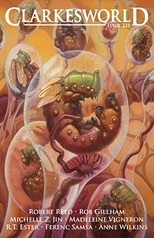
 Clarkesworld #231, December 2025
“Tomorrow. Today.” by R.T. Ester
“The Cold Burns” by Anne Wilkins
“Between Here and Everywhere” by Robert Reed
“Home Grown” by Madeleine Vigneron
“Imperfect Simulations” by Michelle Z. Jin
“The Hole” by Ferenc Samsa
“This Sepulchral Aegis” by Rob Gillham
Reviewed by Mike Bickerdike
This issue of Clarkesworld offers 2 novelettes and 5 short stories.
“Tomorrow. Today.” by R.T. Ester is an interesting SF short story, offering an intriguing premise. A child, born with a serious medical condition, is given a new body every four years; the replacement bodies being necessary as they do not grow in the normal fashion. The child therefore seems not to age for four years between instances of body replacement. It’s a well-told tale, exploring whether one’s body and its physical age, define who we are as individuals.
“The Cold Burns” by Anne Wilkins is a dystopian SF short story, set in a nightmare authoritarian world. Those who don’t keep their families carbon footprint below a rating of 10 are frozen and shipped off to the Moon for processing as a prelude to colonising Mars. A young man gets work in a freezing works, living in terror that his sick mother won’t escalate their footprint rating. The ideas a fine here, though the approach is a little heavy handed. Some of the physics seems off base too, which perhaps shouldn’t matter, but I suspect certain ideas will be jarring for many. For example, it was revealed that humans would defrost from 200 degrees below freezing within five to ten minutes if exposed to the air.
“Between Here and Everywhere” by Robert Reed is an SF novelette, set in the far future on his oft-used ‘galaxy ship’. The nature of the ship is not the only mystery here—Reed manages to introduce a new, unexplained SF idea or situation into every paragraph, never resolving any of the reader’s questions satisfactorily, but rather building obtuse dialogue on top of bizarre events until we are overwhelmed by its strangeness and at a loss as to what is occurring or why. Moreover, the plot fails to engage, and the style is so fixatedly surreal, it’s a chore to read. This tale is likely to split opinion at best, which is a shame, as Reed is a famous and accomplished author and my expectations were justly high at the outset.
“Home Grown” by Madeleine Vigneron is a reflective SF short story. Two sisters toss a coin to see who will escape a dying Earth to join a generation ship to another world. If one sets aside the unlikelihood that the ship’s passengers might be chosen this way, the tale is reasonably successful. The story focuses on the shipborne sister’s dreams of her lost sibling, as she starts her own family. The story is not faultless—it’s rather mawkish and the protagonist is too self-absorbed for us to sympathise with her unreservedly, but it’s quite readable.
“Imperfect Simulations” by Michelle Z. Jin is an entertaining SF short story, set on Alpha Centauri b, site of a new human colony. A boy in school has an augmented mind, such that he can calculate the chances of events unfolding with great accuracy (in a manner reminiscent of Frank Herbert’s ‘mentats’ in Dune). However, due to his incredible foresight, he can predict almost unavoidable problems of the horizon that will threaten the colonists. This is well written and thought-provoking, offering a new perspective on the challenges of colonisation of new systems. Recommended.
“The Hole” by Ferenc Samsa is a highly inventive SF novelette, that reads almost like a fantasy. In a far future, a small remnant of humanity shares their city with servitor ‘golems’, and spend their spare time at houses of entertainment. The ‘houses’ offer twenty or thirty minute shows of violence, decay and disease, for reasons that are never fully explained. This backdrop for the plot is effectively shown, however, and the extreme and strange nature of the future culture recalls Ballard’s short fiction. The protagonist works for the ‘Castle’—seemingly the seat of authoritarian power—and he is hunting a renegade golem. In between work-shifts, he converses with a mysterious female tenant who lives next door, speaking to her through a hole in the wall. Overall, this is more interesting than most of the other stories here, and is also well-structured and paced. It’s recommended reading.
“This Sepulchral Aegis” by Rob Gillham, a short SF story, concludes this issue of Clarkesworld in a satisfying way. It’s a very intriguing story, turning the technological advances inherent in ‘generation spaceships’ on their head; when an ‘alien’ is brought onboard a generation ship, the new visitor turns out to be a much more advanced human. The ship has been travelling through space so long—with crew and colonists in deep freeze—that their technology seems archaic and primitive to the female human visitor. The scenario is interesting in showing the challenges and disruption caused by mixing divergent technological levels. Overall, the story is rather good.
More of Mike Bickerdike’s reviews and thoughts on science-fiction can be found at https://starfarersf.nicepage.io/