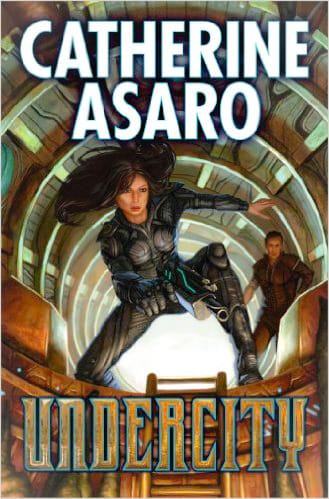
 Undercity
by Catherine Asaro
(Baen, December 2014, tpb, 292 pp.)
Reviewed by Dave Truesdale
Set in her long-running, popular Skolian Empire series, Catherine Asaro starts a new sequence with female protagonist Major Bhaajan, former Skolian military (Imperial Space Command), now private eye. Bhaajan takes on a new case (handsomely paid) from an unknown client on her distant homeworld of Raylicon (the historically important world upon which the Ruby Empire was founded and which features prominently in Catch the Lightning from 1996). Traveling to Raylicon, Bhaajan discovers her client is a member of the ruling matriarchal family—the House of Majda. Matriarchal ruling families are the norm here, with males sequestered and treated much like women in an Earthly harem, though not as harshly. In fact, they are treated quite well, given in-house educational opportunities and other “freedoms” within the palace confines. That said, they are not allowed out in the world alone and are kept away from females not in their own ruling family. Bhaajan has been called to find Dayj, one of the to-die-for handsome princes from the house of Majda, who has escaped and is now out on his own experiencing what he feels he has been missing. The situation is a critical one, in that the House of Majda has many enemies, and the missing prince, well-meaning but naive to the real world, fails to realize what a bargaining chip he might become if abducted. Thus, Major Bhaajan has been called in to find him at any cost.
A native of Raylicon, Bhaajan grew up as an urchin in the underground, generations-old slum society beneath the City of Cries with other orphans and forgotten outcasts, running in gangs and surviving as best she could. One of the few to make it out of the slum underground, with its labyrinthine maze of tunnels and caverns, aqueducts and canals, ofttimes illegal activities and warring gangs, Bhaajan trades on her knowledge that anything of importance going on in the City of Cries is known to the information underground. Contacting old friends who are plugged in to the latest scuttlebutt and gossip, she uncovers bits and pieces of information concerning the whereabouts of prince Dayj, confirming her worst fears. Dayj has indeed been captured by a nasty gang lord, a person she knew long ago but who has now taken a dark path to further her own greedy ends. Amidst hidden danger, several high-tech fight scenes and some fancy maneuvering, Bhaajan’s efforts pay off and Dayj is found. But this is only half the story, for in the rescue attempt Bhaajan learns just why Dayj has been held, which turns out to encompass a larger, more dire scheme involving impending all out war with the rival gangs, a war with far-reaching implications. And while trying to forestall the upcoming internecine underground war Bhaajan uncovers yet another secret the militaristic warrior gang is hiding and which could involve the balance of power in the entire Skolian Empire itself.
It all ties in nicely and is a credit to the author. A missing prince leads to the discovery of an underground war in the making, which leads to further discovery of something (not revealed here) having ramifications for interstellar travel that could alter the balance of power for whichever interstellar power possesses it. And this something, in turn, directly involves the underground society, culture, and people beneath the City of Cries that literally no one expected—least of all the rulers of Raylicon, Bhaajan, or this reader. Another nice plotting touch is that while Undercity takes place on a single planet—a microcosm if you will—the closing reveal (the final something exposed) shifts our attention to interstellar travel and the greater macrocosm of the Skolian Empire itself, which leaves us wondering what the author has in mind for volume two in the adventures of once street ruffian, then Major in the Skolian military, and now P. I. Bhaajan.
There are more personal details involving Bhaajan’s early life and those she left behind, including interesting bits of detailed story business which are best left for the reader to discover, for they breathe the necessary and welcome depth into this otherwise action and plot-oriented tale, giving it a well-rounded feel.
At the end of the book the author provides a complete timeline of events for all of the Skolian books and stories, showing us that Undercity takes place in 2205 A.D. (relatively early in the entire timeline of the 15 or so previous novels—depending on how you count—at less than 100 years after Earth discovered interstellar flight with the famous inversion drive in 2122 A.D.), and is when the Dust Knights (referenced in other novels) were formed. Asaro took advantage of a nice opportunity to fill in some history with that little origin story.
For those familiar with and already fans of Catherine Asaro’s Skolian Empire novels (one of which, The Quantum Rose, won a Nebula award in 2000) this one will not disappoint. For those coming to Asaro and the Skolian Empire for the first time and who like entertaining SF adventure anchored in the detective milieu, Undercity would be the opportune place—the first in a new series—to take the plunge.
♣ ♣ ♣
Next: Artemis Invaded by Jane Lindskold (Tor, June 2015, hc, 320 pp.)
Dave Truesdale has edited Tangent and now Tangent Online since 1993. It has been nominated for the Hugo Award five times, and the World Fantasy Award once. A former editor of the Bulletin of the Science Fiction & Fantasy Writers of America, he also served as a World Fantasy Award judge in 1998, and for several years wrote an original online column for The Magazine of Fantasy & Science Fiction. Now retired, he keeps close company with his SF/F library, the coffeepot, and old movie channels on TV. He lives in Kansas City, MO.