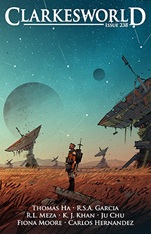
 Clarkesworld
 “The Life and Times of the Extraterrestrial Potoo” by K.J.Khan
“Cliff’s Girl” by Fiona Moore
“Focus” by Carlos Hernandez
“The Animator and the Glazer” by Ju Chu (translated by S. Quiuyi Lu)
“Our Revels Are Now Ended” by Thomas Ha
“This Is an Emergency Broadcast” by R.S.A. Garcia
“Nesting Behavior of Imported Species Troglodytes Aedon on Planet Americearth” by R.L. Meza
Reviewed by Henry Gasko
A huge issue of seven stories in this month’s Clarkesworld, totaling over 50,000 words. It opens with “The Life and Times of the Extraterrestrial Potoo.” This story, by K.J. Khan, brings us another installment of that recently popular science fiction cliché, the rapacious conglomerate making money by exploiting the resources of a newly discovered Earth-like planet, even though they know that the planet should be off-limits because of the presence of intelligent life.
In this version, Isaac, a ne’er-do-well young man from Earth, is collecting alien pollen, a magical substance that can apparently give humans a life extension boost. Through a series of unlikely accidents, Isaac becomes separated from his partner and then loses the use of his communication equipment. But at the same time he meets one of the funny-looking but cute locals that the humans have dubbed “Potoos” after the funny-looking but cute species of terrestrial owls.
He christens the alien Dave and together they wander through the forest. Nothing much happens in the way of actual action, but they do become friends (Dave can read minds so they have no problem communicating) and Isaac eventually learns that the aliens in fact have a very odd life cycle: they are some kind of animal-plant symbionts and their reproduction depends on the pollen that the trees are releasing into the air and which Isaac has been busy harvesting. And unsurprisingly, with this new-found insight, Isaac determines to do something with his otherwise wasted life to save the Potoos, although exactly how is not at all clear.
So a well-meaning but obvious story which is really more fantasy than science fiction: not only is the alien pollen incredibly useful to humans despite having evolved in another solar system, but the alien Dave is able to transform in an instant from the height of a small human being into a 30 foot giant before shrinking to the size of an ostrich egg in preparation for his rebirth.
You have probably heard of “cozy mystery” stories, the type of mystery usually set in the English countryside, with not a lot of actual menace and a solution that is delivered in due course by some genteel busybody with too much time on her hands and an unhealthy interest in her neighbors’ affairs. And if there is a cozy science fiction equivalent, it would be “Cliff’s Girl” by Fiona Moore. This is a post-apocalyptic story, but banish any thoughts of the horrors of The Road or The Stand or a hundred similar tales. If you had to live in a post-apocalyptic world, this one wouldn’t be bad at all. In fact it is the most bucolic SF tale I have read since the great Earth Abides by the late George R. Stewart from 1949.
The story is set in the country-side of Wales, where the survivors are living peaceful agronomy-based lives with the help of various robots that have also made it through whatever it was that destroyed civilization as we knew it. The main characters are Morag, a farmer, and her younger sibling Cliff, and the story is apparently part of an ongoing series about the two siblings.
Since the surviving robots are incredibly useful, most of the farmers have at least a working knowledge of how to repair them, much as any farmer today would be able to repair a tractor (at least in the days before tractors became basically computers on a very large set of tires).
Cliff is particularly good at these kinds of repairs and has been traveling the hills fixing robots for a living. He has now returned with a companion, Mandy, whose main interest is rehabilitating robots that can no longer do useful farm work, turning them into toys. When they arrive, they learn that Morag’s favorite robot Seamus is acting out of character. They are eager to help but Morag gives Cliff and Mandy strict instructions not to touch Seamus while she goes off to find a solution. Of course things go wrong in a gentle, family-misunderstanding sort of way. But needless to say everything turns out fine in the end, in this best of all possible post-apocalyptic worlds.
There is certainly nothing objectionable here but on the other hand there is nothing terribly interesting either. No strong emotions, no character arcs. And despite the mention of wolves in the hills, there is no real danger. In fact the entire story seemed to be just a minor stepping stone in the series, a way to bring Cliff back to the farm and allow Morag to go forth on her own adventures in the next installment.
I must admit that for a large portion of “Focus” by Carlos Hernandez I was lost and confused. The story begins with a meeting of a bird-watching club near Lake Zurich (not that the location plays any role in the plot). A motley crew of attendees are partaking of a feast but are mostly bickering about what to do with the body of one of their members, Julio, who apparently died in mysterious circumstances the previous day. The crux of the debate centers on “Delphis” which are cornea implants that allow them to see the birds through any members’ eyes, and possibly do much more, and which Julio has implanted in each of the members before his death.
But what are the full functions of the mysterious Delphis? Why did Julio die? And why do the birdwatchers fear that he may be able to harm them from the afterlife? None of these questions are answered even as the characters engage in about 6,000 words of witty repartee, leaving the reader wondering what in the world is happening.
But then the author deigns to give us a flash-back, a short section which tells us in very efficient terms everything we need to know to understand what has been going on. Unfortunately this occurs around the two-thirds mark of the story, with the entire initial part being nothing but an extended flash-forward to supposedly whet our appetite.
But by this point I was floundering and had frankly lost interest; I was certainly not tempted to go back and revisit the proceedings. Clearly this author, like many others, thinks that the way to create suspense is to withhold information from the reader and make us wonder what has happened, rather than giving us the necessary background early on so that suspense can arise naturally as we wonder what is GOING to happen.
Artificial Intelligence, or AI, is the topic of a massive amount of debate at the moment. Much of the discussion has been about its voracious appetite for electricity and water, and these are legitimate concerns. But they are merely technical issues to be solved. The real question is how will the creative work of humans, upon which the AI’s suck like so many leeches before regurgitating their own feeble copies, be safeguarded. This is the theme of “The Animator and the Glazer” by Ju Chu. In this near future, creators of art must employ a “Glazer” to safeguard their work from assimilation, preventing copycat works by AIs. Glazing involves making minor changes to the pixels of the artwork, leaving it unchanged to human eyes by rendering it almost impossible for an AI to analyze and reproduce. I’m not at all sure that this would work in practice; current trends seem to indicate that the AIs are probably more than equal to bypassing any little roadblocks we throw in their paths. But that is a debate for another time.
In this story, the Glazer Lu Yuan fails to carry out the necessary updates to his software and the AIs are immediately able to copy the style of the Animator Wu Tuo, leading to financial ruin for both of them. Things look dire until Wu Tuo resorts to drastic measures to safeguard his artistic style, with a maneuver that is perhaps more metaphorical than realistic but is all the more chilling as a result. This is a highly recommended story about a technology that is already bulldozing a path of destruction through the world’s creative endeavors, leaving behind a landscape where AIs will have nothing to feed on but the regurgitations of other AIs, ad infinitum.
“Our Revels Are Now Ended” by Thomas Ha is a cross between Borges “The Library of Babel” (which the narrator acknowledges) and Patrick McGowan’s The Prisoner (which is not acknowledged). As in that intricate spy allegory from the 1960’s, there is an interrogation taking place here, though it is never quite clear who is interrogating whom. Add to that a touch of surrealism in the form of a giant book-eating monster and you have a fascinating story which, for once, possibly explains itself too fully.
“This Is an Emergency Broadcast” by R.S.A. Garcia appears to be an attempt to write an edgy, torn-from-the-headlines, in-your-face type of story. The style is a series of short paragraphs that segue into one another in what is obviously meant to be a jarring fashion, linked by nothing more than a common word. This results in a “story” with no real cause and effect, no dialogue, and no narrative structure. The bits and pieces do link back to an ongoing thread: the release of a new online system called Restful that can feed fantasies directly into the brains of those who subscribe, in a way very reminiscent of Dick’s “We Can Remember It for You Wholesale.” And the process is further tied to a soporific drug called Lulsify, a device that dates as far back as Huxley’s soma in Brave New World. So unfortunately there is nothing really new here, despite the post-modern presentation.
Along the way there are also allusions to just about every ill that the modern world is facing, including a president’s undeclared war, online influencers, climate change, reality TV, mass shootings, and consumerism. All of these are meant to cast the piece as some kind of larger satire on modern society. But with such a scatter-shot approach to such a wide range of easy targets, it’s soon obvious that there is no room for exploration of the trends in any depth, or even superficially.
The final story, “Nesting Behavior of Imported Species Troglodytes Aedon on Planet Americearth” by R.L. Meza, uses another minor trope in the SF universe: a story told from the point of view of an alien. In this type of story the alien has no conception of what the humans are actually doing, and describes every action literally and without context. The entertainment value is meant to lie in the reader’s ability to guess exactly what the humans are actually up to. So in this story, we have “screamers” who are humans that we eventually learn are engaged in the other common trope that we encountered in the first story this month: the predatory and insatiable conglomerate effectively raping a planet despite the existence of a possibly sentient species. Your enjoyment value will depend on whether you think these sorts of guessing games are clever and witty or merely juvenile and pointless.