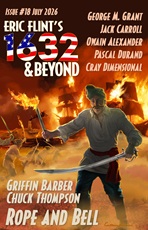
 Eric Flint’s 1632 & Beyond #18, July 2026
“Rope and Bell” by Chuck Thompson and Griffin Barber
“A Break In The Clouds” by George McClellan Grant
“Rumors On The Rialto” by Jack Carroll
“Shut Up And Train More” by Owain Alexander
“Who Killed Snow White?” by Pascal Durand
“Through The Eyes Of A Canine” by Cray Dimensional
Reviewed by Malory
[Editor’s note: The following is offered by Tangent reviewer Mike Bickerdike as a guide for those not familiar with this magazine’s concept. Eric Flint’s 1632 & Beyond is a magazine comprising stories set in the late Eric Flint’s “Ring of Fire” or 1632 alternate-history universe. For those unfamiliar with the books, the essential concept is that the town of Grantville in West Virginia became transported (by cosmic accident) from our present day to northern Germany in 1632 during the 30 Years War. The book series extends to dozens of novels. The short stories in this magazine are set within that framework.]
Issue 18 brings to an end the third year of this magazine and the opening editorial highlights that, unusually, there’s no theme. Instead, these are “the sort of stories most of us started with: writing about something we care about and exploring what happens with it in the new timeline.” The issue is as good as its word with half of the authors here new to the 1632verse. The stories of the three newbies lean hardest on the premise, while the three veterans lay track for stories that haven’t arrived yet.
In “Rope and Bell” by Chuck Thompson & Griffin Barber, a broker is hooded and delivered to a warehouse in Surat in order to commission the burning of a new shipyard and the slaughter of its shipwrights. At the same time, hundreds of miles north, an engineer is sent down from Agra to help build river gunboats a sultan has no infrastructure for. It’s worth flagging, I think, that this is the magazine’s first story set in India.
I found the action here to be the best in the issue and I very much liked the engineer too. What I couldn’t square, though, was the opposition. The two antagonists were both given long viewpoint sections early, but then they left the story. Also, I couldn’t help but feel that the cult they belonged to arrived a touch pre-assembled, especially with a character name-checking the Temple of Doom. Essentially, though, in an issue where the editorial asks for stories about something the writer cares about, the villains felt inherited rather than made. Nevertheless, the tower sequence is superb and well worth the price of admission alone.
The second piece, “A Break In The Clouds” by George McClellan Grant, considers who rebuilds weather forecasting when no meteorologists came through the Ring of Fire. The answer is Evangelista Torricelli, who has discovered, a touch unnervingly, that his life’s work is already written. I found this to be the best premise in the issue, but the story takes too long to start using it! The opening parts are lectures, business chats, pitch meetings, resignations and a job interview. They’re all well done but the stakes are… low. Fortunately, the second section is a very different animal, and a detail planted in a farm scene near the beginning returns to carry the end with real force. Sadly, I must admit a difficulty with Torricelli’s dialect, which oddly never improves across six years of immersion, and rather turns a great mind into something a bit too comic.
“Rumors On The Rialto” by Jack Carroll has a fun opening where a Venetian secretary and a merchant captain are, over prosecco, working out that four separate forces are converging on Lübeck faster than wind and roads allow. That scene is excellent, and I enjoyed the technical details of an antenna in a newspaper woodcut, a known transmission range, and the contradiction between them.
Carroll clearly understands institutions, and his Venetian bureaucracy has a genuinely felt texture to it. But there’s more to this story than that and I wish it had been allowed out. The man at the tale’s center lies dying, having found that the woman he lost twenty years ago is now widowed. For quite a powerful conceit, there’s a curious lack of actual drama here, and the story just stops mid-meeting. I think there was more to do here to pull the reader into the actual narrative which could have stood it.
“Shut Up And Train More” by Owain Alexander is the first of the debuts, and it gives the story to the Grantville fire department and there’s real expertise in the writing. I enjoyed the focus on the gear, the donning sequence, the pump panel, and the crew moving through the smoke each holding the boot of the man ahead. I might be wrong, but this read like a man who’d lived it rather than just researched it. I also enjoyed a running gag about a firefighter’s personal alarm paying off hard when the beeping stops being funny and the best passage is where the chief looks at a cigar and works out what century he’s lost. However, against that, there’s at least twenty named characters in a reasonably short story so it wasn’t always easy to feel involved with the general thrust of things.
“Who Killed Snow White?” by Pascal Durand sends a young aristocrat into the Grantville library, where he finds his own family in the Brothers Grimm. His kinswoman died in 1554 at the Habsburg court and the idea underneath the tale is a good one. The dwarfs were miners, the word describing men bent and shortened by years underground, many of them children. The crypt scene it builds to is definitely the finest set piece across the collection where we have four people around one preserved body, arguing about what it means. Sadly, Elisabeth—who is the most alive person in the story—doesn’t arrive until halfway through and the family confrontation that should’ve been the emotional crux is disposed of in summary. There’s an excellent second half here, but the first needed a punch-up.
“Through The Eyes Of A Canine” by Cray Dimensional is the best story in the issue. Hilde, eighteen, is being run out of yet another town for telling people that she speaks with God and Satan. But then the road ahead drops away and there’s suddenly a parking lot.
I’d suggest readers ignore the title, because there’s no talking dog. There is, though, a young woman who works out her dog will greet a person who’s really there and ignores one who is not. Throughout, the reader stays just ahead of Hilde, with the up-timer’s English rendered through her comprehension gap, reaching her in fragments. Overall, this is a story about a corner of the 1632verse where the cure is indistinguishable from theft, and it needs no prior reading at all.
In conclusion, laying track is solid work in a shared universe, and the regulars who do it here are the reason there’s a universe to jump into. Still, the true power in Issue 18 runs through the three writers who haven’t quite learned the house style yet: a fire department, a fairy tale read as an industrial crime, and a psychiatric story. I’ve always thought that ideas are harder to teach than sentence structure and that’s the true win for this issue.
Malory reviews short fiction and is still working out where the good stuff hides.