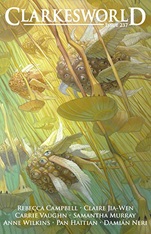
 Clarkesworld
“Up the Line to Death” by Carrie Vaughn
“The Floating Republic” by Rebecca Campbell
“A Life Measured in Seconds” by Anne Wilkins
“Ice, Rock, Empathy” by Damián Neri
“The Potential Side Effects of Roleplay Stimulation Therapy” by Claire Jia-Wen
“Three Cases from the Cosmic Psychiatric Clinic” by Pan Haitian (translated by Blake Stone-Banks)
“Burning Day” by Samantha Murray
Reviewed by Seraph
“Up the Line to Death” by Carrie Vaughn
I don’t think that there is any plot more classic to science fiction that autonomous entities gaining awareness and sentience. That does mean the bar is pretty high anytime an author wants to brave that well-worn path, but this is an easy recommend. Lucas is a civilian contractor with a military division that runs unmanned combat drones, when every UCAV across the world simultaneously land and go into standby mode. When the investigation turns up multiple lines of anomalous code, it turns out to be quite the opposite: poetry. The story deals with very prescient concepts about the ethics of warfare in an era that is changing more rapidly than almost any other, and the reality of what happens when you want a program to be just smart enough to follow orders but not enough to question them. The story maintains a truly human element to a situation that questions what humanity truly means, and the addition of poetry to the progress towards the Singularity is a really interesting touch. What better way to express emerging sentience and consciousness of thought than poetry?
“The Floating Republic” by Rebecca Campbell
Captain Ignatius Faber is Captain of the Philoctetes. Not because he worked his way up, per se, but because he alone survived and remained aboard to inherit the rank. GLZ7E is so very far from Earth, Mars, and the companies whose names change as they war over things far too distant to affect any of the few who have survived out here. For decades, they have survived with their diminishing supplies and crumbling ship high in orbit above the planet. They build lives below on the planet as he keeps an eye on them from above, holding the line as the Company says. The story really begs the question of what it means to live. Is it survival? Adherence to company rules even when the company no longer exists? Is it the unexplored planet and all of its mysteries? Perhaps the people who live, and die, and those who are born as the years march on. Three decades later, is there any reward from the new Company and its soldiers when they finally arrive, with a new warship and new supplies, fancy new uniforms, and no ability to even walk straight in the intense gravity of the planet? The story is that of human settlers, just as all those who came before them throughout the length of human history, choosing to venture out into the unknown. Choosing to cleave to those near them, those they love, those whom they could not survive without. There is no withering criticism or pointed argument being made here… just the quiet commentary on human life and experience, through the eyes of those who forge the way and create the truth of the word home.
“A Life Measured in Seconds” by Anne Wilkins
On the 21st of March, 2615, Ashwan was almost born a God, just a second too late. From that statement alone, you’d think this story was going in a completely different direction than it does, and it was a really interesting subversion. The story is not about mythology, but is rather more like cyberpunk, minus the violence that usual typifies that genre. Barra is a God, and if she could give anything at all, it would be to not be a God, to be normal and allowed to live a life of her own. The concepts here are as human as they can be, questions of free will and personal autonomy, but it is wrapped in a technological aspect that only makes those questions more pressing, and more terrifying in their importance. The contrast between two people born a single second apart yet as different as can be is… striking.
“Ice, Rock, Empathy” by Damián Neri
What remains of the individual after death? Especially when death is not necessarily the end? This story is an exploration of becoming part of something more, something new, as one life ends and the mind/soul returns to nature. Europa does not seem to me to be an easy place for humans to explore, no matter the era or the level of technology. But here, in this story, they manage… in a sense. Like you might imagine, Galileo Base does not fare well in such a difficult and unpredictable environment. However, those few brave souls are not alone in that alien landscape, and while their lives and bodies are quite predictably lost, some few of their minds are able to be rescued by the mysterious creatures that are native to Europa. This story is so very highly imaginative, and I really loved it. It would be very easy to get excited at all of the possibilities, to rush the story, but the pacing was almost precisely perfect, and the depth of the descriptions and interactions really sold the vision, for me.
“The Potential Side Effects of Roleplay Stimulation Therapy” by Claire Jia-Wen
Therapy in the virtual space is genuinely fascinating. For decades, even centuries (or longer) in some cases, various practices have taught visualization and meditation as a way to confront and overcome trauma, take back control of your life. I couldn’t honestly assess whether going above and beyond, providing a virtual reality experience rather than a purely mental/ spiritual one, robs the participant of the discipline and self-discovery that is so central to the meditative methods. Or perhaps it frees up so much of our mind’s processing power to explore the trauma in a safe and controllable environment that the healing can occur more completely. My guess is that both can be true. For Emma, the story strikes a bit of a different balance, and I think it is a profound one. She goes to this virtual therapy because she was injured and, due to the damage to her hands, has lost the central love of her life: her ability to play beautiful music. Whether the therapy helps, whether it does not, it is more so who she meets when going to therapy that makes such an impact on her life. Through the time she spends with her new friend Charlotte, the things Emma observes and recognizes about herself and her own trauma, and the way she grows and learns to stand strong… it’s beautiful. Healing always is, however it is achieved. I think the balance the story strikes is that regardless of what technology we develop, it is the people we care about who save us, and something about that I think will always be true, in any era. The technology may frame or characterize the times in which we live, but it is the human element that defines us and propels us forward.
“Three Cases from the Cosmic Psychiatric Clinic” by Pan Haitian
I’ve read that good story structure consists of three acts, but I would have been happier if this one stopped at two. Well, more specifically if the first of the three cases was left to stand on its own. It doesn’t really fit with the second and third case, and is easily good enough of a story to stand alone on merit. That said, all three cases are told through the voice of Chu Fei, who is a psychologist on the Deep Space Gate. The Gate is a human space station out by the Kuiper Belt, and Chu Fei so wishes to be done with his time there. He doesn’t care for the station or its inhabitants any more than they care for him, and in his mind such a place is the breeding ground of madness. The first case imagines if Geppetto were a psychologist and Pinocchio the patient, and as previously mentioned, would make a wonderful story all on its own. It’s a very clever twist on an old theme. The second case is more sociological than psychological, but centers around consumerism and how wrong it can go. It would seem to me as though it is an attempt at a criticism of capitalism, but I could be projecting on that bit. It is most certainly a criticism of human nature, and probably on more topics, but the first case set such a high bar and this second case just doesn’t match it. It feels disjointed and diffused, not really very clear at all. The third case is also more of a sociological study, but this time on artificial intelligence (specifically a hive mind) and vigilantism in the machine sentience as a response to witnessing crimes humans commit. This case, much like the first, is a very clever take on age-old questions, but has more in common thematically and structurally with the second case. Taken as a whole, the novelette starts very strong and ends almost as strongly, and has a lot of really interesting and valid points contained within. Perhaps the overall structure and the diffused nature of the second case would seem stronger to another reader. I’d have been very happy to see the first story be complete unto itself, given more time to shine and more length for the idea to be explored. And to let the second and third cases get more focus and development on their own, kind of find a separate identity, and really blossom in their own regard.
“Burning Day” by Samantha Murray
I initially wanted to write that this story sort of refreshingly steps away from technology, but in a way it just shifts from synthetic circuits to cellular/biological ones. I’ve heard it said that our brains are just complex biological computers, and this story certainly puts a fascinating twist on that concept. The Ixi of Vivix-11 quite literally grow their memories upon their skin, almost in appearance and feel as if barnacles upon a ship’s hull. Different shapes, patterns, and textures all tell of past experiences, loves, and triumphs, though as you can imagine there is limited space since the skin is the canvas for this storage of memory. Every so often, the creatures must clear this space to make room for more, or else they find themselves moving so slowly that they cease to function. There are so many parallels to technology here, but the focus of the story is on the personal side of all of this. What, or even who, remains when all of this memory is purged, the storage reformatted and once again readied for new memories? The being is the same, but at the same time, is not, and those who still feel and remember are left disconnected with the one they once knew and loved. It is both fascinating and heartbreaking to experience, and I’m glad I got to read it. This is going to have me thinking and reflecting for quite some time, and that’s an amazing thing.