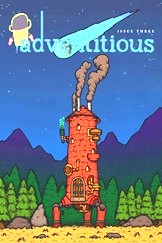
 Adventitious #3, June/July 2026
“Who Tells Your Story?” by Clint Hannah-Lopez
“Alleles” by Amanda Helms
“By the Wings of an Albatross” by Abigail Kemske
“Lindy Bot” by Anna Kahn
“Hollows After Bones” by Elis Montgomery
“The God of the Leftmost Door” by M.R. Robinson
“The Laws of Thermodynamics As Applied to My Dead Mom” by Christopher Blake
“All of My Tomorrows” by L.D. Coulter
“Sunday on the Grass” by John Saul
“Kings_Gambit.exe” by Yelena Crane
“Non Plus Ultra” by M.A. Carrick
Reviewed by Mina
This issue was back to front a good issue, with the best stories in the second half.
“Who Tells Your Story?” by Clint Hannah-Lopez is written by an improv and stand-up comedian, which is how it feels. It’s not so much a story as a conversation between the narrator and Snow White correcting a lot of the narrator’s assumptions about fairy tales. I can see it working well on stage; it works less well in writing. Or I got up on the wrong foot this morning?
“Alleles” by Amanda Helms is a slice of horror. In case, like me, you needed to remind yourself what alleles are: they are matching genes, one from our biological father and one from our biological mother. How they mix and match determines our hair and eye colour.
This isn’t so much a story as the author imagining that there is an allele for your face being covered in ants. Didn’t do much for me.
“By the Wings of an Albatross” by Abigail Kemske takes a look at all our nightmares about teleportation. Marco needs to teleport to an important meeting but things don’t go as planned.
The title “Lindy Bot” by Anna Kahn is a play on the “Lindy hop,” which makes sense in the context of the tale. Tiffany’s husband discovers what Tiffany is willing to do to get back to Earth. The story is skilfully put together and is ultimately a horror story.
In “Hollows After Bones” by Elis Montgomery, we’re in a graveyard with the sentient skeleton of a horse. He follows the glow of a candle, looking for his rider. Where will he end up?
“The God of the Leftmost Door” by M.R. Robinson is a beautiful story. We’re at a way-station for the dead, a pub where they can have a last drink and gather their courage to go through the next door. The god of the entryway is intrigued by the woman who stays for twenty-nine years without saying a word. The god of swept floors persuades him to approach the woman to find out what she is waiting for. For once, they decide to do more than observe and to help the woman.
I particularly loved the names of the “god of long conversations by the fireside after midnight” and the “god of companionable silences.” And the quote: “It’s a scary thing, love. An awful, ugly thing. A beautiful thing and a brave thing.”
“The Laws of Thermodynamics As Applied to My Dead Mom” by Christopher Blake is fun. The narrator is cleaning out his mom and grandmom’s house. It’s quite a task as his grandmom was a hoarder. It’s made even more interesting by his mother’s sentient ashes. Read it to find out how the laws of physics come into it.
“All of My Tomorrows” by L.D. Coulter is very good. Nadia is at her best friend Billy’s funeral remembering a terrible moment in time when she briefly worked as a photojournalist in Jakarta. One of her cameras was a digital camera which generated double images that turned out to be images of the near future. When Billy’s daughter goes missing after the funeral, she uses the camera to work out what happened. And she finds the courage to revisit and face the past.
The only quibble I had with this story was its abrupt ending. But it was gripping and psychologically complex—well worth the read.
“Sunday on the Grass” by John Saul imagines the cow’s thoughts as Seurat paints his famous painting at La Grande Jatte. A comment on the power of the creator (and its limits)?
“Kings Gambit.exe” by Yelena Crane imagines a computer chess universe where “constructs” of dead players must play again and again. Due to a typo in the code, one player, Viktor, is able to think independently. Slowly, he begins to play a longer game to end the enslavement of constructs. Along the way, we learn about his life, his defection from the Soviet Union and his family. He bases his strategy on the fact that algorithms do not understand context. Very relevant in a world gone crazy about AI.
“Non Plus Ultra” by M.A. Carrick is an interesting mix of myth and folklore. A ship gets stranded beyond the pillars of Hercules and must find its way back to mortal realms. The captain must negotiate and trade with goblins and the fae. His ship traverses many perils in an adventure reminiscent of Ulysses’ travails. My favourite quote is: “Torment brings no good into the world.”
The “real” world is set in Spain at the time when those of Jewish descent had to convert or leave.The Sephardim passengers on board make an interesting decision. The captain’s pilot is of Arab descent and considers himself Valencian.
The historical details are interesting. It was a good read, but perhaps a bit lengthy?