
 The Strange Dr. Weird (1944-45) aired “Death in the Everglades” on November 28, 1944 as the 4th of its 29 episodes. We have run 11 previous episodes of this show since 2018, the last two in May and December of 2025. The show ran from November of 1944 through May of 1945 in short 15-minute episodes (a few minutes shorter without commercials), and was dubbed by some as a poor man’s Mysterious Traveler. Indeed, there are similarities between the shows, though MT had a much longer run of nine years (1943-52) and was a full half-hour program. Maurice Tarplin (photo top right, 1911-1975) was the host/narrator for both shows, and one of the writers for MT, Robert A. Arthur (photo lower right, 1909-1969), also penned the scripts for The Strange Dr. Weird. While MT’s shows included tales of mystery and suspense along with SF and the supernatural, The Strange Dr. Weird concentrated mostly, but not always, on the supernatural. Both shows opened with the narrator setting the stage with a tease for what was to follow, but where MT stories were told in conversation while on a train and ended with the narrator beginning another story only to stop when the unnamed passenger to
  whom the story was being told had to get off, The Strange Dr. Weird ends with a variation on the same gimmick, the narrator beginning a story just as his “guest” has to leave. As you might imagine, with actual story lengths running to around a scant 12 minutes, there’s not much room for characterization or extraneous detail, so only the essentials are conveyed—the idea or dilemma takes center stage and remains the focus. And there is always an unexpected twist at the end, providing the moral comeuppance knife in the heart for the bad guy or evil doer. Short and to the creepy point, there’s no lavish musical score or expensive production values here, only the quintessential organ riffs manipulating and accentuating listener emotion at the proper moments in conjunction with the plights of the actors.
“Death in the Everglades” takes us to the home of a lonely, sick old woman who refuses to move out of her home, even when one of her sons begs her to. The stubborn old woman, who hasn’t seen her other boys in a long time, says she has recently heard from them and they have promised to come visit her, and she is not moving out of the home she has lived in for 30 years until she sees her boys again. The problem arises due to the nature of her loving boys, for as everyone knows not all families are blessed with the functional variety. Listen to this short 13 minute radio play to discover just how dysfunctional some families can be and what eventually leads to a shocking “Death in the Everglades.”
Play Time: 29:51
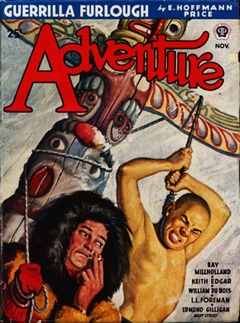
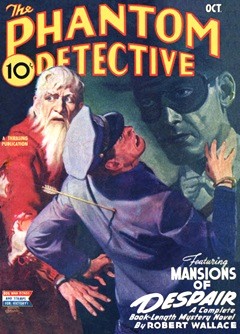
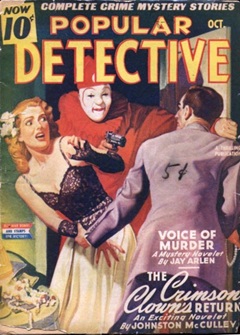
{“Death in the Everglades” aired on a Tuesday evening, 5 days after Thanksgiving in 1944. The neighborhood gang was glad there were no more leftover turkey sandwiches to be found in their lunchboxes. After school the next day they resumed their routine afternoon trek to the corner newsstand to discover what riches awaited them this Wednesday, new magazines arriving most Tuesdays. Adventure (1910-1971) was created in the mold of Argosy, which was selling in the hundreds of thousands an issue. While Argosy featured a wide variety of fiction from western, mystery, romance, and more, Adventure narrowed its focus to stories featuring danger and thrills. Somewhere around the mid-1950s it narrowed its focus even more, becoming more or less a men’s adventure magazine subtitled “The Man’s Magazine of Exciting Fiction and Fact.” It was a monthly in 1944. The Phantom Detective (1933-1953) was Standard Magazine’s answer to Street & Smith’s The Shadow. While it ended up publishing longer, it’s schedule wasn’t as rigorous as that of The Shadow (1931-1949), which remained a monthly for all but its last three years. The Phantom Detective was a monthly in 1944 but transitioned to a bimonthly in 1947 and then to a quarterly from 1950 until its last issue in 1953. Popular Detective (1934-1953) was a prime example of the basic detective pulp. Nothing fancy with its consistently high quality of fiction by most of the best authors in the field, but it was more than enough for its loyal readership that bought a detective pulp for the quality of its stories in the first place. It was a reliable bimonthly in 1944.}
[Left: Adventure, 11/44 – Center: The Phantom Detective, 10/44 – Right: Popular Detective, 10/44]
To view the entire list of weekly Old Time Radio episodes at Tangent Online, click here.