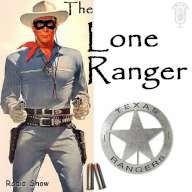
 The Lone Ranger (1933-1954) aired “The Silver Spur” on Monday, June 6, 1938 as the 836th episode of nearly 3,000 (depending on how one counts), though as far as I have been able to discern the first complete, unbroken, extant episode aired on December 17, 1937, with the next episode airing a month later on January 19, 1938. All episodes from January 31, 1933 up to December 17, 1937, and then for the following 4 weeks, are apparently lost.
This is the first episode of The Lone Ranger we have showcased here so some background is in order, much of which I found quite interesting.
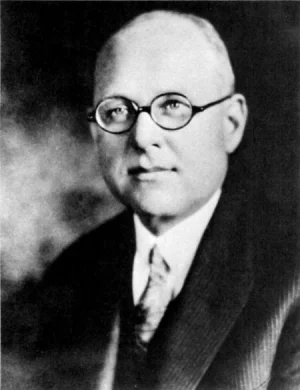
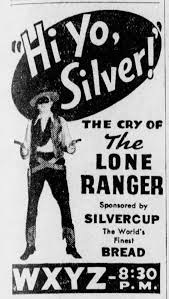
George W. Trendle (1884-1972, photo top right) was co-owner of the Kunsky-Trendle Broadcasting Co. of Detroit, Michigan, and later sole owner of fledgling radio station WXYZ. Trendle wanted to make a name for his station in the area of radio drama, so enlisted the aid of veteran radio story writer Fran Striker (1903-1962, photo at right) to help come up with a character and 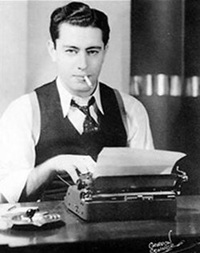 storyline. Though Trendle seems to have gotten the credit for coming up with the character of the Lone Ranger, there is a letter from Trendle to Striker dated January 30, 1933 giving Striker sole credit for creating the character. That issue aside, Striker would go on to pen an astounding number of Lone Ranger episodes, by count 156 a year since the show aired an unheard of three half-hour episodes a week, one every Monday, Wednesday, and Friday for many years. The show was an immediate hit. So much so that in 1934, scarcely a year after its debut, Trendle pressured Striker into selling the character’s rights for all of $10. Striker was being paid $7.50 per episode at the time, but had to support his wife and two young children, not to mention a dozen relatives hard hit by the Depression. In exchange for rights to the Lone Ranger character and the upfront $10, Friker bargained for and got a promise from Trendle for job security during the Depression years, making sure his nuclear and extended family had a roof over their heads and food on their tables. That was the good news under the circumstances. The bad news came 5 years later when in 1939 the Lone Ranger franchise made a profit for Trendle of half a million dollars, an enormous sum for the time. And in 1954 Trendle sold the rights for a record $3 million dollars. Fortunately, Striker kept busy while also writing the scripts for The Green Hornet radio show, which character he also created (and later wrote for the Green Hornet comic strip), two Lone Ranger novels, two movie serials, and some scripts for the radio show Challenge of the Yukon, which would become Sergeant Preston of the Yukon for early television, yet another character born of the fertile mind of Fran Striker. Striker was an incredibly talented writer and respected throughout the business. Unfortunately, he was killed in a car crash on September 4, 1962. To show even further proof of the kind of man he was, Striker wrote a moral code of guidelines for the Lone Ranger which were followed throughout the life of the radio and TV shows.
“I believe,” he wrote—
- that to have a friend, a man must be one.
- that all men are created equal and that everyone has within himself the power to make this a better world.
- that God put the firewood there, but that every man must gather and light it himself.
- in being prepared physically, mentally, and morally to fight when necessary for that which is right.
- that a man should make the most of what equipment he has.
- that ‘this government of the people, by the people, and for the people’ shall live always.
- that men should live by the rule of what is best for the greatest number.
- that sooner or later…somewhere…somehow…we must settle with the world and make payment for what we have taken.
- that all things change but truth, and that truth alone, lives on forever.
- in my Creator, my country, my fellow man.
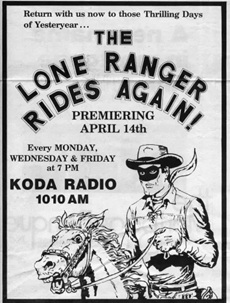 The origin of the Lone Ranger begins in tragedy. Chasing the Butch Cavendish gang, six Texas Rangers are ambushed by the gang. Five are killed, including Dan Reid, John Reid’s older brother. John was wounded but saved by an Indian who would soon come to be known as Tonto. John Reid dug six graves to make it appear to any casual observer that six men had died and been buried. Taking a band of cloth from his dead brother’s vest, John Reid fashioned a mask, whereupon Tonto gave him the name of the Lone Ranger, he being the lone Ranger to survive the ambush. Many years later in a radio episode of The Green Hornet (also created by Trendle and Striker) it would be revealed that deceased Texas Ranger Dan Reid had a son named Dan Reid Jr., who in turn had a son named Britt Reid, now the wealthy publisher of the Daily Sentinel newspaper, making him the great nephew of the Lone Ranger. As all Green Hornet fans know, Britt is the real life identity of the Green Hornet in his crime fighting capacity, making the Lone Ranger his great uncle. Though in different media (radio, TV, film, novels, comic books, etc.) the real name of the Lone Ranger is never settled on, and some say never explicitly given. However, since “John Reid” has been mentioned several times across the decades as the Lone Ranger’s real name and validates the familial relationship revealed in that Green Hornet episode (“Too Hot to Handle” November 11, 1947), it is the one we have chosen to go with here.
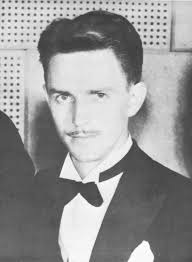 When The Lone Ranger first hit the airwaves in January of 1933 in Detroit, it was the voice of George Seaton (1911-1979) who would play the Lone Ranger, albeit for only a handful of months, whereupon Earle Graser (1909-1941, photo at right) became the Lone Ranger in mid-1933. The show was an immediate success, with a relative unknown by the name of Brace Beemer as the announcer. The program was increasing its audience with each episode, and popular as well as financial success was all anyone could see on the horizon. Then the unthinkable happened and Earle Graser, the voice of the Lone Ranger for more than eight years, who everyone—adults and youngsters alike—had come to know and respect as the Lone Ranger, died in a car crash on April 4, 1941. To its credit, The Lone Ranger crew at all levels hardly missed a beat thanks to some crafty story changes that focused for a few episodes on Tonto, while proffering the excuse that the Lone Ranger had taken ill but would soon return.
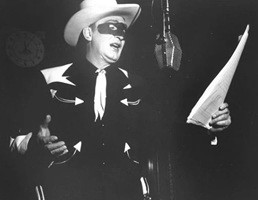 And when the Lone Ranger in short order did return, it was with the voice of the former announcer of the show, Brace Beemer (1902-1965, photo at left), who would go on to become the iconic voice of the Lone Ranger for the next thirteen years. While researching Beemer I ran across a fact reminding me of Fran Striker’s moral guidelines for the Lone Ranger listed above. It is a part of Beemer’s history that at age 14 he lied about his age and enlisted in the Army in able to participate in WW I. He served in Battery E of the 150th field artillery in France and was wounded in action on May 27, 1918. He was still only 17 and ended up being the youngest American sergeant in WW I. As an adult, Beemer lived on his 300 acre ranch in Michigan raising thoroughbred horses. The barn that kept the Lone Ranger’s horse Silver still stands. It is rumored that Silver was buried in the nearby woods. According to wikipedia, “Brace Beemer died of a heart attack March 1, 1965,” and in his later years up to the time of his passing “he was using his famous Lone Ranger voice in automobile commercials running on radio stations.” He was 62.
“The Silver Spur” aired in 1938, three years before Earle Graser, the voice of the Lone Ranger, would die in a car crash. Therefore, the voice of the Lone Ranger in this episode is that of Graser, and the announcer is Brace Beemer who would become the voice of the Lone Ranger following Graser’s demise. Our story is the tale of young Sandy Tindale, recently freed from a two year prison stint involving the shooting of a crooked gambler. The Lone Ranger was partly responsible for bringing Tindale in to face trial two years ago. Now, Tindale is returning on the stage along with a chest containing $5,000. The whole town is waiting for his return from prison as he was well liked, his girlfriend finally getting to see her love once again. But when the stage arrives young Sandy is not aboard, nor is the $5,000. This sets one Banker Pottle into a frothing frenzy because the money is his, though it is ill gotten booty for which Sandy is now sure to be blamed, he being an ex-con and all. Add the fact that the evil Pottle has been trying to get Jason’s girlfriend (the sheriff’s daughter) to marry him while Jason was in prison, and you have the makings for a dandy, if complicated story. It is up to the Lone Ranger to find Tindale again and force him to turn himself in and prove his innocence. Easier said than done because fat old Pottle is screaming at the sheriff to hang young Tindale when he is found. The Lone Ranger has his work cut out for him and therein lies our tale, one that hangs partly on “The Silver Spur.”
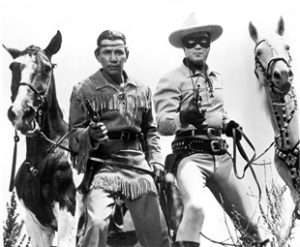
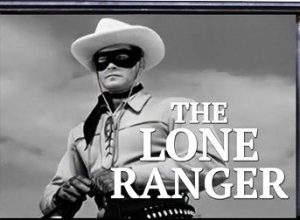
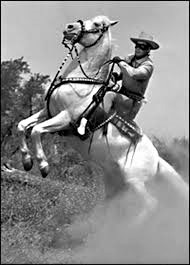
Of course, when The Lone Ranger came to TV (1949-1957) it was Clayton Moore (1914-1999) who portrayed the Lone Ranger and rode his white stallion Silver, and Jay Silverheels (1912-1980) who portrayed the Ranger’s faithful Indian companion Tonto and rode his Paint/Pinto horse Scout. For radio, Tonto also rode a white horse named White Feller, but to avoid confusion when the series came to TV, Tonto got his new horse named Scout.
TV reruns of The Lone Ranger can be seen on several stations or platforms, probably the most well known being Cozi, one of the OTA (Over The Air) channels. It can also be found on Pluto TV, Xumo Play, and The Roku Channel, and probably others by now.
{The linked Lone Ranger art at top left is from the Old Time Radio Researchers website, where several thousand episodes of the show can be downloaded or listened to free of charge.}
Play Time: 29:49
To view the entire list of weekly Old Time Radio episodes at Tangent Online, click here.