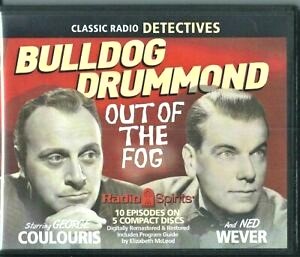
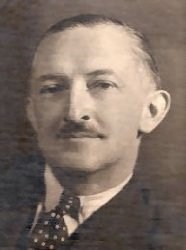
 Bulldog Drummond (1941-49) aired “The Case of the Double Death” on April 16, 1945 as only one of its still existing 27 episodes out of nearly 400. This is the 9th Drummond episode we have run since the first in 2015 and only the third in almost three years. If you like James Bond you’ll find a lot to like in Hugh “Bulldog” Drummond’s adventures. Bulldog Drummond was the character created by Englishman H. C. McNeile (1888-1937, photo at right), who wrote under the pseudonym of “Sapper,” Sapper being the official term for those serving in the Royal Engineers during World War I, and the name suggested by McNeile’s publisher in order to lend the stories an air of authenticity. None other than Ian Fleming, creator of James Bond, wrote of Bulldog Drummond’s author that he was “Sapper from the waist up and Mickey Spillane below.”
McNeile, who fought on the Western front in WWI and retired as a major in 1919, wrote a few stories during the war about Drummond as a detective but to no great success. With his first Drummond novel in 1920 (he would pen a total of ten until his death in 1937), Bulldog Drummond, Captain Hugh Drummond, DSO, MC, and ex-British army, was a detective no longer, but would become an adventurer bored with civilian life and, seeking excitement, would place an ad in the newspaper which read: “Demobilised officer, finding peace incredibly tedious, would welcome diversion. Legitimate, if possible, but crime, if of a comparatively humorous description, no objection. Excitement essential. Would be prepared to consider permanent job if suitably impressed by applicant for his services. Reply at once Box X10.”
 After rejecting the first few responses to his ad, Drummond accepts one from a distraught “damsel in distress” by the name of Phyllis Benton, whom he would end up marrying by the end of the novel. Phyllis’ problem, that for which she has enlisted Drummond’s aid, soon involves him in a deadly adventure with his soon-to-be recurring nemesis Carl Peterson, an evil genius and megalomaniac bent on world (and Communist) domination, his first conquest being Great Britain. The book is full of action and graphic violence, including a scene where a sociopathic torturer is shoved into an acid bath he has used on others. Not wishing to make certain he dies a quick death, Drummond allows him to throw himself out of the acid bath with his clothes smoking and his flesh bubbling and in agony, only to meet a terrible death a short while later. Sapper has Drummond pull no punches in his encounters with the truly evil. Through circumstance–and the bumbling police–Peterson escapes to commit evil another day, which he does for three more novels until his fitting demise.
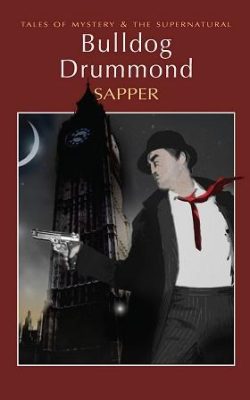
The third Bulldog Drummond novel, The Third Round (1924), gets into Bond territory (and SF) with some pseudo-science involved in the creation of synthetic diamonds. Arch nemesis, and identity-chameleon Peterson is back, whose only desire is to exploit the discovery. Sapper is getting the hang of how to write these books by this time, and it shows. The first four Drummond novels are known as the Carl Peterson Quartet, and are recommended for their action, plotting (in most cases), wild adventure, and a hero who knows good from evil, is smart, but hardly handsome, and is definitely a product of his time (that of post-WWI England, with its prejudices and views of those nations from which it has just emerged from a devastating war), and of Sapper himself, who puts much of his own military experience into the books, and surrounds Drummond with fictional army pals including his best friend Algy Longworth, his manservant James Denny (who you will hear in this radio episode), army buddy Peter Darrell, and other series regulars Toby Sinclair and Ted Jerningham. The Carl Peterson quartet of novels is collected in one volume by Wordsworth Editions (2007, 768 pp., though Amazon incorrectly has it at 320 pp., linked cover above right).
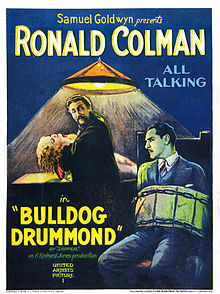 From the 1920s through the 1960s Bulldog Drummond was featured in 23 films. The first two (1922, 1925) were silent, but the third in 1929 with the eponymous title Bulldog Drummond starred Ronald Colman in his first talkie. The period of 1930-47 saw 17 Drummond films, a fair number including one of the famed Barrymore family, John, while Ray Milland would star in 1937’s Bulldog Drummond Escapes. The pair of Drummond films in 1948 would star no less than Tom Conway, and in 1951 Walter Pidgeon would star as Drummond in Calling Bulldog Drummond. An attempt to cash in on the James Bond movie craze in the 1960s saw two more Drummond films (Deadlier than the Male, 1967, and Some Girls Do, 1969), but with little success. The Bulldog Drummond character and adventures were so popular in Britain that in his early days while living in England, young up-and-coming film director Alfred Hitchcock sought the rights to the Drummond character for a film he was set to make titled Bulldog Drummond’s Baby. British International Pictures would not release the rights, so Hitchcock turned his film into the now classic The Man Who Knew Too Much (1934, starring Peter Lorre) without the Bulldog Drummond character. Hitchcock would remake the film in 1956 starring James Stewart and Doris Day.
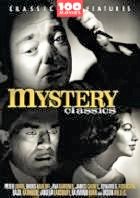 1937-39 would prove arguably the best years for Bulldog Drummond films, when Paramount would make nine of the short B films, most running to around 60 minutes give or take. For anyone wishing to introduce themselves to these fun, suspenseful action forays I recommend picking up the 2006 Mill Creek Entertainment boxed set titled Mystery Classics. It’s one of those “100 Movie Pack” sets reasonably priced with some real gems (along with a few easily forgotten pictures), but including a majority of interesting, entertaining films including six Bulldog Drummond titles: Bulldog Drummond’s Revenge (1937), Bulldog Drummond Escapes (w/Ray Milland, 1937), Bulldog Drummond Comes Back (1937), Bulldog Drummond in Africa (1938), Bulldog Drummond’s Peril (1938), and Bulldog Drummond’s Secret Police (1939). These films stick pretty close (in general) to the original Drummond world as depicted in the novels, save for one striking departure; in the first novel, Bulldog Drummond (1920), Drummond marries Phyllis Benton, while in the movies he’s always about to be married–-just at the altar, as it were–-when something inevitably happens to postpone or otherwise thwart the ceremony, thus making poor dear Phyllis always the understanding, long-suffering bride-to-be whom Drummond is always promising to marry as soon as the current adventure is concluded. It’s a humorous bit replayed in several of the films, and the actress plays the bit to great advantage.
The 1920s and 30s were the heyday of the Drummond novels and films, but American radio would catch up in the 1940s with the Bulldog Drummond radio series, where now Drummond has moved to the United States to continue his adventures, of which this is one. While the American radio incarnation of Bulldog Drummond is slightly watered down in terms of the graphic (and often extreme) violence appearing in the novels, this episode does of course portray its share of violence, though not as much as in some others.
This episode opens with Drummond and his friend and manservant James Denny finishing dinner at a fine restaurant before attending an execution several hours hence. Denny’s favorite hat and umbrella have gone missing from the hat check room so he decides to take the train home for another while Bulldog heads for the prison so as not to be late for their…appointment. When Denny fails to appear, one thing leads to another and he is arrested for murder. One absurd fact after another points directly at Denny being the murderer, and of course his steadfast employer sets about unraveling the clever way in which he has been framed, and more importantly, why. This is a teachable moment, as the saying goes, as any astute would-be writer can, with careful attention, reverse engineer how seemingly irrelevant clues are introduced, when in the story they are introduced, and how each initially unconnected piece of information leads to a theory or deduction (from our brilliant detective, of course, whether it be Sherlock Holmes, Johnny Dollar, Sam Spade, or yes Bulldog Drummond) which then leads to a person or motive or previously overlooked detail that begins to dissolve the strands of the web framing, in this case, Denny, just enough so that a picture begins to take form with the end game in sight. The end game in this interesting murder mystery being when “The Case of the Double Death” absolves Denny of a heinous crime he did not commit. And a sly lesson to be learned is that sometimes to counteract a frame up it takes another frame up. So while two wrongs don’t make a right, sometimes two frame ups do.
(The linked CD at top includes this episode and 9 others in a 5 CD set, all digitally restored and remastered.)
Play Time: 26:40
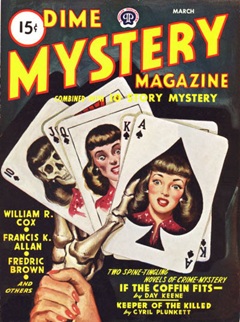
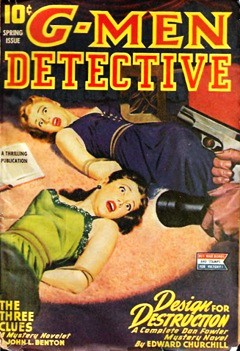
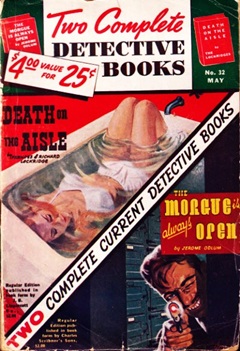
{After a dreary Monday back at school, the neighborhood gang couldn’t make it to the corner newsstand fast enough, looking for more excitement like that in the previous evening’s episode of Lights Out!. They were in luck. Dime Mystery Magazine (1932-1950) began as a standard detective/mystery pulp with a full-length novel and short stories in every issue. That didn’t work out as planned, so after a mere 10 issues it dropped the novel and filled the space with a couple of novelettes to go along with the short stories. It also changed focus to a magazine highlighting “weird menace” stories. This hit the right note with readers and it went on to enjoy a long run, continuing its bi-monthly schedule in 1945. G-Men Detective (1935-1953) began as simply G-Men magazine, but with interest in federal agent crime fiction waning, it added “Detective” to its title in 1940 with a change in format, adding the broader detective fiction story as its focus. A successful move, it ran for another 59 issues before closing shop (with many other pulps) in 1953. It was a quarterly in 1945. Two Complete Detective Books (1939-1954) was one of the forerunners of the various Book Clubs that would spring up later. It offered two complete detective/mystery novels in each issue for a very low price, one that the general public could afford (especially during the war years). It was a bi-monthly in 1945.}
[Left: Dime Mystery, 3/45 – Center: G-Men Detective, Spring/45 – Right: Two Complete Det. Books. 5/45]
To view the entire list of weekly Old Time Radio episodes at Tangent Online, click here.