Special Split Review
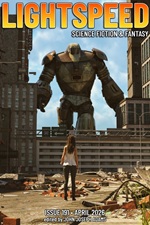 Lightspeed #191 April 2026
“Saint Zero of the Hollows and the Eagle Knight” by V.M. Ayala
“Hell is Empty” by J.R. Dawson
“Dad Died on Discord” by Andrew Dana Hudson
“Six-Gun Vixen and the Machinist of Doom Valley Pt 1” by Ashok K. Banker
Reviewed by Drew Bittner
“Update on Rules for the Spatiotemporal Use of Campus Spaces” by Andrea Kriz
“Six-Gun Vixen and the Machinist of Doom Valley [Part 2]” by Ashok K. Banker
“Empathetic Psychosis” by Justin C. Key
“Time Managment” by P. A. Cornell
Reviewed by David Wesley Hill
{Editor’s Note: Due to an unfortunate turn of events Drew Bittner was unable to complete his review of the April Lightspeed. With much thanks and appreciation David Wesley Hill has stepped up and completed the review.}
♦ ♦ ♦
Reviewed by Drew Bittner
In “Saint Zero of the Hollows and the Eagle Knight” by V.M. Ayala, Zero and their mechanical “pegasus” are part of a grand tournament—one held not on a grassy fairground but on an asteroid in deep space—and they are playing to win. The jousting, they’re told, is an experiment, not entertainment, but as things progress, Zero has reason to doubt the official story. With predictive assistance from their onboard AI, Zero loses an arm but wins the match when their lance punches through the opponent’s faceplate.
A complication soon arises: women are not allowed to joust. Lucky for Zero, their gender is more… ambiguous. And they have a powerful patroness in Silvi de Aguilan, the Eagle Knight, whose wealthy buys certain exemptions from the rules. But wealth can’t buy safety in a joust and death is common in bloodsports. Are these two ready to risk happiness for victory? Unfortunately for Silvi, the next match facing Zero is all too personal. And the one after that might cost Zero everything.
Ayala writes a space age take on the classic tournament, providing Zero and Silvi with serious stakes, personal and reputational, as the story unfolds. The truth behind Zero’s agenda only comes into focus at the end, with the reader left to ponder whether it was all worth it. But it’s a question the story poses gently.
Well written, well themed. Recommended.
In “Hell is Empty” by J.R. Dawson, the world has a singular problem. Hellmouths have sprung open in the skies above major cities and humans are being swept up. No one knows why the victims are chosen, no one knows when the hellmouth might move or go quiescent—there’s no knowing how to manage this except to endure.
Millie and the unnamed narrator go out on a simple chore, to buy dog food from one of the few stores still open, when they see the horrors for themselves. Batwinged devils circling in the sky, a hungry vortex to nowhere appearing like a tornado… and life goes on. People have adjusted, they have acclimated. It’s not that they don’t care. It’s worse than that.
Dawson provides a stark, emotional response to the times we live in. One can’t miss the parallels of a world where the rules no longer hold and violence can fall on anyone in an instant. It makes for a thought-provoking commentary on what we get used to and how the horrifying can become something quite different, given time.
Recommended.
A flash fiction piece with a bit of a punch by Andrew Dana Hudson, “Dad Died on Discord” follows a narrator whose father has gone into a retirement home. He finds solace in logging into games played by his contemporaries—which strike his child as old-fashioned and maybe borderline objectionable (considering that they’re violent online RPGs)—but he enjoys them. Then things take a sad turn.
Hudson captures the poignancy of being there/not being there for an aging parent who may be at the end, unexpectedly in this case, and the pain it causes as we realize we missed something as it was going by us. It’s a neat handful of paragraphs.
In “Six-Gun Vixen and the Machinist of Doom Valley (Pt 1)” by Ashok K. Banker, the titular six-armed gunslinger is looking for work but finds herself in trouble when she’s made unwelcome at a saloon. Lucky for her (?), a fancy patron takes her side—but luck has a funny way of turning around real quick.
Hired by this patron, a lawyer for a wealthy rancher, Six-Gun is set on the trail of natives who supposedly murdered the rancher’s sister’s family and took his niece. Despite serious reservations, she starts on the trail, not for the rancher or his money but to help a twelve-year-old girl who needs rescue.
Complications rise up immediately when she investigates the burned homestead and encounters Rattlesnake, a local who gives her an alternate story: the family at that homestead was marked for “cleansing” by the natives… like Six-Gun herself once.
Why was the girl taken? And why do the clues point to settler-folk rather than natives, as she’d been told? And what awaits at the end of this road?
Banker constructs an engaging, fast-paced read in this first chapter of a longer tale featuring a singular protagonist. The steampunk/Old West setting is unusual, with Banker leaning on senses beyond sight alone to create a fully-realized environment, with cyborg cowboys and mutants among the “civilized folk.” It amounts to one heck of a story and one worth following in future issues of the magazine.
Recommended.
All in all, April’s Lightspeed delivers some really entertaining and thought-provoking stories. Give it a look!
♦ ♦ ♦
Reviewed by David Wesley Hill
Sadly, the fifth story of the issue, and the first assigned to me for review, “Update on Rules for the Spatiotemporal Use of Campus Spaces” by Andrea Kriz, is, as demonstrated by its very title, a piece of sophomoric fluff that is way too meta for its own good and not half as funny as it tries to be. Lacking a plot, not to mention characterization of any kind, this story was no doubt workshopped to death in a graduate creative writing class, but I have no idea how it came to be published in a professional genre magazine. This term paper gets a Spatiotemporal F.
Thankfully, I can recommend the next story, “Six-Gun Vixen and the Machinist of Doom Valley [Part 2]” by Ashok K. Banker, which somehow successfully combines elements of Hindu mythology with the milieu of a future Wild West. The titular heroine not only has six guns, she has six arms and hands, reminiscent of the goddess Durga, not to mention two cubs and a Halfie—an insanely loyal half-mechanical horse the size of a Clydesdale. As the title indicates, this is the second part of a story, the first part of which was reviewed by my predecessor—and which I did not read because I believe every piece of fiction must stand by itself, without any external reference. Thankfully, Banker weaves enough background into the second story that it indeed succeeds on its own merits, and is in parts quite thrilling, not to mention quirky in a good way. As I remarked—recommended. Six thumbs up!
I don’t know how to characterize the next story, “Empathetic Psychosis” by Justin C. Key, since it doesn’t strike me as speculative fiction, being neither science fiction nor fantasy nor horror—unless you consider the positing of the titular diagnosis, which is apparently not a real thing, as qualification for membership in the genre. In any case, much about the story struck me as true, since I’ve had a lot of experience with therapy, enough said, and I kind of enjoyed trying to suss out the unreliable narrator and trying to figure out what parts of the story were real and what parts were imaginary. Honestly, though, a better venue for this tale would have been the American Journal of Psychiatry … if it really exists and isn’t a figment of my imagination.
Last up this month is a sweet piece of flash fiction, “Time Management” by P.A. Cornell, wherein Gwen, after breaking up with Dianne, learns that she has the ability to manipulate time—not to travel in it, but to elongate or compress the time stream. Honestly, who among us hasn’t thought that the good times go past too quickly, while “the worst moments in life stuck with you interminably.” Now, Gwen has the “power” to do something about it… Touching, and recommended!