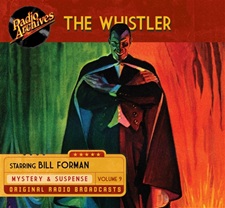
 “I am the Whistler, and I know many things, for I walk by night. I know many strange tales, many secrets hidden in the hearts of men and women who have stepped into the shadows. Yes… I know the nameless terrors of which they dare not speak.”
The Whistler (1942-55) aired “X Marks the Murderer” on August 20, 1945 as the 169th of its 760+ episodes (depending on how one counts). It is the 13th episode of the show we have run since 2017 and only the 2nd since February of 2024. For newcomers, introductory background material on the show is reprised below (it was the most popular west coast radio show for many years), with the background providing context for its not totally unique but unusual narrative format.
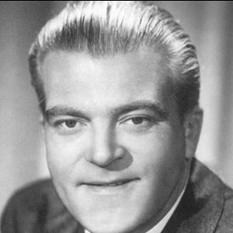
There were two attempts for The Whistler to break into the east coast market that didn’t last long (July-September 1946, and March 1947-September 1948) due to mediocre ratings, so if these episodes are counted as part of the overall scheme of things, the total number of shows ends up somewhere around 769. Over its thirteen-year west coast run it never took a summer break and ran continuously, certainly some kind of record, and its sole west coast sponsor, Signal Gas & Oil remained loyal throughout. While the show had several narrators over the years, the one who held the longest tenure and is most associated with the show was Bill Forman (1915-1966, photo top right). Though Forman is the most recognized narrator for his work in 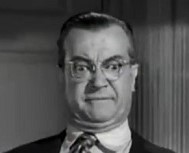
 most of its later years, two of the show’s earlier narrators would also become recognizable for both their radio work and television personalities, Joseph Kearns (1907-62, photo at left) being one and Gale Gordon (1906-95, photo at right) being the other. Kearns (as did Gordon) had a long radio career, and would win notoriety for his ability to mimic almost any voice. Combining his amazing vocal talent along with his acting chops, Kearns would find work in hundreds of episodes of radio shows prior to any TV work that came his way. The TV role he was most associated with was of course Dennis the Menace (1959-63), where he played Dennis’s grumpy old neighbor George Wilson. When Kearns died in February of 1962 he was replaced by none other than his long time radio pal Gale Gordon until the show left the air. Another bit of trivia is that Kearns also wrote at least one script for the show, showing once again that he was not only a capable actor with a rare voice talent but a writer as well.
The Whistler has an interesting backstory, and would take much too long to go into here to give it the justice it warrants. A few points of interest will suffice for this offering of the beloved mystery show, the first of which is the use of the narrator as more than just a host. From Jim Ramsburg’s Gold Time Radio entry on The Whistler: “Like The Shadow’s first personification a dozen years earlier, Inner Sanctum’s ghostly Raymond in 1941 and The Mysterious Traveler in 1943, The Whistler stood outside the stories he narrated. Unlike the others, he used a unique second-person, present tense technique as if to talk directly with the central character of his stories – often an innocent drawn into the plot by circumstances or an amateur driven to murder as a last resort.” A second point of interest has to do with the trademark whistling that opens each episode. From Radio Spirits’ Blog Archive on The Whistler: “The program featured one of radio’s classic openings: a haunting 13-note theme created by Wilbur Hatch (who also composed the show’s eerie mood music). Hatch estimated that only one person in twenty could whistle this exact melody, and for the show’s thirteen-year duration one person pretty much did—a young woman named Dorothy Roberts. In fact, during the war years, Roberts had to get permission from Lockheed (where she worked) to leave her factory job in order to make it to the program and whistle every week.”
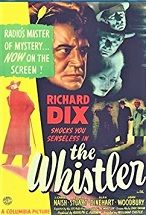
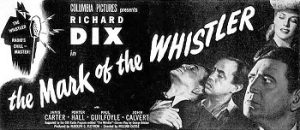
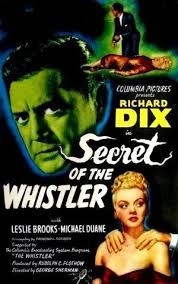
The radio show proved popular enough that Columbia Pictures made eight Whistler films from 1944-48, all but one starring Richard Dix: The Whistler (1944), The Mark of the Whistler (1944), The Power of the Whistler (1945), The Voice of the Whistler (1945), Mysterious Intruder (1946), The Secret of the Whistler (1946), The Thirteenth Hour (1947) and The Return of the Whistler (1948). The show was brought to early television in 1954-55, but never caught on. Nevertheless (and due in great measure to roughly 500 of the estimated 700+ original shows still surviving–-and the movies still showing up on classic movie TV channels), The Whistler probably enjoys a larger audience today than it did in its heyday during the Golden Age of Radio.
“X Marks the Murderer” gives the savvy listener a somewhat unusual format to keep their interest piqued and guessing throughout the performance. There has been a series of grisly murders in the area, and the police have alerted the public, enlisting their aid to help solve what has come to be known as the Atrocity Murders. The police are inundated with theories and bits of information from the public, some crazier than others. Our story centers on a man and woman couple and the oddball theory of the man’s wife who thinks she knows where the killer will strike next. The husband pooh-poohs his wife’s theory (he’s an unpleasant sort of grump by all accounts), and the police are left to piece together unlikely clues as they attempt to prevent further murders, but with little success. How it all works itself out is due to a clever twist rife with irony that indeed proves that “X Marks the Murderer,” and is what makes this episode worthy of a listen.
(The CD linked above includes this episode and 11 others, all remastered and restored.)
Play Time: 29:30
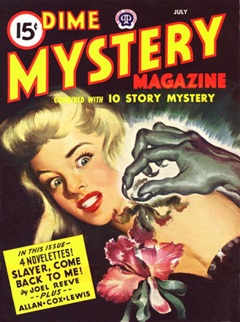
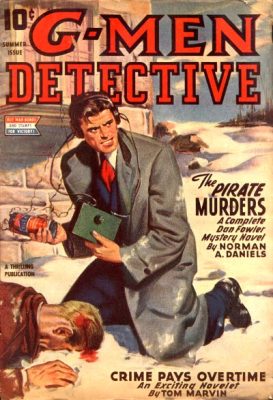
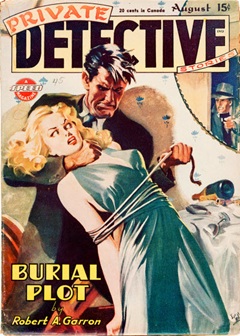
{This episode of The Whistler aired on a hot Monday evening in late August of 1945, just days after the Japanese surrender on August 15th signaled an end to WWII in the Pacific. The neighborhood gang was full to bursting with WWII celebrations everywhere they turned, from magazines, to newspapers, to of course radio broadcasts. With joy and relief in their hearts they were nevertheless ready for a diversion, the kind their favorite detective pulps would give them, so the next morning they headed for their nearby home away from home, the corner newsstand. Dime Mystery (1932-50) began as a rather ordinary pulp featuring a novel and a few stories in each issue. That formula proved unsuccessful so after only ten issues the novel was replaced by more short stories, this time with an emphasis on “weird menace.” This change was a winner and the magazine lasted for another 144 issues. It was a bi-monthly in 1945. G-Men Detective (1935-53) took proper advantage of the popularity of federal law enforcement crime fighters and made G-Men Detective the most popular pulp of its type until 1940, when interest in federal agent crime stories waned and Detective was added to the G-Men of the original title, signaling a different and more contemporary direction to the stories. It also marked a change in publishing schedule from a monthly to a bi-monthly, trading back and forth every now and then to a quarterly. In 1945 it was a quarterly. Private Detective (1937-50) was published by the same publisher responsible for the “spicy” series of pulps the publisher began 3 years earlier and that were later closed due to public pressure and legal trouble. Private Detective came to be viewed as a toned down version of Spicy Detective (1934-47) with less provocative covers and somewhat less twisted psychopathology to its characters. It was a monthly through 1945 but after that its schedule was hit or miss at best, producing anywhere from 4-9 issues a year for its final 5 years.}
[Left: Dime Mystery, 7/45 – Center: G-Men Detective, Summer/45 – Right: Private Detective, 8/45]
To view the entire list of Old Time Radio episodes at Tangent Online go here.