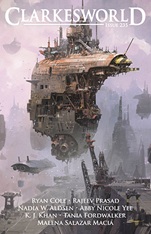
 Clarkesworld #235, April 2026
“Macaroni Art in the Age of Filtration” by Ryan Cole
“D0G” by Tania Fordwalker
“The Trajectory of Memory is Forward” by Rajeev Prasad
“Eternity in Their Hearts” by K. J. Khan
“Shelter” by Nadia W. Aldsen
“The Forgetting Code” by Malena Salazar Maciá
“Human Studies 401” by Abby Nicole Yee
Reviewed by Axylus
“Macaroni Art in the Age of Filtration” by Ryan Cole is the first of two successive stories in this issue that reminded me of the episode “Metalhead” in the anthology series for TV, Black Mirror. [In case you haven’t seen it, one phrase will suffice: “swarms of robotic attack dogs.”] This tale has a similar plot (with a happier ending) set in a different milieu, and the one immediately below has a similar milieu within a somewhat-different plot. Cole’s short story is set in a dystopian world where air pollution is at fatal levels, and everyone must wear an artificial Lung to survive. A young girl named Verity and a boy named Widget travel to the dangerous upper levels of their underground world to find a bit of macaroni art left behind after an apocalyptic event, so they can offer it to its former owner in exchange for an extra Lung.
Like many shy loners, I’m a sucker for a good “accidental survivalist” tale, where social noise is removed and introspection is a go-to motif. Add in a robotic dog (or D0G) that shifts from happy buddy mode to manic killer in an eye-blink, and I’m yours. “D0G” by Tania Fordwalker is set in motion when a middle-aged woman named Billie rescues a scrawny teen-aged boy named Kane. Their world is full of dangers, both human and robotic. This story will remind you of several others, but it does a good job of explaining its milieu and fleshing out its characters. My only (small) reservation is that the reader’s sympathy for Kane in the early going could have been hit with a bigger hammer. The emotions of an ending are better off being bookended with complementary ones in the beginning, else results are off-balance and diminished. “D0G” receives my second-ever three star rating (Tangent’s highest), and it’s only April. Lots of year left. We’ll see what else happens.
In the novella (word count 18,990) “The Trajectory of Memory is Forward” by Rajeev Prasad, memory engineering (paraphrasing directly from the text) has created a species of humanoids known as Have-Nots who are unable to synthesize and store their immediate daily images and names. They wake up each morning haven forgotten these and other details of their lives, so a special group of Have-Nots known as whisperers store memories and repeat them to all others each new day (shades of Lois Lowry’s “The Giver”). The Have-Nots are in perpetual conflict with the cyborg Haves, who live apart in well-defended checkpoints. One Have-Not successfully raids a checkpoint of the Haves, but a rebel Have stows away with him as he flees. Together they travel to find AGod, hoping to persuade it to convince the Haves that they should accept the Have-Nots, and possibly even cross-breed. Taken as a whole, Prasad’s story seemed littered with poor choices and poor writing. I actively disliked it, but your mileage may vary.
My favorite book of the Bible (from every perspective, including literary) is Ecclesiastes, from which “Eternity in Their Hearts” by K. J. Khan takes its title. And I am biased in favor of this tale, because it is yet another in this issue of Clarkesworld that flies straight down my personal strike zone as a reader. Mildly reminiscent of Klara and the Sun by Kazuo Ishiguro, it tells of a humanoid robotic companion designed to accompany and comfort humans as they die. I suppose the story might have found additional depth if the robot, like Klara, had experienced moments of doubt, uncertainty, questioning, or wonder; or the faint frisson of mono no aware at the beauty in ephemerality. Add in some quick descriptions of the world around them: some just to make the world more fully realized, and others to help set up or accentuate a mood or tone. Or just add anything at all that would put a bend in the stove-piped pelt through plot. But never mind all that. Khan’s tale offers a glimpse of humanity on the painful edge between enchanting faith and devastating reason, with an ironic twist. This story is strongly recommended.
“Shelter” by Nadia W. Aldsen follows the fate of a human Social Work Specialist working for Chaska Punku (Chile) Space Port Administrative Authority. An alien under her care collapses into a puddle of goo. Alas, after a promising start, “Shelter” collapses into predictability.
There was a popular commercial in the 2024 NFL Super Bowl built around the line, “In order to remember something, you have to forget something else.” In “The Forgetting Code” by Malena Salazar Maciá, a man uses neural manipulation technology to provide the therapeutic ability to forget painful memories. After his beloved daughter disappears, he attempts to brings her back to life by pouring his memories of her into the waiting form of a human-scale gynoid, meanwhile losing his memories of himself. At 2450 words, it reads at times like a past-tense version of a script treatment, a brief and depersonalized reportorial summary lacking immersive tension. This deprives the story of any memorable emotions or insights.
“Human Studies 401” by Abby Nicole Yee also includes a female artificial humanoid and is at times a bit reportorial, but since the latter matches the context of the tale, it becomes a feature rather than a bug. It is also interspersed with ironic comments from its first-person narrator. In this story, an alien grad student creates a love potion for humans as part of its Master’s Thesis. Recommended (loved the ending).