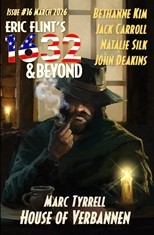
 Eric Flint’s 1632 & Beyond #16, March/April 2026
“The House of Verbannen” by Marc Tyrell
“Something New” by Bethanne Kim
“A Shocking Development” by Jack Carroll
“Wild Flowers and Nailed Hearts” by Natalie Silk
“Antwerp Antics” by John Deakins
Reviewed by Seraph
[Editor’s note: The following is offered by Tangent reviewer Mike Bickerdike as a guide for those not familiar with this magazine’s concept. Eric Flint’s 1632 & Beyond is a magazine comprising stories set in the late Eric Flint’s “Ring of Fire” or 1632 alternate-history universe. For those unfamiliar with the books, the essential concept is that the town of Grantville in West Virginia became transported (by cosmic accident) from our present day to northern Germany in 1632 during the 30 Years War. The book series extends to dozens of novels. The short stories in this magazine are set within that framework.]
Having been previously unfamiliar with the premise and originating story of this setting, it was a genuine treat to experience some of it for the first time. It ranges from the brutalities of human corruption, to the simple interactions of those who find themselves living amongst people who welcome, but do not always understand them. Not all of the stories are easy to read, especially if you are particularly empathetic, so be warned that some of it is outright difficult on the emotions. Yet I found none of it to be gratuitous, and it seems as though a great deal of thought was put into the purpose. Overall there is a grander picture being painted, a story of humanity displaced, and the effects of all that follows.
“The House of Verbannen” by Marc Tyrell
The titular House is a beacon of order in uncertain times, a family of men who still have honor and seek justice when seemingly all around them have more than happily sold their souls to corruption. Alphons specializes in rooting out such sins in the service of Spain itself, and is as much a master of espionage as he is the rapier. When the corruption reaches close to his own connections, he is dispatched to discover its reach and uncover the one behind it all. This was… difficult at times to read, for personal reasons, and may be for others as well. That being said, the writing was never gratuitous or explicit, and there was purpose in the inclusion of details. Overall the story flowed well, was intriguing, and was spot-on in its pitch and length.
“Something New” by Bethanne Kim
Johan is a baker with a penchant for the novelties the up-timers have introduced to the past, and of marrying age. The girl he fancies, Krystal, is all too happy for his attentions, but the bulk of the story is as much about all of the people around them reacting to their dance. The story is essentially a snapshot of life and love in an era where some of the new ways and ideals are overtaking the old ones. Of all the stories in the issue, this was by far the easiest and most pleasant to read. It was so sweet it was almost innocent.
“A Shocking Development” by Jack Carroll
I cannot help but appreciate a clever pun in a title. One of the more unique stories in this issue, it asks the question of human ingenuity faced with replicating technology that saves lives, but shouldn’t exist for 300 years. It explores many of the circumstances that would evolve from the introduction of future tech and knowledge of the future, and is heavily focused on the medical and engineering fields. Some of the story gets a bit technical, but it was no less fascinating and was full of insight.
“Wild Flowers and Nailed Hearts” by Natalie Silk
The old world did not think or do things in a way that fits modern ethics. Anyone who has studied history likely won’t be surprised at that statement, but this story asks what would happen if you were to mix modern and old world concepts, then seamlessly frames it within ageless themes of teen romance, or the lack thereof. It could be argued, and it has been, that such lack of agency for the main character precludes the word romance. Anya is a beautiful girl with a poor father and little in the way of dowry. The way she is bartered and traded was difficult to read. It was clear to me that this was not championing dowries and arranged marriages as much as exploring the collision of those practices with modern ideals. The writing was done convincingly, enough to provoke an emotional reaction, and that is a high compliment in its own right.
“Antwerp Antics” by John Deakins
Van Dyck is a portrait artist with a problem most would covet: two beautiful women who both want his attention. One, a model with a penchant for artists and a sordid past, and the other a former noblewoman of class and privilege with betrothal on her mind. How he solves it is as clever as it could be, and ends fairly happily for all, even if they’re not quite aware of how it all came to be. The thing that stood out the most about this story was how easily it could have just been another period drama set in the past. It was just relatable, it was intriguing, and it didn’t try too hard to blend the setting with the impact of the future knowledge. It’s a really interesting look into how much such a thing might have, but also how humanity is what it is, and how little actually changes.