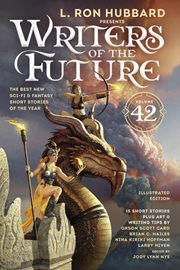
Edited
by
Jody Lynn Nye
(Galaxy Press, April 28, 2026, 480 pp., pb)
“Form 14B: Application for Certification of Consciousness Transfer (Post-Mortem)” by Thomas K. Slee
“Saffron and Marigolds” by Kathleen Powell
“Bloom Decay” by Elina Kumra
“Space Can” by L. Ron Hubbard (reprint, not reviewed)
“Shell Game” by Zach Poulter
“Canary” by Brenda Posey
“The Triceratops Effect” by S. J. Stevenson
“Skinny-Shins” by Orson Scott Card
“A Ready-Made Bubble of Light” by Thomas R. Eggenberger
“Thickly” by Dorothy de Kok
“Ghost Dog” by Mark McWaters
“Dragon Visits” by Nina Kiriki Hoffman
“In Living Color” by Michael T. Kuester
“As Long as You Both Shall Live” by Mike Strickland
“A Girl and Her Dragon: A Life in Four Parts” by Joseph Sidari
Reviewed by Axylus
“Form 14B: Application for Certification of Consciousness Transfer (Post-Mortem)” by Thomas K. Slee is a story which eschews conflict altogether, and yet hangs together in an aesthetically pleasing whole. Whether knowingly or not, it adheres to the East Asian (in Western pop culture, this is usually understood as “Japanese”) kishotenketsu story structure. This four-part framework does not map cleanly onto Western plot structures, aside from Brandon Sanderson’s “promise, progress, payoff”: it includes ki (introduction), sho (development), ten (twist), and ketsu (resolution). As the story opens, Cameron “Caveman” Mannagh had been killed during a live broadcast of a stunt that went horribly awry. Before his death, his consciousness was transferred to a portable holding container. He can interact with the world through a camera, microphone, and speaker. He and his lawyer, Roy Dennis, are now in a bureaucratic office navigating the red tape involved in getting his consciousness transferred to a new body. All of that is the ki. Things get complicated (sho). Then comes the twist of the ten: (spoiler!) they are informed that Mannagh’s consciousness was in fact destroyed irrevocably and is not inside the holding device. This version of Mannagh is an AI construct, programmed by Roy, that believes it is real. Roy Dennis is attempting to obtain Mannagh’s wealth via fraud. I’ll leave the ketsu for the reader to discover. As I read through the passages of this story analogous to ki and sho, I thought I was gonna hafta offer up a noncommittal or even mildly negative review, despite the obvious craftsmanship of the writing. Then the ten piqued my interest, and the ketsu offered a resolution with an emotional payoff, albeit a modest one. Recommended.
“Saffron and Marigolds” by Kathleen Powell is a story of Arthur, a “timid, nearsighted, pacifist baker” who loves the fairy changeling named Menura who kidnapped him. He treats a dragon like a pet, defeats a fairy king, and bakes a mean cake. The milieu is loaded with enticing details. One complaint is that it would have been better if Arthur had faced more decisive adversity/failure along the way (you know, the whole “creation and release of tension” thing). Ditto-ish for Menura, who is talked about by Arthur constantly, lovingly and convincingly, yet oddly spends almost zero time actually present in the story. Her saving grace was her last line of dialog. Finally, I don’t wanna give away spoilers, but I don’t understand why the fairy king has such an all-consuming desire for what Arthur brings to the table. He shouldn’t have, should he? I mean, think about it… This tale is loaded with skillful and effective passing remarks about backstory and milieu, but is also marred by surprising shortcomings. Recommended.
“Bloom Decay” by Elina Kumra is a novelette with abundant parallels to George Orwell’s 1984. Both take place in a dystopian, hypervigilant authoritarian society. Kumra’s parallel to Orwell’s Ministry of Truth and its Thought Police is Renaissance, an arm of the government characterized by an omnipresent data-gathering network. Both tales also include a male protagonist who struggles to preserve some small part of himself through minor acts of rebellion against the panopticon. In “Bloom Decay,” Theodore’s responsibilities within Renaissance involve locating and developing talent used in manipulative social media content. This all-pervasive content is referred to as the Stream, analogous to the “dreadful rubbish” tunes created by Orwell’s Department of Music. In both tales, the goal of the government-generated creative content is the suppression of independent thought and true creative expression. The key difference between the two stories, amidst all the updated technology, is that Renaissance is far more aggressively destructive than Orwell’s Ministry of Truth. The Stream is directly connected to neural monitoring devices and delivered based on individuals’ ongoing responses: “The neural monitors identify divergent thought formations before solidification into problematic creativity structures. [Tablet computers] deliver customized content to redirect these formations toward productive channels.” Even more sinister, Renaissance has recently begun proactively inducing debilitating and potentially fatal neurological degeneration in scholars, artists and free-thinkers who are deemed to be potential threats to the power structure. And the inciting event (of sorts) for Kumra’s tale is the incipient implementation of a program called Foresight. Foresight identifies children who could grow up to be disruptive, and Renaissance intends to suppress these as early as possible.
“Bloom Decay” suffers greatly from cramming a full novel’s worth of plot structure and milieu into a novelette’s word count. I confess I had to reread slowly to catch some of the details zipping past in the dialog. But the more detrimental aspect of condensation is that something inevitably has to be left out. In this case, the story’s emotional landscape is sharply diminished. This may also stem in part from Theodore’s go-to survival tactics: rigid maintenance of interpersonal distance and concealment of self. He tries to present himself as a sterile performance, just a factor in the stream of propositional bits of information. Unfortunately for Kumra’s story, however, the emotional experience is precisely the bit that most readers of fiction sign up for.
Given Theodore’s mask-wearing strategy, how could “Bloom Decay” convey compelling emotional structure, including characters with mutual presence and authenticity? A few good places to start would be intimacy, hope, fear, pain, and change. First, within this milieu, Theodore encounters a street artist named Wenqian and her mother, a former neurobiologist named Dr. Zhang. This triangle of characters creates several options for intimacy. One is the largely-unexplored mother-daughter dynamic between Dr. Zhang and Wenquian. Moreover, Theodore and Wenqian have both experienced emotional pain due to their respective mothers’ declining capacities or options. That could spark a connection between them, whether real or merely wished or hoped-for. And that leads to the second point: giving Theodore one or even two species of hope, however faint, could serve as initial and ongoing emotional hooks, helping readers to place themselves in Theodore’s shoes, putting them in his corner. Third, I cannot review without soapboxing about creation and release of tension. The threat from the panopticon Renaissance never felt very near or present, never generated any degree at all of fear or tension. Renaissance never attempts to thwart the protagonists, which would set up conflict. Fourth, the story takes place in a dehumanizing society that does violence to the sense of natural self, as repeated moral injuries slice away the wholeness and uniqueness of individuals. However, the reader gets little or no direct taste of the existential pain or emotional tax, great or small, levied on Theodore by this dehumanization. Finally, the tale already incorporates change into Theodore’s life, but it is offered as a (relatively) colorful caboose at the end of the long chain of boxcars labeled “milieu” and “plot,” with a few streams of evocative text thrown in as cushions for the butts of the ridersreaders. Could any or all of the three main characters have experienced change via their contact with each other before the denouement? If so, then how, and in what ways? All of these elements could be used to add emotional topography to this story.
Don’t get me wrong. Kumra’s writing is of first-rate, almost masterly caliber, despite wandering dangerously near the precocious or precious (in the negative sense) at times: “…did she persist in diminished form? Her real work redirected to marketable expressions while something essential… withered?” But this tale feels more like a written account of reported events than an emotional experience, at least up until the end, when it feels less so. The Galaxy Press synopsis of “Bloom Decay” describes it as “cerebral, devastating, luminous” (https://galaxypress.com/new-release/writers-of-the-future-volume-42/). I agree unreservedly with the first adjective and hesitantly with the third. As for the second, here I must demur. Devastation is an emotional event.
Even after all this griping, however, I refer you again to Kumra’s writing abilities. The bones of this story have the makings of something great, if Kumra can cut back on the sometimes-almost-pretentious tone and look more deeply into the human aspects. Readers who enjoy SF that is light on emotional texture and heavy on technology and speculation will find this tale appealing. Definitely recommended.
“Shell Game” by Zach Poulter is a very satisfying noir SF thriller. Detective John Rojzik blacks out while his partner is interrogating a “shell”—a human host whose body is temporarily controlled by an alien. When Rojzik wakes up, his partner and the shell are dead, and he is holding a smoking shotgun. This plunges him into a deadly, hidden battle between near-immortal beings. The story is worth the price of admission. At the risk of sounding endlessly repetitive, however, even thrillers could include an emotional aspect. Remember John McClane’s desire to reunite with his wife in the movie Die Hard? Remember Sergeant Al Powell, who had to overcome past trauma? Nothing like that in “Shell Game,” alas, though there is an agreeably sympathetic fortune teller. Strongly recommended.
Can humanity ever evolve past its irrational self-destructiveness? The ethos of Star Trek would say yes, but a cynical, reclusive Arkansas homesteader named Reverie Pearson has a different take on this question. In “Canary” by Brenda Posey, Reverie wakes up one morning with puzzling gaps in her memory and anomalous inconsistencies involving her house and garden. When a mysterious (and annoying) boy shows up at the edge of the woods that border her property, the oddness piles up until she faces a sudden revelation and a fateful choice.
“The Triceratops Effect” by S. J. Stevenson also deals with the inescapable destructiveness of humankind, but situates it within a satirical twist on the extinction of the dinosaurs. Its wisecracking protagonist is a workaday, average-guy time-traveler who hates his boss and his job. He rattles off an unending stream of jokes and witticisms, a few of which are memorably clever. Although his shtick is occasionally overdone and annoying, the protag’s coworkers are interesting and the ending is poignant. Recommended.
A pair of researchers are searching for lost civilizations under the ice-covered waters of the Antarctic when their work is shanghaied by aliens. Is it a cover-up? A conspiracy? Or even stranger, are there dragons living in the Andes? “Skinny-Shins” by Orson Scott Card, written as a response to a preexisting illustration by notable fantasy artist Ciruelo Cabral, makes me wish that Tangent Online had a four- or five-star rating system, or at least halfsies such as 2.5 stars. This tale deserves more than two stars. It doesn’t have any major flaws or even minor ones, at least as far as I can tell. But there’s nothing soul-grabbing here; it’s just excellent craftsmanship. If I give away the highest ranking, however, what’s left to give if I encounter stunning, breathtaking fiction? What would I do with a novella like “Nightwings” by Robert Silverberg, or a novelette on the order of “Nightfall” by (my favorite rock-star SF author) Isaac Asimov? Or… you know… Ender’s Game? Sigh. Just shut up and give the man his three stars. Thanks for breaking my rating system, Uncle Orson.
In “A Ready-Made Bubble of Light” by Thomas R. Eggenberger, Seb and Madhuri are “timers” who save people from deadly incidents by stopping their time flow and altering the outcome. They seldom fail. But one rescue goes inexplicably wrong and the daughter of a quadrillionaire dies. Combing through data after the incident, they find evidence of a mysterious device that sets them on an unexpected and dangerous path.
I just gave out a three-star recommendation for the first time ever in the previous review. For the entire time I was reading “A Ready-Made Bubble of Light,” I was sure I was immediately gonna follow that with yet another. For almost its whole length, this tale is genuinely outstanding. But then… well… some people like endings that trail off into an unresolved whisper (although events do suggest one ending more strongly than others). It’s a matter of taste (or if you’re trying to seem intelligent on the Internet, you can write de gustibus). Moreover, some tales with unresolved endings are far better than others, of course. But this one didn’t work for me. I raced through the whole story much too eagerly to finally be shunted into a low-wattage closure-without-closure. Still, it’s strongly recommended.
In “Thickly” by Dorothy de Kok, women in the village of Bedford, South Africa, undergo a life-altering metamorphosis through a wonder drug called “Thickly.” The drug gives women a curvaceous body, appealing skin, and an exciting new air of confidence. Everyone in the village treats the changed women like highly desirable and admirable people—everyone except the town preacher, that is. A shy, mousy young female protagonist named Nomsa begins to take the drug, but discovers that it has dire consequences. A “monkey’s paw” scenario unfolds.
My reaction to this story? No seriously—this volume of Writers of the Future is giving me a regrettable bout of expectations whiplash. As I read “Thickly,” I was thinking, “The stories are just getting better and better! This one is a wonderment!” In addition to its appealing ramble into magical realism, it explores “pretty privilege” and appearance discrimination within a fascinating sequence of events. And then came the last paragraph… which left me holding two stories in a row afflicted with a bad case of “You really should have invested more time rewriting the ending.” Recall that Ernest Hemingway famously rewrote the ending to A Farewell to Arms 47 times before he settled on a final choice. Still, as I’m about to post on the Internet, it’s all de gustibus. Recommended, but it coulda been much better.
“Ghost Dog” by Mark McWaters is pretty much exactly what you might expect from the title. The protagonist is a stereotypical young guy, his dog is a Westie, and the evil spirit they face is a standard teufelhunden. There is an attractive female psychic medium as a love interest. The story as a whole leans toward cute rather than horrifying. And the ending is, uh, wait, I think I’ve seen this ending somewhere before. I also think there must have been some dog lovers among the Writers of the Future judges this year, because there’s no way I would rate this higher than “Thickly” (see the stories’ WOTF placings on https://tangentonline.com/columns/writers-of-the-future-42-april-2026/ ). That’s true even when you take into account the latter’s gaping, soul-deflating letdown of an ending. Or maybe the judges just weren’t fans of an ending that falls so notably flat. I dunno. The world will never know, so I will move on.
If I call something a “cute little story,” will that sound unprofessional? I mean, it shouldn’t—“Dragon Visits” by Nina Kiriki Hoffman is a cute story. And it’s little, in the sense of being short. The protagonist is a young boy who is very skilled at playing violin. After his mother passes away, he begins to see small, cute, comforting dragons. They are, in fact, cute little dragons. I shall say no more.
“In Living Color” by Michael T. Kuester is a detective story with some mildly gory bits and a passing mention of condoms, making it the least family-friendly tale herein. The story is set in a world where the human race is evolving, and people known as Talents have developed various kinds of psychic abilities. August Stefanik is a Talent who uses his power to solve crimes, holding crime scene photos provided by the police and experiencing psychic echoes. During one investigation, he comes face to face with a psychopathic killer. I think their confrontation scene, while not off track in terms of a satisfying plot point, was a bit condensed and underdeveloped. Ditto for the ending. Once again, perhaps this was an artifact of word count limitations. Strongly recommended.
“As Long as You Both Shall Live” by Mike Strickland is a virtual reality love story. A young woman named Kumiko is stranded forever when her body dies while her consciousness is in VR. Her love interest, Sam Petri, fights to keep their relationship alive.
If I call something a “big ol’ pile of cuteness,” will that sound unprofessional? I mean, “A Girl and Her Dragon: A Life in Four Parts” by Joseph Sidari is reasonably cute. And it’s relatively long-ish. In it a girl develops a lifelong love of a captive dragon named Ash, and works for its release.
Since 1983, the Writers of the Future contest has supplied an important waypoint in the succession of speculative fiction authors whom readers remember, the ones who get recommended online or by word of mouth. The winners in this volume deliver an electric blend of moods and genres: speculative detective stories, including a noir SF thriller (“Shell Game” by Zach Poulter) and a deadly cat-and-mouse game between psychics (“In Living Color” by Michael T. Kuester); cerebral SF with time-traveling first responders (“A Ready-Made Bubble of Light” by Thomas R. Eggenberger) or a hypervigilant, dystopic society (“Bloom Decay” by Elina Kumra); lighthearted contemporary fantasy (“Saffron and Marigolds” by Kathleen Powell); humorous SF (“Form 14B: Application for Certification of Consciousness Transfer (Post-Mortem)” by Thomas K. Slee); and magical realism (“Thickly” by Dorothy de Kok). There are also two new tales by established authors Orson Scott Card and Nina Kiriki Hoffman, plus a memorable reprint by L. Ron Hubbard. People need the power of story. Writers of the Future consistently offers stories worth savoring, worth remembering, and new authors worth watching in the future.