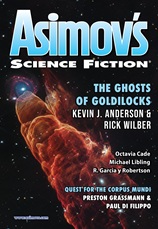
 Asimov’s, March/April 2026
“The Ghosts of Goldilocks” by Kevin J. Anderson & Rick Wilber
“How Else” by David Ebenbach
“How to Live with Polar Bears” by Octavia Cade
“The High Shrines” by Stephen Case
“Satan’s Slave” by R. Garcia y Robertson
“Antarctic Radio” by Gu Shi, translated by Andy Dudak
“A Fierce Need” by James Van Pelt
“The Placemat at Baldy’s Diner” by Michael Libling
“Quest for the Corpus Mundi” by Preston Grassmann & Paul Di Filippo
Reviewed by Mina
In “The Ghosts of Goldilocks” by Kevin J. Anderson & Rick Wilber, the authors revisit a colony trying to survive on the inhospitable planet, Goldilocks. As one character, Just Gando, states: “Generations later, here we are; in spirit and in life, here we are.”
Rick Wilber often introduces characters with Down’s — never romanticised but wonderful all the same. In this story, we have Lonnie (the Old Man of the Hills), whose optimism shines in a harsh world: “Like always, he was one with the world he lived in. Satisfied. Happy. Productive. Curious.” It is Lonnie who finds an abandoned city on Goldilocks, and his discovery leads to the arrival of an alien spaceship.
I thoroughly enjoyed this gentle tale. I cared about the characters: the wandering Lonnie, the struggling farmers Gando and Ella, the weary but tough Mayor Ayekiri and the dying Issa. This chapter in a wider story arc has a satisfying end but leaves many questions open. I can’t wait to read the next chapter.
Shar in “How Else” by David Ebenbach decides to try out VAR (Virtual Alternative Reality): “she embraced the cognitive dissonance.” VAR allows a person to live 10 minutes of an alternative reality occurring if a different decision had been made at a crucial junction in that person’s life. In her 10 minutes, Shar realises that she has always second-guessed her life and never sat still in the moment, as she meets several versions of herself second-guessing every event in her life. The ideas were intriguing but the story was oddly dissatisfying — maybe it was meant to be, reflecting the main character’s inability to be satisfied with her life?
“How to Live with Polar Bears” by Octavia Cade is a novelette where the author plays with polar bears and metaphors. The idea that a fairy tale is a metaphor isn’t original but it is neat. That said, I did not enjoy this never-ending thought experiment (don’t look for a plot or real characterisation). This would have worked better if it had been much shorter — flash-fiction short. It really felt like the author was flogging a dead bear by the end.
“The High Shrines” by Stephen Case is an intriguing short story. It’s set in a world where the “Ais” brought peace and prosperity, and then vanished. We follow an investigator seeking an elusive monk to find out more about why the Ais disappeared. He doesn’t believe the answer he is given. Nor the words the monk quotes: “There are beings — and artefacts — against which we batter our intelligence raw, and in the end make peace with reality only by saying, ‘It was an apparition, a thing of beauty and horror.’” (My research shows it’s a quote from Gene Wolfe.) Did the monk witness a miracle? The tale lets us decide for ourselves.
“Satan’s Slave” by R. Garcia y Robertson transplants a gladiator arena to the Roma colony in Saturn orbit. The story begins with the gladiator Diana praying to the devil with a modified version of the “our father.” The story rapidly becomes multi-layered and complex, as we discover why Diana became a slave and a gladiator, the theft of her father’s invention and a plot to kill her. Diana remains a likeable and honourable character from beginning to end, which I particularly enjoyed.
Woven into the tale are snippets about the American Civil War and an anti-slavery commentary for readers who like complex political and social stories.
“Antarctic Radio” by Gu Shi, translated by Andy Dudak, is a wonderful short story. In just a few pages, we’re drawn into a world after melting ice caps, rising seas and sky-rocketing temperatures. And it’s masterfully reflected in the fate of one family. I always love seeing massive events through the eyes of the little people, the survivors. And the tale ends on a positive note — no mean feat in a world under water. But it’s also a hymn to the power of radio.
“A Fierce Need” by James Van Pelt is a powerful look at the dreams of two friends, Celeste and Theo. Both are driven by their desire to fly into space: Celeste proves to be a brilliant scientist and Theo shows a natural talent at flying. The funniest moment is when Celeste, as a child, blows up her father’s shed with an experiment gone wrong, which she describes as “a rapid, unexpected disassembly.” The most poignant moment is the last time Celeste and Theo hold hands, for only one of them will see space. This tale reminded me of Nevil Shute writing about airplane pilots in World War II — “I rule the wild steel.”
“The Placemat at Baldy’s Diner” by Michael Libling begins with a man, Shore, grieving the loss of his wife and daughter. A placemat leads him to a hotel run by Ava Post with the help of her son and daughter. They have made a living from the purported alien abduction of husband and father, Noah Post. Shore is reluctantly drawn into the alien abduction hysteria. He finds himself caring about the Posts.
The twist at the end is predictable but well done, so the story was a pleasure to read.
“Quest for the Corpus Mundi” by Preston Grassmann & Paul Di Filippo is set in a multiverse, where people can be brought into alternate realities as Revenants. In Spine’s reality, his wife Iris and his friend Lash are dead. His and Iris’ research into free energy for everyone was hi-jacked by the Autarch and the Houses (the “parasites”). But Lash and Iris arrive as Revenants to take him on a quest to save their world. They also call on another Revenant, Berl, to help them. They must find the immortal archmage Augurio to help them halt the disaster that will destroy Spine’s world throughout all realities.
The Corpus is described as a body, the cataclysmic event described as the “incurling of the Hand” or “the closure of the Right Hand.” Our questors (the “symbiotes”) pass through the deserts at Sacrum; they talk about the Lifeline, Wrist, Carotids, Left Axilla, Bloodstream, etc. The tale talks of spinal energies, meridians, chakras and cycles of Awakenings. It’s as if a human biologist took Hindu mysticism and then wrote an SF/F tale. I enjoyed the way adjectives like “diastolic” and “systolic” are thrown about as the questors and their crew fight Chyme cats that remind the reader of white blood cells. Distance is measured in phalanges, centiphalanges and milliphalanges.
Love, pain, loss, hope, redemption and sacrifice lead us to a satisfying end. This adventure to save the world would work very well as a graphic novel (big hint to the authors!). For readers who love complex and imaginative world building.