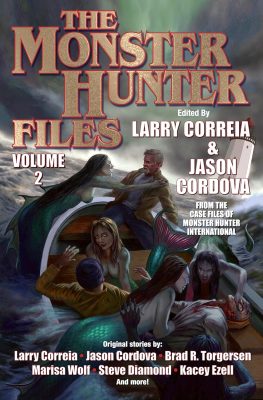
 The Monster Hunter Files, Vol. 2
Edited by
Larry Correia & Jason Cordova
(Baen, March 3, 2026, kindle, hc, 368 pp.)
“Albert Lee and the Scroll of Doom” by Larry Correia
“Eyes Like Mine” by Melissa Olthoff
“Psalm of Vengeance” by Steve Diamond
“Teddy and the She-Beast” by Brad R. Torgersen
“Friday Night Wights” by LawDog
“The Ghost of Bogotá” by Jason Cordova
“Land’s End” by Marisa Wolf
“Inspiration” by Kacey Ezell
“The Hard Earth” by Jack Wylder
“Carnage at the Carnival” by Hinkley Correia
“Legacy” by Robert E. Hampson
“Monsterkommando” by Spearman Burke & Nick Nethery
“Pater Monstrum” by Mike Massa
Reviewed by Jesse James Fain
Larry Correia’s Monster Hunter universe grows even larger in this collection of short stories, expanding the world and giving us points of view from lesser explored factions in the background. The MHI universe is one where all the very real things that go bump in the night are hidden from the general public but combatted by mercenaries and governments all across the world.
Monster Hunter International is the premier private US monster-hunting group. They kill monsters for payouts from the Perpetual Unearthly Forces Fund, a bounty system started by Theodore Roosevelt. Other companies and government agencies exist, such as Grimm Berlin, the German counterpart to MHI, and the Monster Control Bureau, which is the US Government’s team for suppressing monsters, and the knowledge that they exist. It’s often described as a horror movie universe for gun people, as the general fix for cryptids is heavily applied firepower.
The series has eight main novels, two spin offs, and including the currently reviewed work, two short story collections.
We start the anthology off with “Albert Lee and The Scroll of Doom” by Larry Correia, opening the action with poor Albert, our anthology’s narrator, cleaning up in the aftermath of a giant firefight in the middle of his library. Albert and eventually Trip Jones are sifting through the damage, when Albert soon discovers a hidden scroll that functions as a magic chain letter.
“Albert Lee and the Scroll of Doom” is enjoyable, but the flash-forward and dialogue-heavy nature of the story makes it slower and lighter on action than I would expect from Larry and this universe. The concept is hilarious, and Albert’s more nerdy and less cavalier approach to hunting and saving his life has its own charm. I would call it the weakest story in the antho. It’s still a better than average story with cool concepts, but nothing really sparking any deep emotional or “Hell Yeah” moments.
“Eyes Like Mine” by Melissa Olthoff flips the emotional script. We have a back-country brother and sister duo hunting monsters in the sticks. Taylor and Essie come from a Fey-cursed female bloodline that affects Essie’s sight, giving her an inhuman gaze and allowing her to see through veils and illusions, along with ghosts and other hidden entities.
“Eyes like Mine” is full of emotion, action, and tragedy. Essie, Taylor, and Uncle Will are very real feeling characters. As someone who personally lost family in a deep mirror of Essie’s own loss, the stakes hit even harder. This story is a memorable standout.
“Psalm of Vengeance” by Steve Diamond is a sequel to “The Gift” from the first MHI Files anthology. While you can make sense of what has taken place previously, it’s really a good idea to have read “The Gift” first before enjoying this one. We find Fidele, a stunningly powerful servant of the Order of St. Hubert the Protector, sitting in a kitchen as the home is breached and a tactical team pours in.
Psalm of Vengeance is action-filled as a sequel, allowing it to expand the emotional intensity of its predecessor while givimg us an ever-growing Fidele. I love this character arc and very much hope Steve has time for more. This story provides outstanding action but not at the same pace as its predecessor.
“Teddy and the She-Beast” by Brad Torgersen follows my favorite American president and Dippel’s secret creation as they try to establish order after the U.S occupation of Cuba in the Spanish-American War. The woman, who goes by Eva, reappears from “The Bride,” published in Monster Hunter Files Volume One. This is another story where reading its predecessor really helps in getting the most out of this one.
“Teddy and the She-Beast” is somehow both fun and harrowing. I enjoyed the story for its characterization of Eva/The Bride, Teddy, the stalwart men of the Rough Riders and the US cavalry. The story is better than average, but not fully adrenaline fueled. It stands well on principle.
“Friday Night Wights” by LawDog comes next. Told from a dual POV, “Friday Night Wights” opens up with the MHI team Very Large Mammals waiting to pick up two newly graduated Newbies to help out with a vampire hunt. Angela, head of the team, tells part of the tale, while Luis, one of the newbies, carries the rest. “Friday Night Wights” is everything I expected from a classic MHI story. Cleverly destructive, with quick punches of both humor and sorrow. Lawdog understood the formula perfectly and still gave enough originality to avoid being stale. The tale struck several personal chords, and I hope he fully pens Danny and Luis’s tale at some point. That is a near perfect story that absolutely nails the core of this series.
“The Ghost of Bogotá” by Jason Cordova gives us Special Task Force Unicorn going after a drug kingpin in South America, but that’s silly because there’s no such thing as unicorns. Perfection for something that didn’t happen… Hold on, some dude in a black suit is at the door… Bloody MCB.
The story focuses on “Fluffy” who we learn is Chloe Mendoza’s son from MHI Memoirs: Fever. At Stricken’s order, Fluffy and a team of monstrous assassins execute their plot to take out “The Goat” in his mansion, with the suspicion that he might have acquired supernatural aid in his rise to power. The story’s beauty is not in its complications, but in the delivery of the exact kind of creature feature you expect. The story is filled with snark, mayhem, and revelation. Simple is not bad, and for STFU, this is exactly what you expect. It’s a great story with blood pumping action and a fun MC we are guaranteed to see more of.
“Land’s End” by Marisa Wolf introduces Sarah McMurray, a college student who just survived her first monster attack, lost a roommate, and after the classic MCB shakedown, headed back home to her aunt’s bar.
“Land’s End” is a true horror story. Sarah is subjected to constant mental assault on top of her PTSD, and Marisa Wolf walked the fine line of putting the reader in the trauma without losing it all in the confusion. It would have been a perfect MHI story, but nothing exploded.
Next is “Inspiration” by Kacey Ezell. Inspiration puts us with Siena Monroe, a retired MCB agent from the cover-up team, who now does investigations for a high-dollar insurance company in Boston. Siena is looking into a missing painting from the collection of a famous painter who recently committed suicide. If I had a nickel for every story in this anthology that heavily addressed suicide as a supernatural effect, I’d have two nickels. Which isn’t a lot but it’s weird that it happened twice.
“Inspiration” has a unique feel from the rest of the anthology by offering a feeling of mystery and modern noir. Nowhere near enough gunfights and explosions, but I guess we get to have some nuance here. Even though it does not resonate with me personally, the story is much better than average.
“The Hard Earth” by Jack Wylder opens with Jack Wylder and Austin Bowie Gonzalez Houston cutting the head from a letiche in the swamps of Louisiana. Nicknamed Cowboy, as Austin is a Bullman, and Monkeyman, as Jack is human, the two see a lot of trouble coming and decide to skedaddle, resulting in a running gun battle with Cowboy on the minigun. Jack and Austin’s conversation reveals that Earl’s jacket, the skin of Travis, might just trigger a small apocalypse.
“The Hard Earth” is fun, action-filled, and wild in its exploration of Bullman society. Jack’s self insert or naming his MC after himself is a little strange, but it doesn’t harm the story. The story is solid, and the lore established is very cool.
“Carnage at the Carnival” by Hinkley Correia introduces us to Hannah Stone, one of Bubba Shackleford’s own crew when MHI was still Bubba Shackleford’s Professional Monster Killers, and Bubba’s first employed female hunter. The crew is stuck in Loveland, Ohio, killing frog creatures.
“Carnage at the Carnival” is a lot of fun and captures a bizarre episode inside MHI lore proper. Hannah, heavily inspired by Annie Oakley, is a fresh addition to the crew, and Hinkley’s side characters are rowdy, gruff, and relatable. The story is a standout, and I hope we get more works from this time period in MHI history.
“Legacy” by Robert E. Hampson has Dr. Michael Fowler squarely under the glare of Agent Franks. The giant monstrosity turned monster killer and government agent, is letting him know the subject at hand is not for anyone else to hear. Another government liaison named Jason plays the good cop. Jason and Michael discuss the project Michael is about to review. Michael has been asked to review a project that was previously abandoned in the 40s. Parallel to the atom bomb, the US had also performed research into “Neurobiological Demon Bondings.”
“Legacy” is a fine Lovecraftian horror tale set in the MHI universe, and further explores the world of the strange demons that seek to reach Earth, but fight one another as much as humanity. The story is predictable in a lot of ways for fans of the genre, but faithfully follows the admittedly solid formula fans are used to. I give this one higher marks for quality, but chastise it because not a single person or thing got shot.
“Monsterkommando” by Spearman Burke & Nick Nethery gives us a Grimm Berlin team rolling out to an urban hunt, as something is preying on the Ukrainian refugees housed in one of the old American army bases from the Cold War.
“Monsterkommando” nails the MHI feel, action, and emotional content we’ve come to enjoy. My only complaint is the amount of German used in the story will have most single language speakers reaching for a translation, that being most of the US. The story is near MHI perfection and tied for my favorite of the anthology.
“Pater Monstrum” by Mike Massa lets us ride into battle with Sextus Bassus, a legendary Roman hunter whose ghost we saw during Operation Siege. Sextus and his cohort of monster slayers encounter a tribe of Urks assaulting a Roman caravan and intervene to save the lives of a young nobleman and his bodyguard.
“Pater Monstrum” bounces between Roman-era warfare, dramatic political intrigue, and a strong character-driven narrative. Plenty of incendiaries and arrows were flying since this part of history lacks gunpowder. Mike Massa packs a lot into a small tale, and this one is a great ending to a great anthology. This was a terrific story to end on, and my only complaint is that the Roman style of communication is either too well captured or too ingrained in our dramas, leading to some of the dialogue feeling melodramatic.
Overall, Monster Hunter Files Volume Two was well worth my money, and introduced a collection of awesome new additions to the franchise. While some individual stories didn’t tickle my fancy personally, all of them provided a fun read and made me excited to see what the next story had in store. Check it out, if for nothing else than to make the MCB’s life harder.
Jesse James Fain is an author, editor, and lover of all things to do with fighting or fiction. If you enjoy his brand of ranting and reviewing, you can find more at jessejamesfain.substack.com or outlawauthor.com