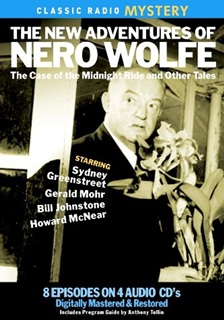
 The New Adventures of Nero Wolfe (1950-51) aired “The Midnight Ride” on March 16, 1951 as the 21st of the 26 episodes of this run. Prior to this radio incarnation there were two earlier series, one in 1943 and another in 1945 (each short-lived), and relatively little is known about them with only two episodes now known to be in circulation. Thus, with these two along with the 26 episodes of the 1950-51 series only 28 survive. This is only the seventh Nero Wolfe episode we have showcased since the first in 2018 and only the third since 2020, the last coming in May of 2025. For newcomers to the series we reprise and slightly update the introductory material provided in that first episode from 2018.
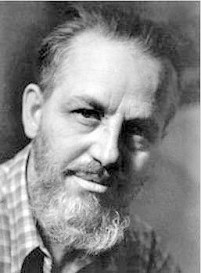
The Nero Wolfe radio programs were of course based on the popular mystery/detective novels of Rex Stout (1886-1975, photo top right). From the first Nero Wolfe novel in 1934 (Fer-de-Lance), Stout would write a total of 33 Wolfe novels and 39 novellas. Wolfe was given to us as a large man, described as being 5’11” and weighing “a seventh of a ton” (which is about 286 lbs.). Wolfe is an eccentric character in several respects. Due to his size he rarely leaves his home, avoids physical contact with both women and men, is fed gourmet meals served by his talented Swiss chef, reads voluminously, does not own a television, spends an inordinate amount of time tending his orchids, and apparently enters some kind of trance state 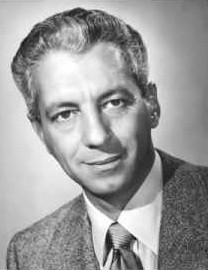 when mentally solving crimes. This last is perhaps a reflection of the method by which Stout wrote the novels, for he has gone on record as saying he wrote them complete in his head before setting them to paper, and never reread them once finished. Rarely venturing outside the confines of his home, Wolfe relies on his able assistant Archie Goodwin to do the legwork–-chasing down leads and clues and interviewing persons of interest. Verbal wordplay between Wolfe and Goodwin shows them at times to be at odds with one another, the amicable jibes springing from their contrasting personalities lending added spice to the stories. Radio and later TV and film actor Harry Bartell (1913-2004, photo at right) played Goodwin in episodes 17-26, episode 26 being the final broadcast on April 27, 1951. Bartell was a ubiquitous character actor on many a radio show, some with regular, recurring appearances (Dragnet, Pete Kelly’s Blues and Yours Truly, Johnny Dollar for but three examples), and episodic appearances on shows such as The Saint, Suspense, and Lux Radio Theater. And if that wasn’t enough, for several years he was the announcer on The New Adventures of Sherlock Holmes as the person kicking off each episode by interviewing Dr. Watson (Nigel Bruce) and asking about his latest adventure with Holmes. No less busy was he in 50s & 60s television, with roles in many classic favorites, a few of note being Gunsmoke, Get Smart, I Love Lucy, The Wild Wild West, The Untouchables, Have Gun Will Travel, The Fugitive, and even science fiction with The Twilight Zone. At 90 years of age, Harry Bartell passed away on February 26, 2004 in Ashland, Oregon.
In 1958 Rex Stout became the MWA’s 14th President, and in 1959 he was honored as the Mystery Writers of America’s third ever Grand Master, its highest award. At Bouchercon XXXI in 2000, the Nero Wolfe novels were nominated as Best Mystery Series of the Century, and Stout was nominated as Best Mystery Writer of the Century.
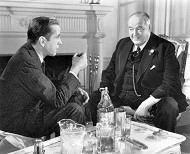
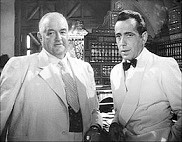 The New Adventures of Nero Wolfe starred the incomparable Sydney Greenstreet (1879-1954, photo top left and elsewhere) as Rex Stout’s iconic detective. Greenstreet is best known and remembered for his film roles, the first of which (at age 62) was as Kasper Gutman (“The Fat Man”) in 1941’s The Maltese Falcon, opposite Humphrey Bogart as detective Sam Spade (photo at left). Actually, Gutman’s first name as spelled in the book was Casper; it was changed in the film to Kasper (or Kaspar). It was Gutman who had spent many years traveling the world with a sizeable fortune in search of the jewel-encrusted bird that was the McGuffin driving the plot in this now classic movie. His fourth film a year later in 1942 saw him in a secondary role in yet another of Hollywood’s classic films, Casablanca (photo at right), as Signor Ferrari, owner of the Blue Parrot, a rival establishment to Bogart’s character Rick Blaine and his Cafe Americain. Once again, Greenstreet was cast as an unsavory character, exemplified by Ferrari’s ironic statement: “As leader of all illegal activities in Casablanca, I am an influential and respected man.” Though beginning his film career at a late age, Sydney Greenstreet would have various roles in 24 films from 1941 through 1949, an average of three films a year. During this time he would share screen time with some of the biggest stars in Hollywood, including Spencer Tracy, James Stewart, Humphrey Bogart, Clark Gable, Ava Gardner, and Joan Crawford. Tennessee Williams wrote his play The Last of My Solid Gold Watches with Greenstreet in mind, dedicating it to him. It was at the end of his brief, eight-year film career in 1949 that Greenstreet took on the role of Nero Wolfe for radio. Stout is reported to have been highly pleased with Greenstreet in the role of his genius detective, and while a popular show it left the airwaves after 26 episodes, the advent of the new medium of television convincing potential sponsors to divert their advertising dollars to tv with its potentially larger national audience reach.
“The Midnight Ride” begins with the usual phone call with someone asking for Nero’s help. Only this one is frantic and from Nero’s longtime dentist of all people. It is soon followed by another frantic call from a young woman named Gloria, who in mid-sentence and after asking for Archie instead of Nero is attacked from behind, being cut off with a hand over her mouth as she mumbled something incomprehensible. Things quickly spiral out of control when the dentist (whom this Gloria has also called) is followed to Archie and Nero’s place by two men, one of whom kidnaps Archie and the dentist at gunpoint and with the aid of the car’s driver takes them to a secluded spot where he is ordered to shoot them. He misses them on purpose (why?), but in a smart move Archie and the elderly dentist have feigned death and do not get up until the car is gone. What in the world is going on here? Why the frantic phone calls to the dentist and Archie from this unknown woman named Gloria; why was the dentist followed to Archie’s, and why were they then ordered to be shot at midnight in the middle of nowhere? Odd pieces of information pile up one after the other, none seemingly connected to anything and doled out slowly to make this mystery even more confusing. Bit by bit, however, a connection is made that pans out and they end up at a large old home where they encounter a butler-type gentleman who proclaims to be Gloria’s uncle (but who is not), they finally meet a young Gloria who is supposedly crazy (but who is not), and a second, older Gloria who is proclaimed dead (but who is not). Curioser and curioser is a fit description for this unseemly and possibly dangerous situation, and only after Nero reveals two clues no one else has spotted is the final answer to what has been happening, and the why of it, made clear. To learn the secret of this odd mystery (let’s throw in a murder for good measure) you must simply listen carefully to this convoluted tale that begins with “The Midnight Ride.”
(The linked CD at top includes this episode and 7 others, all remastered and restored.)
Play Time: 28:48
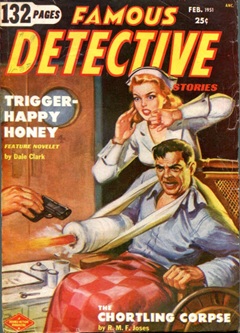
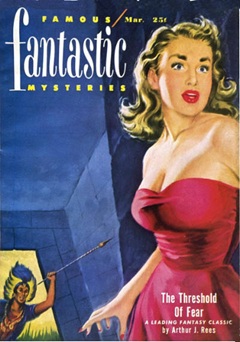
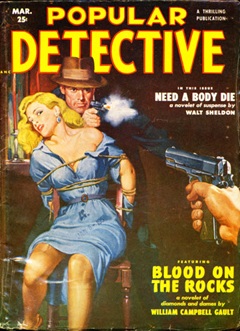
{“The Midnight Ride” aired on a Friday night in the middle of March, 1951. Perfect timing for the neighborhood gang as it meant they could head straight for the nearby newsstand early the next morning. Famous Detective (1938-57) is remembered more for its 8 title changes than anything else. From June of 1950 to October of 1956 it was known as Famous Detective. Its numerous titles no doubt had something to do with its longevity. It was a quarterly in 1951. Famous Fantastic Mysteries (1939-53) answered the need of fans of the fantastic and scientific who had missed out on any number of classic stories from before they were born, when there were not many pure genre magazines. Edited by the astute Mary Gnaedinger, she gave her readership what it wanted in spades. Famous Fantastic Mysteries was a bi-monthly in 1951. Popular Detective (1934-53) was a meat and potatoes detective pulp which ran material from many of the top authors in the field, no doubt accounting for its admirable run of 19 years and 133 issues. It too was a bi-monthly in 1951.}
[Left: Famous Detective Stories, 2/51 – Center: Famous Fantastic Mysteries, 3/51 – Right: Popular Detective, 3/51]
To view the entire list of weekly Old Time Radio episodes at Tangent Online, click here.