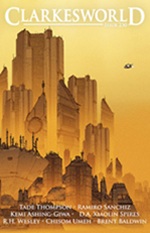
 Clarkesworld #230, November 2025
“The Stone Played at Tengen” by R. H. Wesley
“The Apologists” by Tade Thompson
“Prerequisites for the Creation of a Possible Predicted World” by Chisom Umeh
“The Fire Burns Anyway” by Kemi Ashing-Giwa
“Jade Fighter” by D. A. Xiaolin Spires
“Trees at Night” by Ramiro Sanchiz
“Ratlines” by Brent Baldwin
Reviewed by Victoria Silverwolf
“The Stone Played at Tengen” by R. H. Wesley takes place in Japan during the late nineteenth or early twentieth century. What seem to be stars suddenly appear in the sky in the pattern of the board used in the game Go. With the help of the emperor’s astrologer, a team of Go experts play this celestial version of the game against their mysterious opponents.
The premise is an unusual and striking one. The author clearly knows Go very well and is adept at creating a convincing portrait of the time and place. Although my synopsis may make the story seem melodramatic, in fact it is an intimate one with appealing characters and strong emotional power. Notably, the experience of playing the game is more important than loss or victory.
“The Apologists” by Tade Thompson begins like a gruesome crime story, with the brutal murders of a woman and her young daughter, followed by a police detective investigating the case. The setting seems at first to be a realistic version of modern London, but there are hints that it is something very different. The detective faces many dangers before she discovers the truth about the crime, her world, and herself.
This story is reminiscent both of police procedurals and the works of Philip K. Dick, particularly those dealing with alternate versions of reality. The narrative style is often cold, distant, and cinematic. In some ways, it reminds me of the Italian crime film genre, popular in the 1970s, known as giallo, with the addition of speculative elements. Similarities are graphic violence, a mystery plot with multiple twists, and the involvement of an artist in the case. Not for all tastes, this novella will best appeal to readers of crime fiction and those who enjoy being mystified by events that remain unexplained until the story’s climax.
In “Prerequisites for the Creation of a Possible Predicted World” by Chisom Umeh, artificial intelligence is used to create simulated versions of what historical times thought the future might be like. The setting is a colony world in the far future, where such simulations are used as tourist attractions. During a recreation of the 1962 Seattle World’s Fair version of the future, a crisis occurs.
Much of the story deals with the romance between an employee of the company and his supervisor. This has little to do with the simple plot. The crisis is solved easily, so there is not much suspense.
Narrated in second person present tense, “The Fire Burns Anyway” by Kemi Ashing-Giwa is a character study of a person who creates dreams that can be recorded and shared by others.
This brief tale appears to be an allegory for the conflict between the creative urge and the need to make compromises in order to make a living through one’s art. As such, it is likely to be primarily of interest to writers and other creators.
The narrator of “Jade Fighter” by D. A. Xiaolin Spires participates in virtual reality versions of martial arts training. She encounters a simulated fellow student who is more like a real human being than others of her kind. The two become close friends and benefit from their relationship.
This story makes for pleasant if undramatic reading. The experience of virtual reality is convincingly portrayed, although it strains credibility for the simulated student to be so much more self-aware than others.
“Trees at Night” by Ramiro Sanchiz is translated from Spanish by Sue Burke. It involves the famous Tunguska event, a massive explosion in Siberia caused by the entry of an asteroid into Earth’s atmosphere in 1908. In this alternate version of the twentieth century, the event released strange entities and opened a portal to a distant planet in the far future. Those people who contract a disease from the entities travel to the planet in search of a cure, which turns out to be something very different from what is expected.
The plot deals with a boy suffering from the disease and a librarian on the planet who befriends him. The story is not as straightforward as my synopsis may suggest, with much that remains mysterious. The narrative style reminds me of magic realism, despite the science fiction content. Readers more interested in mood than clarity will best enjoy it.
Slightly over one thousand words long, “Ratlines” by Brent Baldwin is narrated by a rebel whose punishment is to serve as a disembodied brain piloting a starship. During a voyage carrying members of the ruling class fleeing justice, the narrator deals with the passengers in the only way possible in such limited circumstances.
Inevitably expository and telegraphic given its brief length, this story of oppression and retribution has a certain intensity that may appeal to some readers. Others may wish for a more extended version.
Victoria Silverwolf doesn’t know how to play Go.