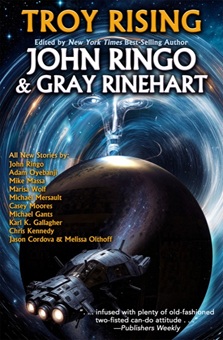
Edited by
John Ringo & Gray Rinehart
(Baen, September 1, 2026, 427pp, Hardcover and Kindle)
“End Run” by Adam Oyebanji
“Candy from a Baby” by Mike Massa
“Hellcat” by Marisa Wolf
“One for the Money” by Michael Mersault
“Syrup Junkie Expat” by Casey Moores
“Shell Game” by Michael Gants
“Seven Traders” by Karl K. Gallagher
“The Holdouts” by Chris Kennedy
“Skeeters” by Jason Cordova & Melissa Olthoff
“The Ringing Deeps” by John Ringo
Reviewed by Rick Cartwright
FAIR WARNING: This anthology is not an entry point into Troy novels Live Free or Die, Citadel, or The Hot Gate. The themes of the stories let them stand on their own, but the reader will get a lot more out of the anthology if they have read the novel series first.
“End Run” by Adam Oyebanji is a peculiar story to start the anthology. It reads more Clancy technothriller than science fiction. The story is well done; it just doesn’t quite fit in the Troy universe.
At core, it’s a story about a mysterious agent trying to persuade a repressive Earth regime to strike at the Terran Alliance.
The real oddity is that it raises the specter of a new, powerful adversary that is not addressed anywhere else in the series or even the other stories in the anthology.
“Candy from a Baby” by Mike Massa. You can’t go wrong reading anything Mike Massa writes. This is a great story about the travails of an individual trying to profit from Earth entering the galactic marketplace. The author skillfully weaves knowledge of the Troy Rising universe into his tale.
The series of spectacular failures, crafted in the way that only Mike can, makes for an enjoyable read. Highly recommended.
Marisa Wolf’s “Hellcat” is another story focusing on the people left behind on Earth. In this case, the youngest sister of brothers all lost to the wars against the aliens. It’s a somewhat dark character study of someone slammed with trauma upon trauma and their reactions.
“One for the Money” by Michael Mercault. This is a story about the inevitable cashing in on the mystique of famous people.
The tale centers on a young man, Zane, who jumps on a limited-time offer to run a tour business in the area Tyler Vernon got his start. He winds up getting more than he bargained for.
One of the enjoyable things about the story, other than you don’t see the ending coming, is that it references a family important to the entire Troy series mentioned in a previous story.
“Syrup Junkie Expat” by Casey Moores. This is a story about veterans. It’s just that the main character is not a human veteran. It tells the tale of a Glatun warrior disillusioned by the indifference of his leaders and the people he swore to protect.
It takes the trope of a veteran who isolates themself in a remote location. Our main character, Harku, starts that way, finding the furthest backwater in the galaxy that he can locate; a little planet called Earth. There, he settles in to watch entertainment, and drink himself to death on maple syrup. If you don’t know what that means, you have stepped into the wrong anthology. The rest of the story is his healing journey, thanks to the humans who have adopted him and refuse to leave him alone.
“Shell Game” by Michael Gants is a funny story that would only generate in the mind of a retired submariner. The premise is fairly simple: farming has suffered from all the attacks that land has absorbed.
Anyone who has worked in remote and confined spaces knows that good food is a major incentive to get through it. What happens when time, distance, and scarcity take away your fresh food and subjects you to the horrors of powdered eggs? You innovate.
This is a fascinating tale of overcoming the real engineering challenges of farming in space. Well worth the read.
Karl K. Gallagher’s “Seven Traders” is one of the best takes on the famous Japanese movie The Seven Samurai I’ve seen in a while.
The author does an excellent job of creating the unlikely pairing of a group of free traders who pattern themselves after the web comic, Trade Hard, referenced in the Troy universe.
All the characters do a lot of growing up when they fight to rescue a Glatun planet from Rangora renegades. Highly recommended.
“The Holdouts” by Chris Kennedy is another Glatun point of view story. This one is different in that the setting is a Glatun system.
The characters face the challenge of evicting the Rangora invaders with no warships of their own. The solution is plausible, and the telling keeps you turning the page till the end. If you liked the underrated The Ministry of Ungentlemanly Warfare, then you will enjoy this one.
Jason Cordova & Melissa Olthoff are both writers who always deliver. When they team up, the result is, as they say, greater than the sum of their parts. “Skeeters” is a story about salvaging the debris of a space battle, a common theme in the novels. The writers do an excellent job of distinguishing their story from the novels and make the reader care about their protagonists the way Ringo makes you care about the Apollo welders and salvagers Butch and BFM in the novels. Except they manage to do it in the constraints of a short story, Highly recommended.
John Ringo is one of my author heroes. Something he said at a panel long ago inspired me to start writing professionally. Which is why this is a difficult review to write.
“The Ringing Deeps” is a novelette sized chunk of the long awaited and still to be written fourth Troy novel. It overlaps slightly with the events of the third Troy novel, The Hot Gate.
The story is vintage Ringo and centers on “Comet” Parker, an engineer turned pilot and her reactions to losing almost all of her found family and the aftermath of a “victory” that looks a lot like a defeat from both sides.
The problem is “The Ringing Deeps” is part of a greater work in progress. There are multiple unresolved plot lines, a character that goes from one scene in the American Midwest to several light years away in the next with no explanation. Perfectly acceptable for a novel that is a fourth to a third done. For an anthology? Not so much.
It makes the anthology feel like padding the word count to justify publishing a work in progress.
To be fair, the author made it clear what he was doing. Call it read at your own risk. There are several wonderful stories in the anthology that deserve a better anchor to the anthology.