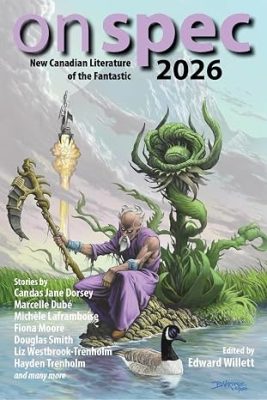
 On Spec 2026:
New Canadian Literature of the Fantastic
Edited by
Edward Willett
(Shadowpaw Press, October 10, 2026, 364pp, Paperback and Kindle)
“The Usual Journey” by Candas Jane Dorsey
“Web We Weave” by Fiona Moore
“Scorch” by Noah Chinn
“The Light Within All Things” by J. Y. Zhang
“George and Ginger Take a Vacation” by Hayden Trenholm
“Cans of Worm” by Michèle Laframboise
“Written in the Bones” by Rebecca Bennett
“Fell Seraph at the Black Cathedral of Trappist-1” by R. H. Wesley
“The Wyvern in the Tower” by Sharon Plumb
“Biggar” by Dave Margoshes
“The Three-Dice Game” by Darry Dinnell
“Ruby in the Barn” by Mark Morton
“The Gloaming” by Marcelle Dubé
“A Natural History of the Victorian Schoolboy” by Sarah Totton
“Door to Door to Door . . .” by Dave Cherniak
“Prodigy” by Douglas Smith
“What Befalls the Beast” by Liz Westbrook-Trenholm
“Ghostlane” by Rhea Rose
“Where Barnacles Whisper” by D. S. Burton
“Growth Medium” by O. L. Drake
“Rubicon” by Catherine MacLeod
“The Buzzing of Flies” by Colleen Anderson
“Catherine’s Wheel” by Mike Rimar
“The Heavy Light of the Drowned” by Peter Darbyshire
“Gloaming Skies” by U. M. Agoawike
“The Necromancer’s Garden” by Claire Scherzinger
“The Absolutely Final Appearance of the Legendary Dead Boys” by Cliff Burns
“Who’s Still Out There?” by Brandon Alexander Rossi
[Editor’s note: Due to the volume of stories in this anthology, reviewing duties have been shared to ensure the review would appear in 2026. Reviews ending with the story by Sarah Totton have been reviewed by Philip Hutson. Reviews beginning with Dave Cherniak’s story have been reviewed by Malory.]
“The Usual Journey” by Candas Jane Dorsey
“Web We Weave” by Fiona Moore
“Scorch” by Noah Chinn
“The Light Within All Things” by J. Y. Zhang
“George and Ginger Take a Vacation” by Hayden Trenholm
“Cans of Worm” by Michèle Laframboise
“Written in the Bones” by Rebecca Bennett
“Fell Seraph at the Black Cathedral of Trappist-1” by R. H. Wesley
“The Wyvern in the Tower” by Sharon Plumb
“Biggar” by Dave Margoshes
“The Three-Dice Game” by Darry Dinnell
“Ruby in the Barn” by Mark Morton
“The Gloaming” by Marcelle Dubé
“A Natural History of the Victorian Schoolboy” by Sarah Totton
Reviewed by Philip Hutson
“The Usual Journey” by Candas Jane Dorsey is told in the second-person; it’s the story of a person unstuck in time, traveling a seldom-traveled road in rural Canada. At points, the protagonist seems to be less unstuck in time and more just lost in their own memories or the memories of a ghost they encounter on their journey.
I did not find the second-person point of view helped to tell the story that already felt a bit disjointed. There were sections where it seemed the author was trying to make a profound point, but being a bit slow, they were lost on me.
“Web We Weave” by Fiona Moore is the story of a young woman, Tia, who has just completed a classics degree. Not wanting to continue in academia, she takes a job as a web developer at one of the small companies in her town. From there, she bounces around other small companies in her area and then finally gets a job at the big company in her city, where the story really gets started.
“Web We Weave” started slow, with lots of build-up developing the character and the environment, but ended with a bang.
“Scorch” by Noah Chinn is set in a near-future dystopia. The protagonist, Alex, a young girl, is autistic and only finds comfort in reading. The story starts with the narrator saying the words in Alex’s story on her tablet were wrong, a character was missing, the dialog was different, and the ending had changed. After Alex has calmed down from a meltdown, she is finally able to verbalize her angst and complains to her father that the words are wrong. He replies that he knows but gives no more details. The story goes on to say that Alex’s father knew the words would change because of his position in the new government.
This was a good, modern interpretation of many themes in Fahrenheit 451. I did enjoy it.
“The Light Within All Things” by J. Y. Zhang is a fantasy story set in an unknown land. The story follows an orphan who is rescued by a traveler. It is told in a collective narrator format. The traveler rescues the orphan, taking them along on their trip to some unknown destination. Throughout the story, the collective narrator is trying to tell the protagonist that the traveler cannot be trusted.
This story would be better if there were more to it. There seemed to be lots of story around the minimal bit of narrative, leaving the reader with questions about what happened and why.
“George and Ginger Take a Vacation” by Hayden Trenholm is a science fiction story set in the far future. The protagonists, George and Ginger, are a field team of two, working for “The Agency,” an intelligence agency for the Empire. The story opens with the duo receiving orders to accompany an ambassador on a mission of peace treaty negotiations. From the assignment brief, they are expecting a cushy assignment of spa days and luxury suites; unfortunately, the mission as written is changed radically, and their luxury vacation becomes a steerage-class trip.
This was a fun and easy adventure harkening back to the SF pulp magazines of yore.
“Cans of Worm” by Michèle Laframboise is a science fiction story set in the far future. The story opens with the protagonist, a teenager, not keeping up with her group of friends as they are headed off to partake in some less-than-appropriate activity. The world of this story is that of a generation ship traveling towards a potential new homeworld. The ship is made up of interconnected, large city-sized cylinders. Passage between the cylinders is possible but restricted to prevent potential contagions, both biological and psychological.
This is a short glimpse of life aboard the ship where some unknown number of generations have come and gone. Unlike many of these stories, the population of the ship has not lost the ability to do all the things that are required to continue in their exploration and eventual settling of a new world.
This was a good, solid science fiction story.
“Written in the Bones” by Rebecca Bennett begins as a fantasy story set in a land where the remnants of a lost age are buried. The story opens with a paleontologist, Anna, trying to retrieve some bones that were stolen from her dig. She confronts a traveling peddler, Mama Pepper, whom she knows stole them. The story continues with the two as they begin traveling and their interpersonal dynamics, with a little magic thrown in.
The story was well written with a well-developed world; its opening promised the reader a fantasy adventure and then turned into a cozy lesbian romance story.
“Fell Seraph at the Black Cathedral of Trappist-1” by R. H. Wesley is a fun SF story set in 2775. The tale follows a heavy metal cover band of three, who make enough from a night’s gig to pay for the beer. The story starts with the trio trying to come up with a way to get passage to a concert in another solar system, with a little world-building and character development along the way. The story really gets started once they secure passage and travel to the concert venue.
This was a fun story of a group of friends getting exactly what they wanted, just not what they expected.
“The Wyvern in the Tower” by Sharon Plumb is the story of a knight-errant off to earn the right to serve a lord. The action begins with our hero, Sir Archibald, trying to get his mount, Blossom, to stop chasing a rabbit like an untrained puppy. From the spot in the woods where he finally gets control of his ill-behaved horse, he spies an old woman struggling to fill buckets at a well. While assisting her, as a good knight is wont to do, he learns that a fair maiden is a captive in a tower not far from the well.
During the narrative, we find that the protagonist was a young man trying to live a life he was ill-equipped for, which added to the story.
This was a unique and fun retelling of the story of Rapunzel with an unusual twist.
“Biggar” by Dave Margoshes is the story of an owner-operator of a small commercial airline in Saskatchewan. The town of Biggar and the area around it are described as a bit magical; the weather, soil, and even the air all have very unique properties. All the uniqueness provides the setting for the event that is the focus of the narrative.
The beginning of the tale offers lots of backstory of the area of the province where the town is located; when we finally get to the action, it’s quite brief and more like a tall tale that would be told at the local bar for drinks, leaving the reader with lots of questions.
“The Three-Dice Game” by Darry Dinnell takes place in St. John’s, Newfoundland and Labrador. The protagonist, Thomas, is a minor league baseball player whose friend and roommate is on the same team. The inciting incident is a game of baseball where the roommate, Vinnie, ignores the signal from the third-base coach to stop as he rounds third base. He is safe with a miraculous error by the catcher. After the game, Vinnie tells Thomas, “I knew I was going to be safe.”
The story lightly touches on the concept that reality is all a simulation, but in this format, a short story, not much can be said about such a big subject.
“Ruby in the Barn” by Mark Morton is a short horror story. The unnamed protagonist has just lost his dog, Ruby. In this world, the dead come back to life unless the body is cremated. The story goes on, talking about the world they live in, where the dead come back not as flesh-eating zombies but more as mindless, soulless robots with a slight penchant to nibble.
“Ruby in the Barn” was an interesting thought experiment that felt more like the notes for a bigger world the author was planning on using.
“The Gloaming” by Marcelle Dubé is a fantasy story set in Wheaton Valley in the Yukon. Lizzie’s husband and dog went missing about a month before the start of the story. Shortly into the narrative, the old man down the road, with bad breath and questionable hygiene, tells her that her husband is not coming back. He continues and says that this happens every twenty years.
This was a fun story that started slow but built to a solid, fun, and exciting ending.
“A Natural History of the Victorian Schoolboy” by Sarah Totton is set in England in a boys’ school. The protagonist, George, finds himself in a difficult situation in which he has lost a bet of some kind, and now owes the bookie, the school tough kid, two pounds (the equivalent of about $500) with no way to pay it. The story follows the efforts of George to acquire the money with the help of his bun-obsessed friend Porty.
This was a different story that seemed more like the opening few pages of a much larger work. It was made up of a few scenes that hinted at many things to come that it never delivered.
The portion of the anthology I reviewed had some very solid stories mixed with a few that I did not find interesting. Overall, this anthology would be worthwhile to acquire.
Philip Hutson’s ramblings and poor attempts at storytelling can be seen at https://tr8t.com
“Door to Door to Door . . .” by Dave Cherniak
“Prodigy” by Douglas Smith
“What Befalls the Beast” by Liz Westbrook-Trenholm
“Ghostlane” by Rhea Rose
“Where Barnacles Whisper” by D. S. Burton
“Growth Medium” by O. L. Drake
“Rubicon” by Catherine MacLeod
“The Buzzing of Flies” by Colleen Anderson
“Catherine’s Wheel” by Mike Rimar
“The Heavy Light of the Drowned” by Peter Darbyshire
“Gloaming Skies” by U. M. Agoawike
“The Necromancer’s Garden” by Claire Scherzinger
“The Absolutely Final Appearance of the Legendary Dead Boys” by Cliff Burns
“Who’s Still Out There?” by Brandon Alexander Rossi
Reviewed by Malory
“Door to Door to Door . . .” by Dave Cherniak is a flash piece told from one side of the doorstep, by a kid selling chocolate bars for his Boy Scout troop. And the boy, Charlie, seems to know rather a lot about each customer… His first visit is to an old lady who grew up in Poland and is married to a man who’s been horrible to her for forty years. Charlie has a special bar for her that’s called a Black Velvet Bar, but “their real name is Lesser of Two Evils Bars.” Every house gets a chocolate bar like this, with the knocks and doorbells speeding up into a sort of montage that’s very well judged. I liked that Charlie stays cheerful while awful things happen, meaning this all comes out darkly funny more than grim. This is a nasty little treat.
“Prodigy” by Douglas Smith is narrated by a ten-year-old telepath sitting on stage at a school recital, scanning the audience for the two strangers pretending to be parents. Our MC notes that children like them get “found, captured, imprisoned, disappeared,” so the plan is to play badly deliberately. I’d usually grumble about there being a music lecture in the middle of a story, but here it’s used as the engine of the suspense and it’s very well done. I did find two ten-year-olds calling each other “my love” and “beloved” a bit odd, but the recital itself is a terrifically well-done set piece.
“What Befalls the Beast” by Liz Westbrook-Trenholm is about a colony whose ancestors came “from the stars.” These people forage by day, hide from the heat in a cellar and sleep up in woven tree bowers through nights that are far longer than their bodies were made for. However, something has started shredding the bowers. And the people in them. Meanwhile Hern the Hunter has been swaggering in with what the colonists call meat worms. The narrator, Mowena, can’t stand Hern, and the night attack on her and her bower is the best-staged scene in the half of the book I’ve reviewed. Saying that, Hern is a little more of a cartoon than he really needs to be, while Mowena spells out what it all means a touch too neatly near the end. Nevertheless, this is a properly good piece of planetary SF.
“Ghostlane” by Rhea Rose takes place in a bowling alley where Hayden Korman comes back to Lane 13 to bowl for someone called Miriam, in a game that’s apparently for rather more than a free hot dog. Shirley, behind the counter, is great fun, and so is the orange neon ball she pushes on him. There’s a bowl-off against Viktor, a stranger in hand-tailored tweed and there’s real tension in a game of ten-pin, which is no small thing to achieve! As a demerit, I wasn’t overly keen on the italic passages at the start and the end, which explain the premise twice. Still, it’s an enjoyable one.
“Where Barnacles Whisper” by D. S. Burton starts out as cyberpunk, with a broke narrator who wants a mod arm. A man with chrome eyes, in a diner, slides him an address on a serviette to a rotting house on an inland sea with a dead floating jetty out back, home to an old woman who calls herself Dr. E and does her work “pro bono.” The trolleys upstairs say MORRISVILLE MORTUARY, which is a fun detail, and from there it goes properly gross in a way horror fans will enjoy. The prose does get itself a touch tangled up at times (“Her gloves were inflated yellow insects, on her arms, extending again, setting them to work.”), and I often lost track of who was where. There’s certainly a very creepy story in here, but it’s more of a messy one than could be hoped.
“Growth Medium” by O. L. Drake is narrated by an untenured, inept and fairly petty professor who is dreading “bring your fancy pet to work” week on campus. Natalie, “the wicked witch of bioengineering,” has brought a labradoodle that barks in Morse, the Dean has a cat with grafted wings and our narrator has a spider from the garage. Every time the Dean asks whether it does anything, the answer is that it . . . respirated. This is all very funny, the escalation is well paced and the narrator is grubby enough to be good company. I had a great time with this.
“Rubicon” by Catherine MacLeod is narrated by Rosalee, who has gone home to the small town of Harrington, where people knock four times, “Because Death knocks three when He’s coming for someone close to you, and it’s best you know who you’re opening the door for.” The night her father Seth dies, she hears three knocks, and the same morning her husband comes skidding into the kitchen to announce that he’s going to Mars. Seth’s death is taken for a suicide, but his arthritis was so bad that he “damned sure couldn’t tie a noose.” What follows is a very satisfying small-town mystery, with Seth’s slightly shady friends and the town’s notables, and the details are excellent throughout. This is one of the best stories in the book.
“The Buzzing of Flies” by Colleen Anderson follows Frank, who has spent three months touring fifteen states to raise money for his foundation and for his daughter Phaedra’s brain surgery. He’s now ended up in an old hotel in the Rockies with a fly problem. The opening is great, and the desk clerk’s nervous “hygiene requirements” (if guests bleed at all, “you must flush any evidence of blood away. Down the toilet.”) are a terrific hook. I was also intrigued by Frank’s wife on the phone suggesting a much less saintly man than the one he thinks he is. The middle, though, with its cycle of waking, swatting and flushing, sags quite a bit. Still, this is competent and creepy enough.
“Catherine’s Wheel” by Mike Rimar is told by the devout niece and housekeeper of an elderly Isaac Newton, who is polishing mirrors for his telescope when he tells her that he may have made it possible “to peer into Heaven itself,” and that he’s already seen a soul through it. That soul belongs to Robert Hooke, of all people. It’s a cracking idea, and the small accident Catherine has while polishing, which she decides not to mention, gives the story a nice bit of guilt to work with. However, a lot of it is debate between science and faith, which does feel like it goes on for a while, and Catherine works out her uncle’s real motive in a long explanatory passage that I’d rather have been left to put together myself. The whole thing is a very clever conceit, but it is a bit talky.
“The Heavy Light of the Drowned” by Peter Darbyshire has Shell driving eight hours from Vancouver back to Deep Reach, a fishing village where lanterns etched with names hang on the dock to call lost people home. The lit one has her name on it. Her mother has walked into the sea, as people in Deep Reach do now, because no one has died since her father pulled the boneglass out of the water years ago. The atmosphere is superb, from the widow Persephone with her barnacle-like growths to the church with a figure made of bones and netting behind the altar. The names are a bit on the nose (Shell, Siren, Persephone and Lir, in a story about the sea) and one confrontation comes out of nowhere, but this is excellent weird fiction, and it’s my pick of the horror in my half.
“Gloaming Skies” by U. M. Agoawike is told in the present tense and follows the Huntress and Alymant, her fifteen-year-old adopted human daughter, whose blood can sometimes turn a vampire back into whatever it was before. They wander a world where the sun has gone and the rain burns, with the Huntress telling Alymant a story about humans, elves and an “apparatus” while lopping off aristocratic heads. The mother-daughter banter is the best of it and there’s real warmth in their relationship. However, the history lesson is so coy about what the apparatus actually was that I found it increasingly hard to care. There are also a few slips out of the present tense which jar and the lore is laid on very thick. Nevertheless, there’s a lot to like in the central pair.
“The Necromancer’s Garden” by Claire Scherzinger is narrated by Michael who is a roboticist with a seminary background who performs funeral rites for retired golems. It’s told in the second person to Sadie, the first grand AI (built by Michael’s mother, Hadley), who wants to die and can’t. It’s a story about depression and assisted death, so it won’t be for everyone, but it’s all handled with real care. Sadie is a brilliant creation, smug and sad in equal measure. Hadley, the mother, is mostly there to say “You owe me,” and the backstory comes in one big flashback which stopped things dead for me for a good while. Even so, this is ambitious, strange and moving, and it’s my favourite story in my half of the book.
“The Absolutely Final Appearance of the Legendary Dead Boys” by Cliff Burns is one long, almost entirely unpunctuated, lower-case rant from a fan who is high on something called “vitamin x” and heading to see the dead boys, a punk band with one single and one aborted gig. The frontman staggers out with a “hellllloooooo cleveland” (they’re nowhere near Cleveland, which fans of the real Dead Boys will enjoy). The narrator’s logic, that “it was so awful and pointless it had to be great,” made me laugh out loud, as did the bassist, “the dude once described as a human asparagus.” There isn’t a lot of story to it, it’s more of a mood really, but I had fun with it all the same.
Finally, “Who’s Still Out There?” by Brandon Alexander Rossi is about Daniel Tellemanch, who lives alone in a cottage below an old monastery, watching a silent city full of people who never go outside. Every so often, one of them is “called on” and walks away and doesn’t come back. The best scene is Tellemanch winding up Cindy on voice chat, telling her pigs fly and then asking what colour they are, which is funny and makes the point lightly. Elsewhere, though, the point is hammered home too much, Tellemanch is quite smug about his books and paintings, and the prose gets overwrought. There’s a decent idea here, but it wasn’t for me.
My half of On Spec 2026 is mostly dark, full of ghosts and drownings and people walking somewhere they really shouldn’t. However, there’s a giant spider and a zombie punk band to lighten the mood, and at its best (Scherzinger, MacLeod, Darbyshire and Westbrook-Trenholm) it’s as good as anything I’ve read in any anthology this year.
It’s great to see On Spec carry on.