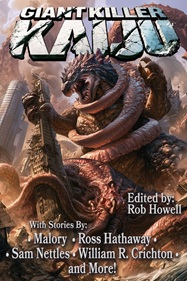
 Giant Killer Kaiju
Edited by
Rob Howell
(Raconteur Press, October 2026. 260pp., pb & kindle)
“Gustave” by Nuin Lochlan
“The Salt Worm” by Paul F. Manger
“Leftovers” by Samuel Nettles
“The Deadly Kaiju Prank – Osoroshi Kaiju No Itazura” by Mark E Moeser
“The Dragon Of The Northern Road” by William R. Crichton
“The Thing At The Tunnel” by S. A. Cook
“Strange Beasts” by Andrew Albritton
“Salvage Rights” by Malory
“Reservoir Reckoning” by Fendy S. Tulodo
“Type Of Waste: Other” by Ross Hathaway
Reviewed by Eric Kimminau
The title for this anthology of 10 stories, “Giant Killer Kaiju” evoked within me exactly what editor Rob Howell discussed in his introduction, “memories of the Godzilla and Mothra movies of the 1950s, something we watched,” for me, Saturday mornings or weekend evenings, igniting my lifelong passion for all things kaiju. I absolutely had to see these stories.
In Nuin Lochlan’s narrative “Gustave,” an itinerant youth named Rick surreptitiously infiltrates a traveling carnival and subsequently secures employment as an assistant to the circus’s animal overseer. Tasked with helping manage a colossal, aging reptile named Gustave alongside its intrepid handler, Margo, the protagonist, navigates the grueling mechanics of carnival. As the tour progresses, the formidable creature exhibits an escalating volatility, heightening tensions between the performers and management. If ever there was a rip snorter to start a Kaiju anthology, this was it. I would pay to see this one on the big screen. The sudden yet foreseen ending and all. The whole mess running off into the sunset. LOVED IT!
In Paul F. Manger‘s short story “The Salt Worm,” a veteran tour guide and his passengers navigate a perilous encounter with a massive subterranean creature in the Salar de Uyuni after a tourist inadvertently removes a specimen from its natural habitat. This is truly a gripping tale and again, I would pay to see the movie if it was half as good as the story. On initial scan, I thought the conversational style was going to be a problem. It wasn’t. It pulled me in and kept me riveted and gave life to Diego, Sofia and Margaret.
“Leftovers” by Samuel Nettles, unfolds on the tropical planet of New Manila. An illicit transaction on the water takes a disastrous turn when a commercial fishing crew encounters a catastrophic marine disturbance. Following this incident, the narrative shifts to local detective Benjamin Bautista and his enigmatic, overly helpful robotic assistant, Mare, who are hired by a gang lieutenant to investigate the mysterious destruction of a smuggling vessel. Bautista quickly deduces that a creature ingested a stolen shipment of contraband and is now hopelessly addicted. What can stop the beast’s destructive rampage? Sam Spade meets Blade Runner meets Monarch Underworld. A fun read. I would embarrassingly love to see Mare onscreen. Yes, I am a fan.
Mark E. Moeser’s “The Deadly Kaiju Prank – Osoroshi Kaiju No Itazura” follows a cast of disparate figures navigating a mysterious amphibious threat off the coast of France. Observer Jean-Michel Charron tracks a young heiress before an aquatic beast attacks the vessel, casting passengers into the ocean. As news reports proliferate regarding widespread coastal devastation, military casualties, and naval engagements, various figures, including a wounded veteran serving as a beach attendant, confront the creature directly, culminating in high-stakes negotiations evaluating both the monster’s destruction and advanced technological defense strategies. While the primary story line carried the day, the sudden introduction and demise of each of the three embedded story lines left gaps and an impression of sloppy inclusion and integration rather than adding substance and background. Not enough explanation or follow up. Just remnants left to hang. I wanted it to be more and appreciate the effort. This could have been a much richer and more robust telling that fell short due to brevity.
In the historically set “The Dragon of the Northern Road” by William R. Crichton, Gavros, an auxiliary Roman officer, investigates a destroyed supply caravan in northern Britain and discovers wreckage devoid of bodies and personal property. Upon arriving at a remote frontier garrison, he encounters mounting casualties and survivor accounts of a massive winged predator attacking the region. A local inhabitant explains that the garrison’s disruption of local fauna has provoked a territorial apex predator. The garrison executes an organized strategy to drive the creature away. Is a Dragon a Kaiju? Something I had never previously considered. Rodan? Possibly. Manda the sea dragon? Certainly. King Ghidorah? Most certainly. I discovered there are many other lesser known dragon kaiju after reading this very well written story. A fantastic dark fiction read mixing the world of Dragons with the Roman war machine in Britain. This would be another wonderful Saturday matinee.
Set within an 1880 Colorado railroad camp, S. A. Cook‘s “The Thing At the Tunnel” chronicles the operational difficulties encountered by a project director during the excavation of a mountain tunnel for the Denver Continental company. Amidst routine construction delays and labor hazards, the workforce is targeted by an aggressive, unidentified animal that damages machinery and causes multiple fatalities. A fantastically told story with everything needed to fill the mind’s eye with the pictures presented. Another homage to the Monarch-esque sudden appearance and disappearance of kaiju. Very well presented!
Andrew Albritton’s “Strange Beasts” chronicles the protracted terrestrial and aquatic conflicts between an awakened reptilian behemoth and a rival tentacled adversary across a radically altered globe inhabited by miniature human civilizations. I have to say that a Kaiju story from the perspective of an intelligent, well-spoken kaiju with an above normal vocabulary is hard to come to grips with. I kept getting flashes of Young Frankenstein after the doctor and the monster had shared intellect through machinery. Nothing of the sort happened in this story but it did keep me engaged through the end.
“Salvage Rights” by Malory details the events surrounding the commercial salvage of a deceased Class Four creature off the coast of Texas, focusing on an independent operator named Del, his crew, and an unexpected live specimen discovered within the carcass. Over the course of the day, corporate interference leads to a dangerous breach, causing the surviving juvenile creature to escape into the industrial refinery zone. Amid escalating chaos, the narrator drags the disoriented animal into the shipping channel rather than allowing military forces to engage it over land. In the aftermath, the narrator faces legal and financial repercussions. This story is very well written. The best of the show so far. Perfectly set stage, amazing color and commentary, grabbed you by the tail and didn’t let go. The editor commented that Malory was an amazing, accomplished writer. This absolutely adds to that assessment.
“Reservoir Reckoning” by Fendy S. Tulodo recounts a tale of Kalina Draganova, a senior engineer at the Thornvale Dam who observes seismic irregularities that contradict automated safety systems and historical data patterns. Following the discovery of an enormous, recurring geological anomaly and a potential structural failure, Kalina and her colleagues coordinate emergency evacuations while confronting difficult crisis-management decisions to prevent a catastrophic regional disaster. Some of the best writing of this entire anthology. It employs the concept that Nothing Is Scarier, using the audience’s imagination to do the heavy lifting while focusing entirely on the characters’ dread to perfection while building the protagonist and driving the reader to get behind her efforts and supporting her decisions. Very well done!
Ross Hathaway’s “Type Of Waste: Other” examines the practical logistical challenges following a catastrophic metropolitan event, centering on Sanitation Director Marta Ruiz as she manages the unprecedented removal of an eighty-thousand-ton deceased kaiju obstructing downtown infrastructure. Rather than focusing on the initial battle, the story details the procedural reality of urban disaster management through a satirical lens, illustrating the complex negotiations required to clear hazardous matter from public thoroughfares. What is “Stationary Kinetic Aftermath? I can speak idiot when necessary.” I can truly say I have never considered “what happens after we kill the kaiju?” In no movie has this ever entered the picture. While I doubt this is going to be the next monster blockbuster, I could image a week-long mini-series trying to depict such an event. This story was AWESOME! Imaginative reality meets cataclysmic destruction “and a cult.” The number of quotes that have permanently entered my vocabulary from this story demand its forthcoming classic status. For example, have you ever considered the smell of a dead kaiju? “It was low tide at Armageddon, yes, but also burnt rubber, old shrimp, wet dog, hot pennies, graveyard mulch, and something sweet enough to be insulting.” Gold! How about politically correct statements? “We understand you’re facing an unprecedented disposition challenge.” Titanium! “Phase Five: burn everything.” Double Platinum!!! Then you read Phase 6! “Ghost smoke.” Actinium-225 estimated at ~$29 billion per gram.
Rob Howell’s anthology Giant Killer Kaiju succeeds as an exceptionally evocative homage to classic creature features, expertly striking a balance between nostalgic Saturday-morning thrills and sophisticated, multi-genre storytelling. While a few contributions succumb to uneven narrative integration or jarring stylistic choices, the collection as a whole flourishes through dynamic execution, ranging from tense Roman-era historical fiction and high-stakes industrial crisis management to a brilliantly satirical exploration of post-disaster urban sanitation. Driven by engaging characterization and immersive atmospheric dread, this compelling ten-story volume offers a refreshingly imaginative celebration of colossal monster lore that will deeply resonate with lifelong fans of the genre.
Eric Kimminau is a BBS geek turned IT professional seeking the next Great Adventure. Let’s Go!