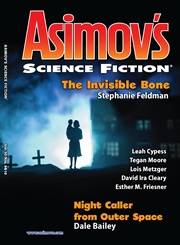
 Asimov’s, September/October 2026
“Visiting Skins” by Christopher Ruz & Rich Larson
“This World Is a World of Dew” by Andrea Kriz
“Night Caller from Outer Space” by Dale Bailey
“The Great Game” by Lois Metzger
“Forever and Again” by Leah Cypess
“The Invisible Bone” by Stephanie Feldman
“The Case of the Lost Busker” by David Ira Cleary
“Embers” by Lawrence C. Connolly
“The Weight of a Heart” by Tegan Moore
“The Wages of Saints” by Eric Del Carlo
“We Shall Be Monsters” by Esther M. Friesner
Reviewed by Malory
There are eleven stories in this issue, seven of them novelettes, and I think it would be fair to say that this is an unusually dark one. There’s quite a lot of horror here, or at least horror wearing science fiction’s coat.
“Visiting Skins” by Christopher Ruz & Rich Larson starts with a group of friends driving out to one of their parents’ house in the woods. It’s a year on from when another member of their group vanished into the trees during an acid trip. Our narrator, Tom, has organised the weekend for therapy-related reasons. He keeps telling us that he’s the calm one and the guy in charge, which is of course a bit of a red flag. There’s a book about a sixteenth-century monk Tom’s sister won’t put down. Oh, and there’s a cave. What I especially enjoyed here was how much the authors plant details that get collected later on. Moths in the sink, a cuckoo nest from their childhood, a dog that comes back from the trees with something in its fur… all of that pays off nicely. Saying that, it’s a pretty long novelette and the swearing is utterly relentless, so it won’t be for everyone. I thought it was excellently nasty, though.
“This World Is a World of Dew” by Andrea Kriz takes us to an Institute a long time after some sort of epic catastrophe. The surviving DNA sequencers have become holy objects and the letters A, C, G and T are pretty much divine. Everything about this feels very authentic and the moment when a new initiate starts sequencing the colonies that survived has a proper intellectual kick to it rather than just being a plot beat. The refrain from the Issa haiku the title comes from is threaded through the whole thing very nicely. I did feel that the big speech was the author putting the argument on the table a bit too unsubtly, but the rest is so well done it’s forgivable. A very good story.
“Night Caller from Outer Space” by Dale Bailey is a title that promises a bad drive-in movie, so what follows is a bit of a surprise. Ezra runs the overnight shift on a country station in southern Iowa, and he’s returned to work a few months after his wife was taken by something that came down out of the sky. Then his request line starts ringing with nothing on it but static and, maybe, his name. All of the radio craft details are gorgeous and the song titles do some super emotional work. And I appreciate that the author is careful never to tell us for certain what happened to Ezra’s wife. As with “Visiting Skins,” this is a long one, and at 14,000 words it’s a bit of a slow burn, but I loved the texture of it.
“The Great Game” by Lois Metzger is the lightest thing in the issue, and after the first three I was rather glad of the change of pace. Cindy, who edits a biodiversity newsletter, is nudged by an entire day of fours (an alarm going off at 8:04, the 4 train, “Forsooth!”) into Board Game Night in Bryant Park. There she finds three glamorous women who need a fourth for Sorry!… and then rather more than that. The four a.m. phone calls are great, with each of these women unloading their problems until Cindy’s wrung out. The Sex and the City business is all fun and the Parker Brothers lore is a nice touch and, although the climax is over and done rather quickly, it all made me smile.
“Forever and Again” by Leah Cypess starts with a man on a subway platform explaining to the narrator that she’s going to be murdered and that he’d like to watch. He’s lived this day two hundred and forty-seven times, he says, and she’s the one who, on previous loops, taught him some important stuff. The narrator’s a quantum-arrays engineer and she believes him at once, which, while a little unbelievable, saves us all a lot of time. Her voice is prickly and funny and her working out what the versions of herself she can’t remember have already decided is well done. The middle section gets a touch mechanical, with a kidnap plot and an explosion that appear to exist mostly to move the cast between rooms. But the last few pages are very smartly done and end things nicely.
“The Invisible Bone” by Stephanie Feldman was, for me, the standout of the shorter pieces. It’s New Year’s Eve and Kee announces that she’ll be taking the Year Walk, which is a Scandinavian ritual of circling the church at midnight to see a vision of the year to come. Pretty much everyone assumes she just wants a glimpse of a husband. What she actually wants is to deal with the thing that’s been hiding in the woods. Feldman writes the whole back story as a run of midnights, one after the other, which is a lovely piece of construction, and the horror is delivered with real conviction. At 4,000 words, this story does more than several of the novelettes manage. A real highpoint.
“The Case of the Lost Busker” by David Ira Cleary is a hardboiled detective story narrated by a cat. As you do. Marius is a private eye in a world where humans belong to their cats rather than the other way around. A calico called Krystal comes to him because her busker’s gone missing. If that sounds like a bit of a slight joke stretched over 8,000 words, then it both is and it isn’t. Cleary commits absolutely to the sensory side of his world and much of the noir patter is properly funny rather than just a pastiche. The villain’s scheme, once we actually get to it, is pretty silly, and the way it’s dealt with is dafter still. To be honest, though, I didn’t mind. This is a story that knows exactly how quirky it is and has a good time anyway. As did I.
“Embers” by Lawrence C. Connolly puts a kid in a vintage Mustang at three in the morning, where he nearly runs down a red-headed woman in a torn gown who’s walked away from a wrecked Cadillac. She wants a lift to where a party’s going on and everyone at it looks a bit like her. Connolly writes with a fun, pulp-paperback rhythm, but I’d guessed what was going on a fair way before our hero does. I’m not sure the rules of the story ever quite come clear, but the atmosphere is well created and the last line lands well.
Then there’s “The Weight of a Heart” by Tegan Moore, which I loved more than anything else here. Our narrator is a teenage girl who’s been left at her grandmother’s house after her parents’ divorce. She’s existing on Ambien and anime fanfiction chat rooms while writing something about a demon that eats the hearts of the unjust. And then, one morning, she hears a sound from her grandfather’s room… I found Moore’s control of her narrator’s voice to be remarkably well done. The girl’s both self-lacerating and self-excusing at the same time, and her wider family unit is delivered beautifully. And the Egyptian material gets more and more solid until the story’s moved somewhere else entirely. It’s my clear recommendation from the issue.
“The Wages of Saints” by Eric Del Carlo has two lupine clerics arriving at the office of Clay Sho, who runs a wormgate, to enquire about a miracle. The author tells the events of the past in present tense and the present in past, which might sound annoyingly gimmicky but actually isn’t at all. The impact of this is that Del Carlo keeps the memories sharp while the office scenes are slightly indistinct. It’s all nicely done, even where it loses me a touch in the figure of Jocasta who leans rather hard on a single insult for a personality. The romance sub-plot feels a little bit of a distraction, especially when what the story’s actually interested in (the gap between what a miracle is and what a church decides one is) is a good question which is well explored.
Finally, we come to “We Shall Be Monsters” by Esther M. Friesner. This is Frankenstein, but told from Elizabeth’s side of things. The creature has come to murder her on her wedding night and she talks to him about what she’s realised from reading Victor’s notebooks. I’d suggest that Friesner has a far bleaker view of the Frankenstein household than I’ve come across before, but the pastiche of the period voice is sustained for nearly 12,000 words without wobbling, which is impressive. I’d imagine that a number of readers are going to find some of the revisionism here to be more than a touch heavy-handed, and there are, annoyingly, places where Elizabeth stops the story to reinforce what women ‘are for in this world.’ For me, this was a bit unnecessary as the reader could’ve been trusted to get there on their own. Nevertheless, as a piece of literary hijacking it’s bold, angry and works pretty well.