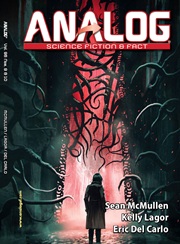
 Analog, September/October 2026
“The Light of Darian” by Sean McMullen
“Beggars Mounted” by Eric Del Carlo
“The User Manual” by Tony Ballantyne
“Septo’s Taj” by R.R. Corvi
“Bella’s Heart” by A.T. Sayre
“Robo Bashers” by Harri Hemlock
“Socrates” by Geoffrey Hart
“Relative Error” by Jay Werkheiser
“Meeting a Mom at the Edge of Space” by Xu Mason
“A Dark or Red Forest” by Jakub Tomczyk
“The Supply-Side Ouroboros” by Noah Lemelson
“Roots Remembrance” by Jennifer S. Hane
“Upcoast” by J.L. Rifkin
“Career Considerations for Starship Burglars” by Hans Ege Wegner
“The Daughter” by Stephen Case
“Wee Man” by David McGillveray
“Bright Points on the Quiet Sun” by Jody Rich
“Preggo Bomb” by J.R. Dewitt
“Neomergence” by Paul E. Franz
“Will Everyone Please Rise?” By Adam-Troy Castro
Reviewed by Philip Hutson
“The Light of Darian” by Sean McMullen is set in a near-future London. The narrative opens with DI (Detective Inspector) Zaral and an intern forensics technician, Reeves, investigating the death of a burglar in a strange house. During their investigation, they find that the owner of the house created a planetary analog of a detected extrasolar planet’s atmosphere. After visiting the house, Reeves has a strange dream and starts to act differently.
There are gaps in the narrative on how some of it could take place, leaving plenty of room for the reader to think about. This was a different take on a first-contact type story, presenting a different method of an advanced civilization making contact.
“Beggars Mounted” by Eric Del Carlo is a science fiction story set in the far future. The story opens with a wrangler selected to help a rich kid wrangle a sentient spaceship, referred to as a beast, to prove his right to be called a man. The ships are extremely valuable and normally under a protective system that is only removed during the spectacle. The wrangler has an ulterior motive: to take a ship from the boy in order to deliver it for a huge payout.
The story starts with so many painterly words that the descriptions are almost lost, but then quickly gets down to telling a good story.
The author did an impressive job and was able to squeeze a huge universe and story into a novelette.
“The User Manual” by Tony Ballantyne is the story of a trio of traders, in the far future, delivering an order of weapons in exchange for a young 11-year-old girl genius. After the weapons are delivered, the traders are tasked with delivering the girl to the Federation of Scientists, where she will be tasked with determining why hyperdrives all around the galaxy are failing. As would be expected in any transaction involving weapons, there are problems from the get-go.
This was a fun and different story with some new ideas on how some of the old standby science fiction technology works, including hyperdrives.
It included an excellent line of dialog from a “Slavemaker”: “Have you thought about passing responsibility for your life to us?”
In “Septo’s Taj” by R. R. Corvi, humans have mastered interstellar travel with the use of cryogenic sleep and a near-light-speed drive. The story takes place when the pilot of a long-term single-person exploration mission is woken from cryo-sleep to investigate a planetary body of interest in a far-off solar system.
In the narrative, humans have only encountered the remnants of one other spacefaring alien species (long extinct) that also never developed a hyper-light-speed drive. The goal of every pilot is to find the extremely valuable artifacts from that long-gone civilization, to allow them to retire in luxury from the proceeds.
I enjoyed the idea of the search for artifacts and maybe some great knowledge from the creatures that were there before. “Septo’s Taj” was a fun, fast read.
“Bella’s Heart” by A.T. Sayre takes place around the asteroid belt. The narrative is split between two time frames; the first is sometime after the initial prospectors have arrived, and the second is much later, when the rough-and-tumble of the prospector’s era has been replaced by a Disneyland version. The protagonist in the earlier time, Bella, is trying to escape an abusive husband with an impromptu escape aboard a skiff that was little more than an engine and cabin. The later time period narrative is split between a couple, Viv and Sal, who are vacationing in a former prospectors’ town on a large asteroid. In the flash-forward, we learn the results of Bella’s escape.
I found the story lacking in any empathetic characters. Trying to divide the narrative among three protagonists in such a short format left me with no connection to any of them.
The tale “Robo Bashers” by Harri Hemlock is a dark science fiction story set in a near-future England. The story opens with a group of boys destroying an android in an empty garage. It continues in this manner, with the boys not having anything to do but to act out the hatred of their fathers toward the growing android population taking away jobs.
This was a decent retelling of an old story of a population fighting against an imported cheap labor force (in this case, androids) taking away their jobs.
While “Robo Bashers” was well written, I found the protagonist and his friends being so violent and hate-filled distasteful.
The short story “Socrates” by Geoffrey Hart is about what happens right after first contact. The story takes place days or weeks after the navy (space navy) has made contact with a new intelligent, space-going species on the species’ home world. A seasoned first contact expert, Chandra, is brought in to try and create a basic commitment to negotiate for collaboration, before the Chinese Bloc is able to come in and take over. The aliens are described as looking like tardigrades, if tardigrades were the size of a large dog.
The story starts strong, providing a lot of detail, but then just ends. It felt like the author started writing a big epic story and then looked at the word count guidelines and wrapped it up as quickly as he could.
“Relative Error” by Jay Werkheiser is an interesting science fiction story exploring the concept of alien science. The protagonist, Willis, is tasked by the military to talk to an alien and find out how a faster-than-light drive works. During the exchange of information, Willis finds out that the aliens’ understanding of the universe is so far removed from humans that he has to start from the basics to try and begin to understand.
The story was interesting and ties in with some theoretical physics that questions our limited three-dimensional view of reality.
“Meeting a Mom at the Edge of Space” by Xu Mason is set in the far future, where the protagonist, Galt, is a mine supervisor for an asteroid mining operation. Galt receives a request for a visit from her female genetic contributor, her mother. In this future world, the process of birthing has been separated from the raising of children to better make use of resources.
The story was a unique look at the continuation of the human race where procreation is done in a sterile process and the effect it has on the offspring.
“A Dark or Red Forest” by Jakub Tomczyk is a first contact story gone wrong. It is set in the far future when interstellar space travel is possible with a combination of cryogenic hibernation and a near-light-speed drive. The story opens from the point of view of the encountered alien.
This was a different take on an alien encounter. I enjoyed the slight cosmic horror angle with an alien that was alien in thought and physiology.
“The Supply-Side Ouroboros” by Noah Lemelson takes place in a not-too-distant future where everything is automated. The story is a protagonist-less, setting-driven dystopian vignette. There are scenes in the narrative where there are humans, but they are all external to the perfect system.
It was an enjoyable bit of a thought experiment about what use humans are in a fully automated world.
“Roots Remembrance” by Jennifer S. Hane is set on an unknown distant planet in some future time. The protagonist, Akash Marana, is experiencing communication from plants via their fruit. The exobiologists who had studied the world and the plant life had already concluded that there was no intelligent life and were not interested in hearing otherwise. Akash has to find a way to convince the ones in charge that he is right.
This was a bit of an alien encounter story and a bit of a detective story. I enjoyed the genre blending.
“Upcoast” by J. L. Rifkin is a snippet of the life of a sentient crab creature. The protagonist, Sea-Thrift, is a very old crab with only the desire to see everything there is to see. The normal life of a crab is to grow, find a mate, and then produce offspring, where the couple becomes food for their progeny.
The author did a good job of telling the aliens’ story, giving the reader just a taste of what life is like for the crabs.
“Career Considerations for Starship Burglars” by Hans Ege Wegner centers around a sentient autonomous weapons robot after the interstellar war it was created for is over. The robot, lacking any other employment option, gets involved with a crew of thieves. The robot, Igor, is having what would be termed in humans a midlife crisis and has to navigate its differing desires for the future.
The unique perspective of an autonomous weapons system was interesting.
“The Daughter” by Stephen Case is set on a planet where colonization had just begun. The protagonist is a scientist liaison sent to help investigate some planetary aberrations.
In between the time the settlers started the journey to the planet and the timeframe of when it is taking place, humans developed faster-than-light travel and communications. That transition of space travel technology offered some interesting scenes.
It was a good tale reminding us that humans are humans; in the words of Buckaroo Bonzai, “No matter where we go, there we are”.
“Wee Man” by David McGillveray is about a set of twins, and the protagonist, a computer genius who suffers from a birth defect that keeps him severely underdeveloped. The team is out at an out-of-the-way asteroid trying to quickly mine it. The asteroid has a large amount of gold and other high-value ores, making it perfect for a fast payday.
The story moves quickly but gives plenty of detail to put the reader in the story and in the protagonist’s head.
The climactic scene was written well, along with the ending.
“Bright Points on the Quiet Sun” by Jody Rich is set in the present day. The protagonist, Naveen, is a research scientist working on the creation of superposition of particles in an accelerator.
When we first encounter Naveen, he is experiencing a vision of a woman who is going to die in the next few days. In the vision, he learns details of the woman’s life, concluding with her death.
Along the way, we find that the unwelcome visions of people were shared by the other scientists who had partaken in the experiment.
I liked the story and especially the ending, leaving the reader to wonder about the final outcome of the protagonist.
“Preggo Bomb” by J. R. Dewitt is set in the far future. The protagonist, Axe X-92, is a sentient mecha with a human pilot to provide a check on the AI. The story opens with the mecha somehow in the middle of a simulation of a pregnant woman in a house about to have guests. The scene unfolds with the mecha trying to understand where this simulation came from. The reader finds out that, a moment before the simulated experience, the mecha took a missile to the chest, leaving the mecha to wonder if the vision was some leftover memory of its female pilot.
This was an interesting take on rebels fighting back and the weapons they use.
“Neomergence” by Paul E. Franz is the end of a story; it takes place during the last few hours of a spacelift to get the last of the humans off a planet. The world that the humans are fleeing is inhabited by a sentient beetle-like creature who is for the most part friendly to the humans.
While the last of the humans are being evacuated, the creatures are surrounding the walls of the compound, trying to be taken off-world to escape the portion of the alien population that will kill them for having been involved with the humans.
It was a good story that had many similarities to the final airlift of the Vietnam War and recent events in Afghanistan.
The descriptions of the horror of the creatures left behind was written very well, making for a very good story.
“Will Everyone Please Rise?” by Adam-Troy Castro is a flash science fiction story with the premise that, to join the interstellar alliance of sentient species, the joining species must have an anthem. The story describes some of the other species’ anthems and then goes into the process that humans undertook to come up with theirs.
What seems like a ridiculous idea for a story had a satisfying ending.
Philip Hutson’s ramblings and poor attempts at storytelling can be seen at https://tr8t.com