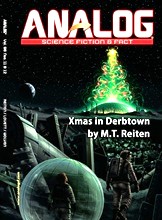
 Analog, November/December 2026
“Xmas in Derbtown” by M.T. Reiten
“Murderer” by Nick Wolven
“Built to Last” by Clancy Weeks
“A Grove of Binding” by Tom R. Pike
“When It Came Time to Disband the Dragon Corps” by Eric Del Carlo
“Orders of Magnitude” by Jerry Oltion
“The Day Before” by Shane Tourtellotte
“Blue Dot and the Unmoving Red Oval” by Jeff Dasteel
“What’s a Douglas Fir?” by James Van Pelt
“A Question of Focus” by Craig Kenworthy
“Do Not Ship” by Ted Kosmatka
“A Eulogy for Pandora” by Don Raymond
“Jumal’s Drift” by Hayden Trenholm
“Father of the Year” by Brandon Keaton
“Derailed” by Hûw Steer
“Hundred-Handed” by John Markley
“Elder” by James Dick
Reviewed by Malory
This is a sizeable double issue with seventeen stories. Four are novelettes, twelve are short stories and there’s also a flash piece included. Between them, there’s Christmas on the Moon, a tipped-over steam train on Mars and… a family of turtles having a barbecue.
So, here we go…
“Xmas in Derbtown” by M.T. Reiten is the cover story which follows Joey. He’s a boy still small enough to get about in a “hamster ball” bubble, in a squatter town dug into lunar lava tubes. On Christmas Eve, Joey’s dad takes him to see the luxury resort next door’s plasma Christmas tree, and then a drone chases them home. The dialogue has a fun bite to it, while Joey’s worrying over his wish list to St. Nick is sweet without ever tipping over to being sickly. On occasion, some of the telling can be a little flat, but this is a warm, clever story that’s a properly good choice for the cover.
With a jarring change of tone, in “Murderer” by Nick Wolven, Anne kills her father, the Colony Controller, at dawn and heads straight out into the jungle of Lachesis and her brother, now in charge, leads the search after her. The first line is a cracker (“They cordoned off Anne’s house at dawn, while her hands were still shaking, still red with blood.”) and the narrative switches smartly between brother and sister.
The planet, though, is the real star of the piece, with its “hypersymbiosis” and creatures like the dying muckbird that seeks out parasites so that it “would die, but it would die in a state of bliss.” There’s a fair bit of lecturing about evolution along the way, and Anne’s reasons for the murder are held back for longer than necessary, but this is still a rich and properly strange tale. I enjoyed it a lot.
“Built to Last” by Clancy Weeks follows Laura Dobbs, an old Martian pioneer flying to Earth, where her old EVA suit is headed for a museum. She spends the journey sniping with her daughter over the comm and drinking scotch with the captain until a meteoroid knocks out attitude control on a liner where nobody but Laura has a suit. The captain gets some good lines (“The only decision I make every day is who to invite to the captain’s table for dinner.”) and so does the old spacer wisdom (“Out here, if you ain’t dead yet, things can always get better.”). The engineering is hands-on and, overall, this is great fun.
“A Grove of Binding” by Tom R. Pike brings us an archaeologist watching the past through a shimmering “Barrier” in a Lapland grove, where, during the last winter of the war, Nazis are working prisoners to death digging into a hill for… reasons. I liked that the viewing of the past is treated like any other lab experiment, with queues and budgets and that the “revival chamber” for questioning the dead comes with proper rules about who can be brought back. The history of the Finnish front takes a while to get through, though, and I did find the back third to be more than a little preachy. Even so, this was an ambitious tale that stayed with me.
“When It Came Time to Disband the Dragon Corps” by Eric Del Carlo is about a Galactic Consortium who bred dragons, and invented a whole Corps of riders to keep its miners busy, realizing that now that the mines are done, the dragons have to go. I loved the satire here, especially the detail that the locals “vied mightily for the privilege of shoveling dragon shit.” The MC’s suspicion that his colleague is testing him does get repeated a lot, though, and there’s a little too much explaining as opposed to drama. Saying that, the dragons are glorious and, considering it’s all very tongue-in-cheek, the whole thing is surprisingly moving.
“Orders of Magnitude” by Jerry Oltion begins with Amy getting a telescope for her sixth birthday and also having a star named after her, which then blows up. Amy, as it turns out, grows up to be an astrophysicist and then a pilot, testing an antigravity drive with some very big launches. It’s a classic Analog idea, worked through properly, and there’s lots of very funny moments. As demerits, the middle section skips through the decades in a hasty summary and nobody but Amy gets much room. Still, it’s a fine, old-fashioned idea story that’s well executed.
“The Day Before” by Shane Tourtellotte has John Case switch off the wallscreen on some momentous news and drive his wife and son over to his grandfather, so they can all have one ordinary day. The grandfather’s dry lines are the highlight, while a neighbour’s visit nearly bursts the ‘no-news’ bubble. The board games go on a bit and, for me, there isn’t as much SF on the page as I’d like, but it’s a warm and humane tale that’s worth your time.
“Blue Dot and the Unmoving Red Oval” by Jeff Dasteel is set entirely among octopus-like creatures living under the ice of an ocean world, where Blue Dot can’t stop exploring upwards. This is a properly alien tale, from the counting in base eight to the breathing packs the MC makes out of intestines and mussel-foot protein. Weird, but inventive!
“What’s a Douglas Fir?” by James Van Pelt is a flash piece about a Christmas-tree farmer with a customer who keeps asking the title question in phrases borrowed from carols. The farmer’s rant about artificial trees runs long for a story that’s only a thousand words, but that doesn’t stop this being a pleasant seasonal treat.
“A Question of Focus” by Craig Kenworthy follows a young math teacher at a billionaire’s academy in Chicago, who’s had a brain procedure that sharpens one area of focus. On the day of a big announcement she finds a note on her door that reads “Don’t remember to . . .” Lots of this story manages to be both funny and sad at the same time and, overall, is a smart bit of satire about billionaire schools.
“Do Not Ship” by Ted Kosmatka is narrated by Stephen, a code-hygiene worker who finds a chunk of old code tagged “Do Not Ship” that has gone out to five million phones anyway. In light of recent, real-world news, I thought this was strangely prescient… The chat-window opening is very funny and his boss’s description of junk DNA (“Extra shit between the shit that actually does the shit.”) might be my favourite line in the whole issue.
“A Eulogy for Pandora” by Don Raymond opens with “Hope’s a fine and brightly feathered thing, and she flutters about the galaxy’s hundred billion worlds, pointing skyward.” Then it drops in on a turtle-like family watching the launch of their nation’s first interplanetary probe at a barbecue. Which is, you know, the first time I’ve ever written that sentence. From there it hops from world to world and is both witty and very cleverly shaped.
“Jumal’s Drift” by Hayden Trenholm has Willie’s business partner missing for weeks. The banter with his ship’s AI, Hope, is great fun (when Hope reports that something is “Not registering as radioactive,” Willie asks, “Just a regular bomb then?”). Compared to many of the other stories here, though, it is quite talky. And an awful lot of it feels like it’s told in summary.
“Father of the Year” by Brandon Keaton is set in a near-future New Zealand where boys are given a contraceptive implant at thirteen and men need a government app’s “Fatherhood Suitability Score” of 0.70 before they can try for a baby. The satire of government apps is very funny and the MC’s voice is very likeable, even if the system is stacked so heavily against him that it’s close to a straw man. This was one of my favourites across the issue.
“Derailed” by Hûw Steer opens with the chief engineer of the Great Martian Railways limping round in a dust storm beside her tipped-over nuclear steam locomotive. She has a broken leg, a leaking boiler and about two days of air, meaning that the rest of the story is a proper engineering survival tale. The MC’s voice is great fun and I loved the little rail-laying drones the crew call “Gromits.” The middle has a lot of cable going back and forth, but it was still an excellent tale.
“Hundred-Handed” by John Markley is told from inside a self-replicating cyberweapon which wakes up aboard a kilometres-long Eurasian warship with a set of instructions that ends “Kill every last human being on the ship.” What follows is evolution on fast-forward, with copies competing and then cooperating, and some lovely deadpan machine logic, with the exchanges with the ship’s own AI at the heart of everything. It’s a very violent piece, but this is a properly impressive bit of hard SF. More of this, please!
Finally, there’s “Elder” by James Dick which is the third of the stories with these characters. Kate Sloan, still grieving her mother, becomes principal investigator on a NASA mission to Europa, where the ice turns landers into statues. It’s full of good moments, from a Japanese lander made of wood to the plan to send “a piece of cookware a billion kilometers across the Solar System.” A lot of the exposition comes out in Q&As with reporters, and I think newcomers to this trilogy will feel the missing weight of the earlier stories. Nevertheless, it’s ambitious and warm, and a big finish to the issue.